
Why AI Director Agents Change Scene Planning
Most people who make AI video start the same way: they type a prompt, watch a clip appear, and then try to stitch the results into something that feels like a film. It rarely works. The clips look good individually and fall apart together, because nobody made the directing decisions in advance. An AI director agent flips that order. Instead of generating first and thinking later, you describe the story, and the agent returns a structured plan: beats, shots, camera language, lighting intent, and a sequence of prompts that share a consistent visual logic.
That shift is small in theory and enormous in practice. Directing is not one skill; it is a stack of decisions about what the audience should notice, when they should notice it, and how the frame should make them feel. A good agentic tool separates that stack into layers you can review and edit. You approve the narrative spine, then the shot list, then the look, then the individual generations. Each layer is cheap to change before pixels exist, and expensive to change after.
This guide is for solo creators, small studios, and marketing teams who want cinematic results without assembling a full crew — but who also do not want the flat, generic feel that comes from prompt-and-pray production. The workflow below treats an AI director agent as a collaborator with a specific job, not as a magic button.
What an AI Director Agent Actually Does
It helps to know what is happening under the hood, because it changes how you write your briefs. Most agent directors do three things: they parse narrative structure, they translate that structure into camera and lighting decisions, and they manage continuity between shots.
Script Parsing and Narrative Structure
The agent reads your script, treatment, or even a paragraph of premise and extracts the load-bearing elements: who wants what, what blocks them, where the emotional turns happen, and which beats are setup versus payoff. It then marks scene boundaries and estimates pacing — how long each beat should breathe.
Practically, this means you get a beat sheet back within seconds. That beat sheet is your first real decision point. If the agent identifies your midpoint as the confrontation but you intended it as the reconciliation, you fix it there, in text, before a single frame is generated. Creators who skip this step end up paying for it later with dozens of unusable clips.
Shot Planning and Virtual Cinematography
Once the beats are locked, the agent proposes coverage. A two-person argument might become: wide establishing shot, over-the-shoulder on the challenger, close-up on the listener's hands, then a slow push on the face as the decision lands. Each of those is a prompt with camera, lens, movement, and lighting parameters attached.
This is where an agent earns its keep. Human shot lists take hours and require experience to get right. An agent can produce three alternative coverage plans in the time it takes you to open a notes app, and you can mix and match: take the pacing from plan A, the intimacy from plan B, and the ending push from plan C.
Continuity Across Generated Frames
Continuity is the hardest problem in AI filmmaking. Characters drift, wardrobes change, lighting flips between shots, and a room that had one window suddenly has three. Agents address this by carrying a persistent description of each element — character reference, wardrobe, location bible, color palette — into every prompt in the sequence.
The result is not perfect, but it is dramatically better than prompting each shot in isolation. Treat the agent's continuity notes as a checklist you verify after generation, not as a guarantee.
A Practical End-to-End Directing Workflow
Here is a workflow you can run today with any capable agent director plus a generative video model.
Step 1 — Lock the Spine of the Story
Write a one-paragraph premise and a list of five to seven beats. Do not write dialogue yet. Feed this to the agent and ask for a beat sheet with emotional turns marked. Edit until the turns land where you want them. Budget: twenty minutes. This is the highest-leverage twenty minutes in the entire project.
Step 2 — Convert Beats Into a Shot List
Ask for coverage per beat, with a stated intention for each shot — what the audience should feel or learn. Reject any shot whose intention you cannot articulate. A shot list of eighteen to twenty-five shots is a comfortable range for a two-to-three-minute piece.
Step 3 — Generate in Small Batches
Never generate the whole film at once. Generate one scene, watch it end to end, note what breaks, then fix the reference descriptions before moving on. Batches of three to five shots work well because they are long enough to reveal continuity drift and short enough to discard without regret.
Step 4 — Assemble, Trim, and Score
Cut on motion, not on the beat grid. AI clips often have a usable middle and weak edges, so trim aggressively. Add sound design before music; footsteps, cloth, and room tone do more for realism than a sweeping score does. Music hides problems, sound design exposes and fixes them.
Choosing the Right Model for Each Shot
Not every shot deserves the same engine. Different models have different strengths, and matching shot type to model is one of the fastest quality wins available.
- Establishing and landscape shots: favor models with strong environmental coherence and wide-depth handling. These are forgiving because there are no faces to drift.
- Character close-ups: favor models with strong facial consistency and controllable identity references. Expect to regenerate more here.
- Action and motion: favor models with stable temporal coherence. Fast movement exposes warping, so test with a short clip before committing.
- Stylized or graphic sequences: favor models with strong style transfer, since you want the look to dominate over photoreal detail.
Build a small decision table for your own project: shot type, chosen model, reference assets, and fallback model. When a generation fails, you regenerate with the fallback instead of rethinking the whole approach.
Also consider cost per second of usable output rather than cost per generation. A cheap model that needs nine attempts to produce one usable clip is more expensive than a premium one that nails it in two.
Prompting Like a Director, Not a Search Engine
Keyword soup produces generic images. Director-style prompts produce shots. The difference is specificity in five areas: subject, action, camera, light, and mood.
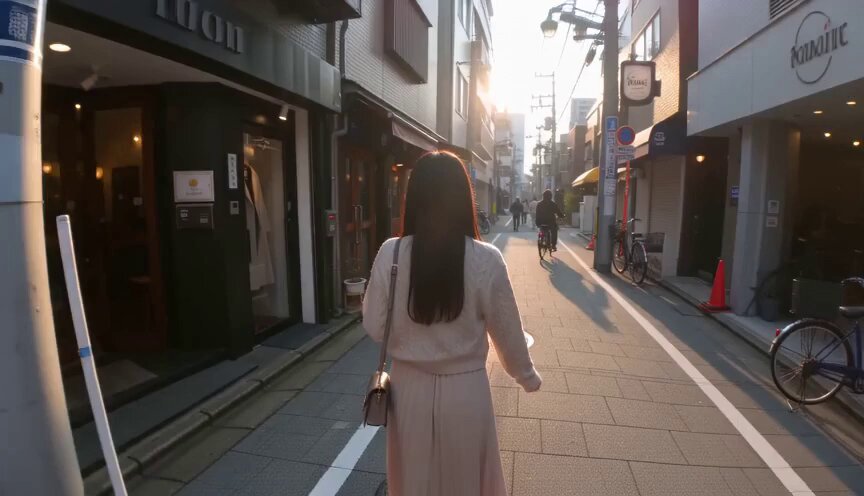
A weak prompt says "a woman walking in a rainy city, cinematic." A director's prompt says "medium tracking shot, 40mm, following a woman in a soaked wool coat from behind as she crosses a neon-lit street, rain backlit by shop signs, shallow depth of field, cool cyan highlights against warm sodium spill, melancholic and unhurried."
The second version gives the model decisions to make rather than room to improvise. It also gives you a vocabulary to adjust later: if the shot feels cold, you change the light; if it feels distant, you change the lens and distance; if it feels static, you change the movement.
Three habits make prompts more reliable. First, keep camera language at the front so it is not diluted by later tokens. Second, keep a consistent phrase for each recurring character and paste it verbatim every time. Third, avoid stacking contradictory instructions — "handheld and locked-off" gives you neither.
Maintaining Visual Continuity Across Many Shots
Continuity is a system, not a hope. Build a small bible before you generate anything, and keep it open while you work.
Character sheet. For each character: age range, build, hair, distinguishing features, wardrobe, and a canonical reference image. Copy the same description into every prompt that includes them.
Location bible. For each location: architecture, time of day, light sources, dominant colors, and which direction the windows face. If a scene has a window on the left in shot one, it stays left in shot nine.
Palette lock. Pick three colors and one accent. Mention the palette in every prompt. This single habit does more for perceived production value than any model upgrade.
Lens discipline. Choose two or three focal lengths for the whole piece and reuse them. Audiences read lens changes as meaning. Random lens variety reads as noise.
After each batch, run a continuity check: watch the shots in sequence with the sound off. Drift is easier to see when you are not distracted by audio.
Common Mistakes in AI-Assisted Filmmaking
Generating before planning. The most expensive mistake. Every minute spent on the beat sheet saves several generations later.
Treating the first output as final. Agents propose; directors decide. The first shot list is a draft, not a specification.
Ignoring motion continuity. Two shots can match perfectly in style and still cut badly because the subject exits frame left in one and enters frame right in the next.
Overloading a single shot. A shot that tries to show a location, a character, an action, and a mood usually delivers none of them clearly. Split it into two.
Letting the model choose the ending. Generated clips often drift toward generic resolution. Decide the final image yourself and prompt toward it.
Skipping sound. Silent assembly hides rhythm problems that become obvious once sound is added — usually at the worst possible time.
Time, Compute, and Iteration Discipline
Set a regeneration budget per shot before you start: five attempts for hero shots, two for connective shots. When you hit the limit, change an input rather than rolling again. Change the lens, the time of day, the framing, or the model.
Track two numbers: usable seconds per hour of work, and regenerations per usable shot. If the second number climbs while the first falls, your prompts are too vague or your continuity notes have drifted. Stop and fix the notes.
Batch similar work. Generate all the wide shots together, then all the close-ups. Switching shot types constantly forces your reference material to reload mentally and produces inconsistency.
Finally, schedule a hard review point at roughly seventy percent completion. Watch the whole piece with fresh eyes and cut anything that does not serve the spine you locked in step one. Deletion is the cheapest quality improvement available.
Frequently Asked Questions
Do I still need to write a script if an agent can structure the story?
Yes, but shorter. A one-page premise with clear beats gives the agent something to respect. Without it, the agent invents a structure, and you spend the rest of the project fighting decisions you never made.
How many shots should a short AI film have?
For two to three minutes, eighteen to twenty-five shots is a healthy range. Fewer feels static; more becomes a montage that never lets a moment land.
Why do my characters change between shots?
Almost always because the character description was rewritten or abbreviated in later prompts. Paste the canonical description verbatim, attach a reference image where supported, and regenerate only the drifting shots.
Is an agent director useful for commercial work?
Yes, especially for storyboards, pitch videos, and concept reels. It compresses the distance between an idea and something a client can watch, which is usually the hardest part of approval.
What should I do when a shot refuses to work after several attempts?
Change the shot, not the prompt. Rewrite it as two simpler shots, shift the framing, or move the action to a different time of day. Persistent failure usually means the shot is overloaded.
Where Human Direction Still Wins
An agent can plan coverage, maintain continuity, and generate faster than any individual. What it cannot do is decide what the film is about. Taste, restraint, and the willingness to cut a beautiful shot that does not serve the story remain human work.
The most effective creators using these tools treat them as a first assistant director: someone who organizes, proposes, and keeps the production moving, while the final call stays with the person who knows why the story matters. Build the workflow, protect the spine, and let the agent handle the logistics. That combination produces work that looks intentional — which is the only real difference between a collection of clips and a film.
