
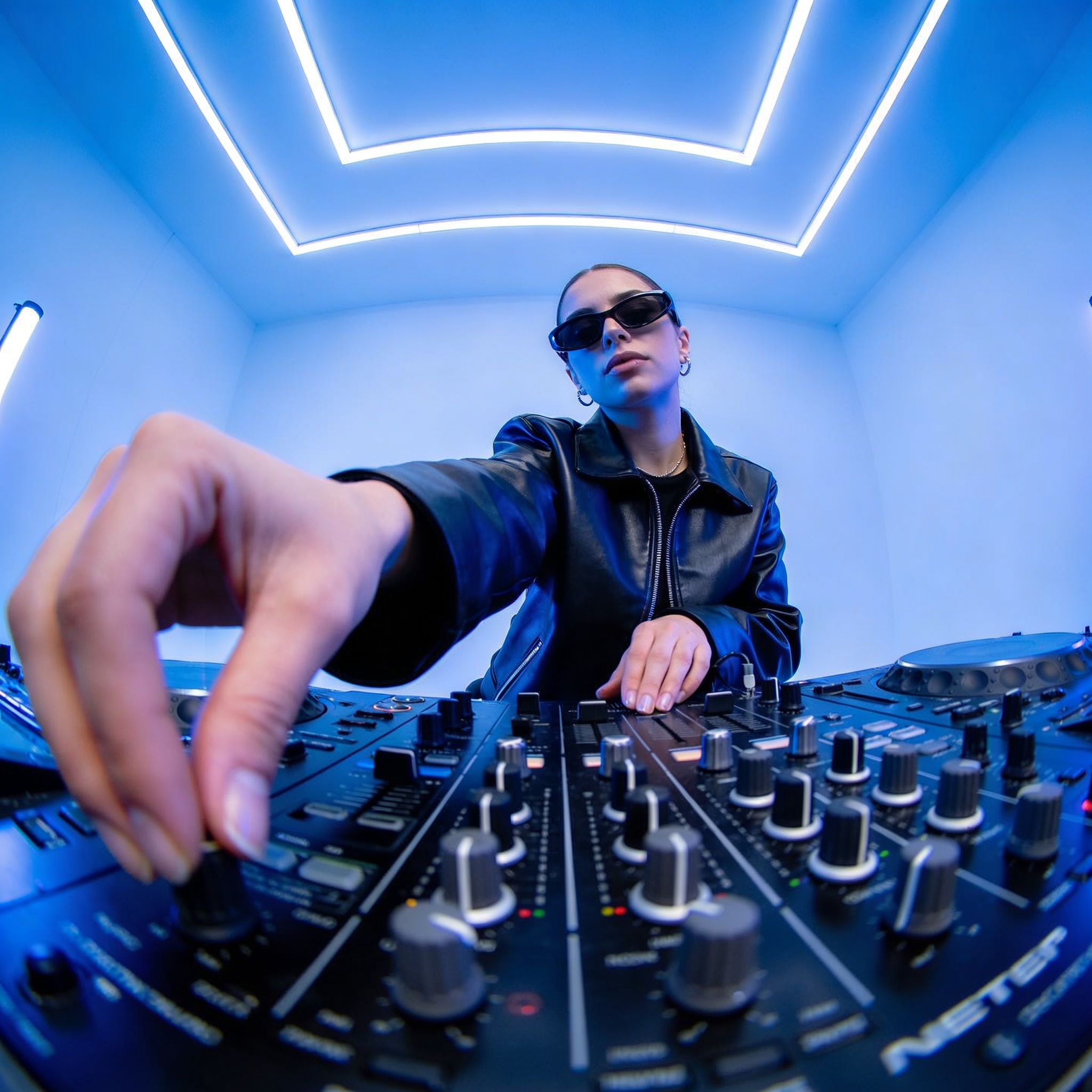

Why sound decides whether an AI video feels real
Modern text-to-video models can produce a convincing eight-second shot of a rain-soaked street market, a wind-scoured plateau, or a neon-lit night drive. What they cannot do is tell you what any of those places actually sounds like. Human ears are forensic. A mismatched ambience layer, a stale music bed, or a ducking curve that snaps in and out will break the illusion faster than a slightly warped hand or a face that shifts between frames.
That is why audio has become the real differentiator in AI-assisted production. Visuals are increasingly commoditized: the same handful of generation engines, the same prompt libraries, the same upscalers. Sound is where craft still shows, because sound is where intent is still required. A model can generate a thousand loops in a minute. Only you can decide which one belongs under this scene, at this emotional beat, at this exact moment.
The bottleneck has also moved. A few years ago the hard part was finding a legally safe track and cutting it to length. Today the hard part is semantic fit: does this music actually belong to this culture, this landscape, this character? Keyword search is no longer the constraint, and neither is generation cost. Judgment is the scarce resource.
This guide lays out a neutral, tool-agnostic workflow for building soundtracks for video with AI assistance. It focuses on the hardest case: "exotic" or geographically specific soundscapes, where a generic world-music loop reads as fake and a careless choice can read as disrespectful.
The three layers of a video soundtrack
Before touching any generator, separate the problem into layers. Most amateur AI videos fail because all three layers are collapsed into one track of background music.
Layer 1: Voice and dialogue
Narration, dialogue, and voice-over carry meaning. They must win every frequency fight they enter. If your video has a presenter, the voice is the spine of the mix and everything else is decoration. Even for AI-generated voice, treat the vocal as the anchor: it defines how loud everything else can be, and it defines the emotional register the music must support rather than compete with.
Layer 2: Music
Music sets emotion, pace, and genre expectation. In AI-assisted production, music is usually generated from a text prompt or assembled from a licensed library. The trap here is scale: a track that sounds impressive in isolation often flattens a scene because it is doing too much. Good scoring for short-form video is often boring on its own — a pulse, a pad, a small motif — precisely because its job is to leave room.
Layer 3: Ambience and foley
This is the layer that sells realism and the layer most creators skip. Ambience is the continuous bed: room tone, wind, distant traffic, insects, rain, the hum of an engine. Foley is the specific, sync-locked detail: footsteps, cloth movement, a cup being set down, a door latch, a match striking.
When you generate ambience for a location, you are effectively answering the question "what does being here feel like?" That answer is rarely a melody. It is texture, distance, and density.
A practical rule: build from the inside out. Voice first. Then ambience, because it establishes the acoustic space the voice lives in. Then foley for accents. Then music, which should be the last element added and the first element to be reduced when the mix gets crowded.
Decoding a place into sound: geography, culture, emotion
The hardest brief in sound design is also the most common one: "make it sound like somewhere else." Exotic is not a genre. It is a bundle of geography, culture, climate, and emotion, and each of those pieces translates into different audio decisions.
From location to a sonic inventory
Start by writing down what is physically present in the scene. Not adjectives — objects and events. A fishing village at dawn might produce: water lapping at a hull, rope creaking under tension, a small outboard motor two hundred meters away, gulls, a low diesel generator, one voice calling across the water. That list is your ambience and foley plan.
Then note the acoustic environment. Is the scene indoors or outdoors? Narrow alley or open plain? A stone courtyard has a short, bright reverb; a snowfield has almost none. Reverb and delay tell the listener what the space is made of, and they are far more convincing than any instrument choice.
Finally, note what should not be there. Absence is a design tool. A desert scene with no insects and no distant traffic feels different from a jungle scene with constant biological noise. Silence, or near-silence, is often the most exotic texture available.
Emotion first, instrumentation second
Once the inventory exists, decide the emotional register: awe, unease, nostalgia, momentum, melancholy, celebration. Only after that should you reach for instruments and scales.
This ordering matters because it prevents the most common failure mode in AI music generation: prompting for a style label ("tribal drums," "oriental strings," "ethnic flute") and getting a pastiche that fights the scene. A slow, sparse drone with a single breathy woodwind can express awe over a mountain range far better than a busy percussion loop — even if the percussion loop is technically "more regional."
Avoiding cliché and appropriation traps
Three practical safeguards:
- Separate texture from tradition. Field recordings, natural resonance, and environmental tone carry place without claiming cultural ownership. They are usually the safest and most effective choices.
- Avoid sacred and ceremonial markers. Specific ritual instruments, chants, and prayer calls have meaning that a background music bed cannot honor. Do not use them as decoration.
- Interrogate the cliché. If the sound you chose is the first thing that comes up when someone types the country name into a search box, it is probably a stereotype, not a portrait.
The best regional sound design is usually specific, restrained, and slightly unexpected. Specificity reads as research; spectacle reads as tourism.
A practical workflow from brief to final mix
Here is a repeatable five-step process that scales from a fifteen-second social clip to a ten-minute documentary segment.
Step 1: Write the audio brief before generating anything
A one-page brief prevents hours of rework. Include:
- Format, duration, and aspect/delivery target
- Whether there is voice, and whether it is spoken, generated, or absent
- The emotional arc, beat by beat (for example: calm introduction, rising tension, release, quiet button)
- Three reference tracks or scenes, with a note about what specifically you are borrowing (pace? texture? low-end weight?)
- Two hard constraints, such as "no drums" or "nothing above 8 kHz except foley"
Constraints are the most useful part of the brief. Generators produce mediocre results when asked for "epic cinematic music," and surprisingly good results when asked for "sparse low strings, no percussion, slow evolution, room for narration in the 1–4 kHz range."
Step 2: Generate or select the music bed
Decide between generation and library selection based on three criteria: uniqueness, deadline, and risk tolerance.
- Generate when you need something that fits an unusual brief, when you need a specific duration with a specific arc, or when you want a distinctive identity for a series.
- Select from a library when you need predictable quality, a clean license trail, and a version with stems and alternate edits.
Whichever route you take, request or look for stems. Having music split into drums, bass, harmony, and melody changes how much control you have in the mix. With stems you can remove the percussion during dialogue, or thin the arrangement in the final third so the ending lands quiet.
When generating, produce at least six variations of the same brief rather than one, and listen to them at low volume under a rough cut. Tracks that impress on their own frequently fail under picture, and tracks that seem dull in isolation often work perfectly in context.
Step 3: Build ambience and foley
Layer ambience in two or three passes rather than one.
- Base bed. A continuous, loopable texture. Keep it low and wide, usually high-passed around 80–120 Hz so it does not fight the music's low end.
- Mid-ground detail. Occasional events: a distant vehicle, a bird, a passing conversation mixed very low. These give the bed a sense of time passing.
- Foreground foley. Sync-locked accents tied to visible action. These need frame accuracy, not volume.
For AI-generated ambience, generate longer than you need — sixty to ninety seconds — then cut and crossfade to avoid obvious loops. Slight pitch variation between repetitions of a bird call will do more for realism than any amount of EQ.
Step 4: Mix, duck, and glue
Mix order: voice, then ambience, then foley, then music. Set dialogue peaks first and mix everything else relative to that.
Ducking — lowering music when voice is present — should be gentle and slow. A 2–4 dB reduction with 150–300 ms attack and 400–800 ms release is usually invisible. Aggressive ducking that pumps in and out on every syllable is one of the clearest amateur tells in AI-assisted video.
A little shared processing glues layers together. A subtle bus compressor over ambience, foley, and music (but not voice) helps elements feel like they occupy one space. Reverb should mostly be applied per layer with a shared room character, not dumped on the master.
Step 5: Quality control and delivery
Check the mix in four places: studio headphones, a phone speaker, a laptop speaker, and a car or small Bluetooth speaker. The phone check reveals whether dialogue survives when the low end disappears. The car check reveals low-frequency buildup that headphones hide.
Also run a mono check. Vertical social video is often watched on a single phone speaker, and stereo information can vanish entirely. If a critical sound effect only exists in the left channel, half your audience will never hear it.
Prompt patterns that produce usable music
The difference between a useful generated track and an unusable one is usually specificity plus restraint. Templates that work well:
- Instrumentation + role + restriction: "Solo frame drum and low drone, no melody, sparse, slow, designed to sit under narration without masking speech frequencies."
- Emotional arc + duration: "Starts quiet and unresolved, adds a single low string swell at roughly 40 seconds, resolves softly in the final 15 seconds, no percussion."
- Texture + space: "Recorded-sounding, distant, slightly roomy, as if heard from across a courtyard, minimal high frequencies."
Patterns that reliably fail: naming a genre plus a region ("Bollywood meets Nordic folk"), stacking more than four instruments, asking for a strong melody when the track will sit under voice, and requesting "epic" anything without a tempo reference.
Keep a prompt log. When a variation works, you want to know exactly which words produced it — not just what it sounded like.
Loudness, sync, and technical standards
Loudness normalization across platforms has made over-compression pointless and damaging. Mix to the target of your primary destination rather than mastering as loud as possible.
| Deliverable | Integrated loudness | True peak ceiling |
|---|---|---|
| Web and social video | -14 LUFS | -1 dBTP |
| Broadcast (EBU R128) | -23 LUFS | -1 dBTP |
| Voice-forward explainer | -16 LUFS | -1 dBTP |
| Vertical short-form | -14 to -12 LUFS | -1 dBTP |
Beyond loudness, three sync details matter in AI-assisted workflows. First, when video is generated at a slightly variable frame rate, conversions can drift audio by a frame or two over a long clip — verify sync at the head and tail, not only the middle. Second, action-to-sound alignment in generated footage is rarely perfect, so choose foley that reads clearly rather than foley that claims precision. Third, leave a two-frame handle on every foley hit so you can nudge without creating gaps.
Licensing, provenance, and disclosure
Two questions decide most legal risk: where did this audio come from, and what rights do I actually hold?
For generated music, read the terms that apply to your account tier and confirm whether commercial use is permitted, whether attribution is required, and whether the output can be registered as part of a larger work. Keep a record of the prompt, the generation date, the tool and version, and the account used. That log is your provenance trail if a platform ever asks.
For library music, save the license certificate and the track ID with the project files, and check whether the license covers the intended distribution (some cover online video but not paid advertising or broadcast).
For voice, confirm consent if you are cloning or synthesizing a real person's voice. Synthetic voice is now widely accepted in some contexts and heavily penalized in others, and platform disclosure rules continue to tighten.
Finally, be careful with AI-generated ambience that imitates identifiable recordings. If a generated texture is clearly modeled on a famous field recording or a recognizable melody, treat it as a derivative work rather than original material.
Common mistakes and how to fix them
Music too loud and too busy. The single most frequent problem. Reduce music by 3–6 dB, or cut it entirely for the first five seconds and let ambience carry the opening.
No ambience layer at all. The scene feels like it happens in a vacuum. Add a base bed at -30 to -24 dB and hear the image suddenly acquire depth.
Identical reverb on everything. Voice, foley, and music all sound like they are in the same box, which flattens the space. Give each layer its own depth and use a shared room only as glue.
Loop fatigue. The same four-second ambience repeats for two minutes. Vary it every eight to twelve seconds, even subtly.
Generic exoticism. Sitar over a scene in a region where the sitar is not part of the local tradition. Swap style labels for textures and instruments that are plausibly present.
No mono check. Details disappear on phone speakers. Fold to mono and verify that nothing critical vanishes.
Ignoring the ending. The final three seconds determine how the video feels when it stops. Plan a deliberate ending — a fade, a single foley hit, or an abrupt cut to near-silence — rather than letting the music simply run out.
FAQ
Can AI generate a full soundtrack for a short video?
Yes, for music and ambience. Voice and precise foley usually still need manual assembly, and the mix almost always needs human decisions about levels and ducking. Treat generation as a source of raw material, not a finished soundtrack.
How long should each ambient bed be?
Generate or record sixty to ninety seconds even for a fifteen-second clip. Longer source material lets you avoid obvious loops and gives you room to find the best eight seconds.
Should I use one music track or several?
For clips under a minute, one track with internal dynamics is usually stronger. For anything longer, two or three cues give you emotional contrast, provided they share a tonal center or instrumentation family.
How loud should music sit under narration?
Start around -22 to -18 dB relative to dialogue peaks, then adjust by ear. If you can follow the words without effort on a phone speaker, the balance is close.
Is generated music safe to monetize?
It depends on the terms of the specific tool and tier you used. Check the commercial-use clause, keep a provenance log, and prefer tools that state clearly that you own or may use the output commercially.
What is the fastest way to improve an AI video's audio?
Add an ambience layer and lower the music. Those two changes alone fix the majority of flat-sounding AI videos, and they take minutes rather than hours.
Do I need to disclose AI-generated audio?
Rules vary by platform and jurisdiction, and they are tightening around synthetic voices in particular. When in doubt, disclose in the description. It rarely hurts, and failing to disclose can.
The through-line is simple: generation solves availability, not taste. The creators whose AI videos feel genuine are not using better models — they are making better decisions about what a scene should sound like, and then mixing those decisions with restraint.
