
Most creators do not have an AI video problem. They have a repeatability problem. Producing one striking generated clip is easier than it has ever been, and the tooling around text-to-video, image-to-video, and audio synthesis keeps improving month over month. What separates a channel that grows from a folder full of experiments is the ability to make the fortieth video as quickly and as reliably as the first, with a look that viewers recognize before they read the title.
That is a systems question, not a model question. This guide walks through the layers of an AI video content operation: how to design formats, how to pick the right model per shot, how to lock character and style consistency, how to plan and batch production, how to review output before it ships, and how to distribute without rebuilding everything for each platform.
Why a Workflow Beats a Tool Stack
Every few weeks a new generative video model appears, and the temptation is to rebuild your entire process around it. That instinct is expensive. Tools change; the underlying production logic does not. A workflow is what lets you swap a model without rethinking your whole pipeline.
Think in three layers. The concept layer decides what you make: formats, series, hooks, and the promises each episode makes to the viewer. The production layer turns concepts into finished files: scripts, shot lists, prompts, reference images, generation, editing, sound, and color. The distribution layer gets those files in front of people: aspect ratios, captions, thumbnails, scheduling, and performance review.
Most creators over-invest in the production layer because it is the most fun and the most visible. They under-invest in the concept layer, which is why output becomes generic, and in the distribution layer, which is why good work goes unseen. A balanced workflow treats all three as equal, and it treats the production layer as something to be templated rather than reinvented.
A practical test: if you had to hand your process to a collaborator tomorrow, could they produce an episode without asking you what settings to use? If the answer is no, you have a collection of habits rather than a workflow.
Designing the Content Engine Before You Generate Anything
Before opening any generator, define the boundaries of what you produce. Constraints are what make speed possible later.
Start with three repeatable formats
Pick a small number of formats you can produce indefinitely. For example: a 45-second explainer, a 20-second product or concept visual, and a 90-second narrative piece. Each format has a fixed structure, fixed length, and fixed aspect ratio. Three formats is enough variety to keep an audience engaged and few enough that your templates stay sharp.
Define your visual constants
Write down the elements that never change: color palette, lens feel, grain, pacing, typography, and music family. These constants are what make a library of AI-generated clips feel like one body of work instead of a random sampler. Put them in a one-page document and treat it as your style contract.
Budget in hours, not just in tool spend
The hidden cost of AI video is review time. Generating twenty variants takes minutes; watching them and choosing takes an hour. Decide in advance how many generations per finished shot you are willing to review. A reasonable starting point is five to eight per shot for hero moments and one to three for supporting footage.
Build the asset spine first
Create a folder structure and naming convention before you need it: project name, episode number, shot number, version. A consistent naming scheme saves more time than any single optimization in the generation step, because it makes searching, reusing, and versioning trivial.
Choosing the Right Model for Each Shot
No single model is best at everything. The practical skill is matching the shot to the model's strengths. Below is a decision framework rather than a ranking, because rankings expire quickly.
| Shot type | What matters most | Where to look |
|---|---|---|
| Establishing and environment shots | Photoreal texture, stable camera motion | General-purpose text-to-video models with strong landscape handling |
| Character-driven scenes | Identity retention across frames | Image-to-video pipelines anchored on a reference image |
| Stylized or animated sequences | Style fidelity, bold motion | Stylization-focused models and animation-tuned pipelines |
| Product and detail shots | Micro-detail, controlled lighting | High-fidelity image generation plus short motion passes |
| Fast social cuts | Speed and cost, short duration | Lightweight models used for b-roll and transitions |
Text-to-video for establishing shots
When there are no returning characters in frame, text-to-video is the fastest path. Write prompts that describe camera behavior explicitly, because most failures in these shots come from vague motion rather than poor image quality.
Image-to-video for character work
Whenever a recognizable person, mascot, or product appears, generate a still first, approve it, then animate it. This adds one step and removes an entire category of wasted generations. The still becomes your ground truth: if the animation drifts, you re-run from the same approved frame rather than starting over.
Specialty passes for stylized sequences
For animation, fantasy, or heavily designed looks, use models tuned toward stylization and accept that photorealism is not the goal. Mixing a photoreal pipeline and a stylized pipeline in the same sequence without a deliberate transition is one of the fastest ways to make finished work feel incoherent.
Character and Style Consistency: The Hardest Problem
Consistency is the difference between a library and a pile of clips. Three practices solve most of it.
Build a character bible
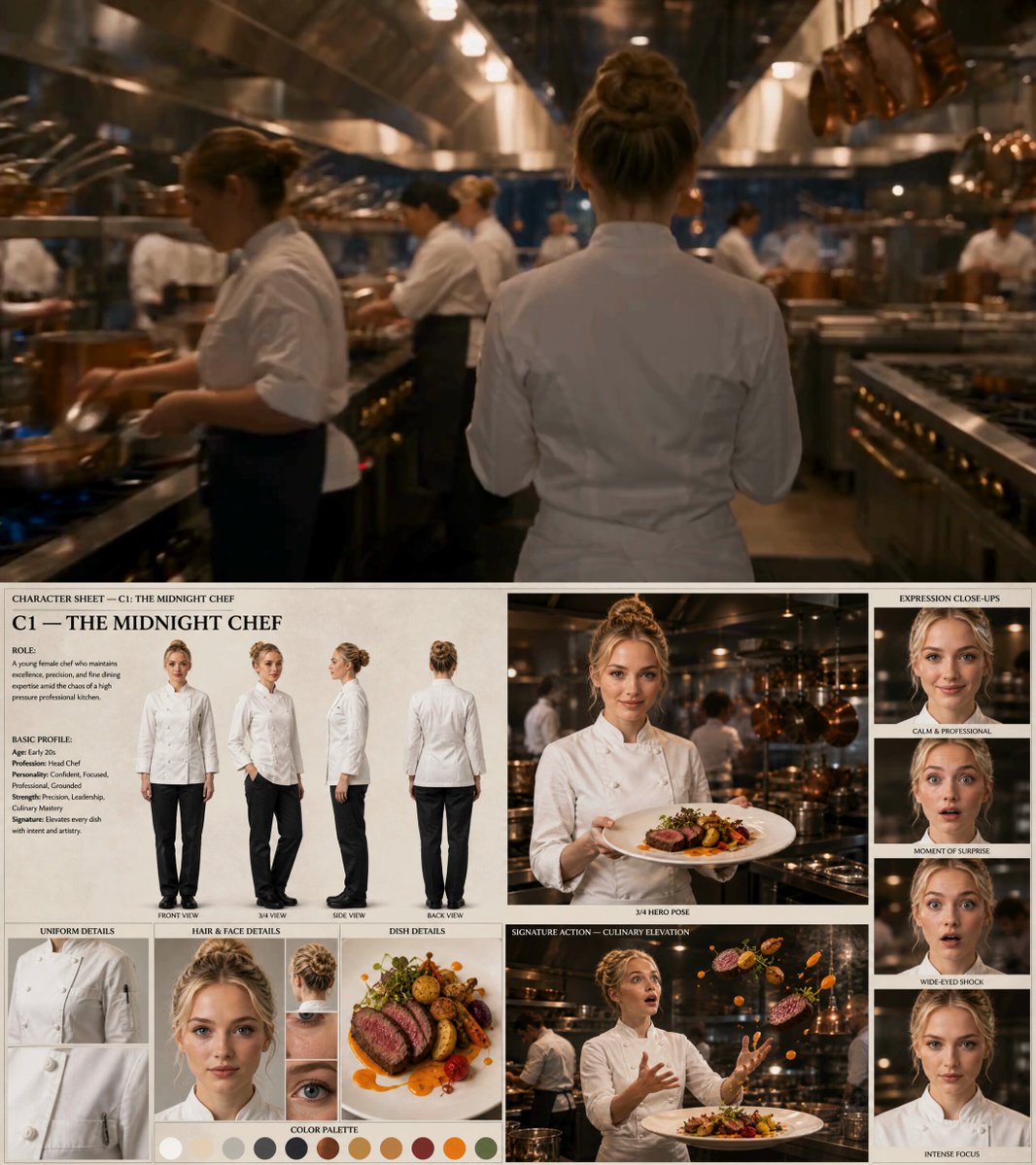
For every recurring subject, collect: a front-facing reference image, a three-quarter view, a profile, two wardrobe variations, and a short written description. Keep it in one folder. Any time a shot needs that character, you start from these references rather than describing the person again from memory.
Lock what you can lock
Seeds, reference images, and fixed prompt fragments all reduce drift. Write your prompts as a template with stable blocks for subject description, wardrobe, and lighting, and variable blocks only for action and camera. When a shot works, save the entire prompt block, not just the output.
Repair with editing, not regeneration
Small inconsistencies in hands, eyes, or accessory details rarely justify another generation pass. A short inpaint, a mask-based fix, or a single-frame composite in an editor is usually faster and more precise. Reserve full regeneration for continuity errors that a viewer would notice in motion.
Grade for cohesion
Apply a single color grade across an episode, even if shots came from different models. A shared grade, shared grain, and consistent black levels do more for perceived consistency than any prompt trick. This step is often skipped by AI-first creators, which is exactly why their output looks assembled rather than directed.
Shot Planning and Prompt Structure That Survives Reuse
A shot list is not bureaucracy. It is the reason you can generate ten clips in parallel instead of one at a time.
Start every episode with a numbered shot list: shot number, duration in seconds, description, camera movement, and audio note. Keep it under one page for short formats. This list becomes your generation queue and your editing checklist.
Use a consistent prompt skeleton so prompts stay comparable across a project:
- Subject: who or what, with reference anchor
- Action: the single change that happens on screen
- Environment: location, time of day, weather, background density
- Camera: framing, movement, lens feel, height
- Light: source, direction, contrast
- Style: palette, texture, grain, era references
- Exclusions: artifacts or elements to avoid
One action per shot. This is the most common failure point. If a prompt describes someone walking, turning, and then picking up an object, most models will blur or skip one of those beats. Split it into three shots and the sequence will feel more directed, not less.
Finally, plan duration honestly. Generative models are strongest in the three-to-eight second range for a single coherent action. Build episodes from short beats stitched together, and use transitions deliberately rather than hiding cuts.
Batch Production: One Idea, a Week of Output
Batching is where AI video operations gain their real advantage. Instead of producing one video end to end, produce by stage across many videos.
A workable weekly rhythm looks like this. Day one: write and approve scripts and shot lists for the entire batch. Day two: generate all approved stills and reference images. Day three: run all image-to-video and text-to-video passes. Day four: edit, add sound, grade, and caption. Day five: schedule and publish.
This structure has three benefits. It keeps your prompts consistent because you are in one mode at a time. It lets you reuse the same reference assets across many shots in one sitting. And it surfaces bottlenecks clearly, because a slow stage shows up as a queue instead of as a general feeling of being behind.
Build a reusable asset library as you go: intros, transitions, lower-thirds, music beds, room tone, and sound effects. A well-organized sound library is often what separates work that feels professional from work that feels generated, because audio continuity is what audiences notice subconsciously.
Quality Control: What to Review Before Anything Ships
Review in two passes. First, watch every clip at full speed without pausing. This catches rhythm and continuity problems that frame-by-frame inspection misses. Second, do a technical pass.
The technical checklist:
- Anatomy: hands, teeth, eyes, and limb counts
- Physics: weight, contact with ground, object permanence
- Text: any on-screen writing, logos, or signage
- Flicker and popping: background morphing between frames
- Continuity: wardrobe, props, light direction across shots
- Audio sync: mouth movement, footsteps, impact sounds
- Cropping: safe areas for vertical and square versions
- Loudness and captions: consistent levels, accurate subtitles
Keep a shared rejection log. Every time you reject a generation, note why in one line. After a month, patterns emerge: you will find that certain prompt phrasings or certain shot types consistently fail. Fixing those phrases once saves dozens of failed generations later.
Publishing Cadence, Distribution, and Repurposing
A finished video is a source file, not a deliverable. Design for repurposing from the start by shooting with generous framing that survives a vertical crop, and by writing hooks that work without context.
Maintain a distribution matrix: for each episode, list the platforms and the required aspect ratio, duration, caption style, and thumbnail variant. Then treat each platform version as a variant, not a new project. Repurposing an episode into three formats should take minutes if your project structure is clean, and hours if it is not.
On cadence, consistency beats volume. Two well-made pieces per week, published on a predictable schedule, will outperform sporadic bursts of eight. Reserve a fixed block each month to review performance and retire formats that are not earning attention. The concept layer is not a one-time decision; it is a portfolio you rebalance.
Common Mistakes That Kill Momentum
Chasing every new model release and rebuilding your pipeline each time. Adopt new models at stage boundaries, not mid-project.
Generating before planning. Without a shot list, you generate variants of an unclear idea and cannot judge which is better.
Skipping the still-image approval step for character shots. This single omission causes most wasted generations.
Ignoring audio. Viewers forgive imperfect visuals more readily than bad sound, dead air, or mismatched footsteps.
Not archiving rejected material. Half-used clips become excellent b-roll later if they are tagged and stored.
Treating consistency as a prompt problem instead of an editing and grading problem. Most cohesion is added in post.
FAQ
How many generations should I plan per finished shot?
Plan for five to eight attempts on shots that carry the story and one to three on supporting footage. If you consistently need more than ten, the prompt or the reference image is the problem, not luck.
Do I need one model or several?
Several, but used deliberately. Most successful workflows use one primary model for the majority of shots and one or two specialty models for stylized or high-detail sequences. Rotating across many models randomly produces inconsistent output.
How do I keep a character recognizable across an entire series?
Create a reference set with multiple angles and wardrobe variations, then always animate from an approved still rather than from text only. Add a final color grade across the episode to unify the results.
What is a realistic output volume for a small team?
A two-person team with a clean workflow can comfortably produce two to four short videos per week with a consistent look. The limiting factor is usually review and editing time, not generation speed.
How long should AI-generated shots be?
Three to eight seconds per shot is the sweet spot for a single coherent action. Compose episodes from many short, controlled beats rather than a few long, unstable ones.
Should I generate audio with AI as well?
Use it selectively. Synthesized voice and sound effects work well for narration, explainers, and stylized pieces. For anything dialogue-driven, record or license the performance, because timing and emotional nuance still read as artificial in most generated speech.
How do I prevent work from looking obviously generated?
Control three things: motion realism, continuity, and audio. Slow down excessive camera movement, keep light direction consistent across cuts, and layer room tone and foley under every scene. These three fixes close most of the gap.
When should I replace a tool in my pipeline?
When it solves a stage-level bottleneck you can name, and when you can swap it without rewriting your prompts or project structure. If a new model only offers marginal quality gains but would force a full pipeline rebuild, wait until your next project boundary.
The through-line is simple: decide what you make, template how you make it, choose tools per shot type, and protect consistency in editing and sound. Do that, and the output stops depending on which model launched this month and starts compounding like a real content operation.
