
What Prompt Flow Actually Means in an Editing Session
Most people treat AI video generation like a slot machine: type a sentence, pull the lever, hope something usable comes out. That approach produces a folder full of near-misses and almost nothing you can cut together. Prompt flow is the alternative — a deliberate sequence of decisions that carries an idea from a rough text brief all the way to a finished, watchable edit.
The word "flow" matters more than the word "prompt." A single well-written prompt is a snapshot. A flow is a chain: reference images feeding a first pass, output frames becoming references for the next shot, camera notes accumulating across scenes, and the edit informing what still needs to be regenerated. When people say a tool "understands" their intent, what they usually mean is that the tool fit neatly into an existing flow they had already designed.
Think of prompt flow as three interlocking loops. The outer loop is narrative — what story am I telling, in what order, with what emotional arc. The middle loop is visual continuity — character appearance, wardrobe, palette, lens choice, time of day. The inner loop is the generation itself — the text prompt, reference inputs, motion settings, and seed values for one specific shot.
Beginners usually work inside-out, obsessing over the wording of a single prompt. Professionals work outside-in. They lock the story beats first, decide what must stay visually consistent across shots second, and only then start writing generation prompts. That single reordering prevents most of the frustration people associate with AI video.
The Four Stages of a Real AI Video Pipeline
Every practical AI video project, whether it is a thirty-second ad or a six-minute short, moves through the same four stages. The tools change, the stage names don't.
Stage 1: Planning and Shot List
Before anything is generated, write a shot list in plain language. One line per shot is enough: "wide shot, empty diner at dawn, steam rising from a coffee cup." This list is your contract with yourself. It tells you what to generate and, more importantly, when to stop generating.
The shot list should specify duration targets as well. AI clips are typically short, so a six-second expectation per shot keeps you honest. If a beat needs twelve seconds, plan two shots or accept that the model will need to extend the motion rather than invent it.
Stage 2: Reference Building
For anything with a recurring subject, build references before you generate motion. A clean front-facing portrait, a three-quarter view, and a full-body shot of the same character give the synthesis model far more to anchor on than a sentence like "a thirty-year-old architect with short dark hair." Text describes; images constrain.
Stage 3: Synthesis
This is where text-to-video and image-to-video models do their work. Generate in small batches, never one clip at a time and never thirty at once. Three or four variations per shot lets you compare while the intent is still fresh in your head.
Stage 4: Assembly, Sound, and Repair
Generated clips arrive silent, ungraded, and often slightly mistimed. Editing here means trimming to the beat, matching color across shots, adding sound design, and identifying which two or three shots genuinely need regeneration. Most projects only need fifteen to twenty percent of shots regenerated — if you pick them deliberately.
Writing Prompts That Survive the Whole Pipeline
A prompt that produces one beautiful still frame is easy. A prompt that produces consistent motion across eight shots is a different craft.
Describe Subject, Action, Camera, Light, and Style in That Order
Order reduces ambiguity. Start with who or what is on screen, then what they are doing, then how the camera behaves, then the lighting, then the visual treatment. A working example: "A female cyclist in a yellow rain jacket pedals slowly through shallow floodwater; medium tracking shot from the left; overcast dawn light with soft reflections; muted documentary grade, shallow depth of field."
Notice what the prompt does not do. It does not stack five adjectives per noun, and it does not name a filmmaker as shorthand for an entire aesthetic. Style references work better as described qualities — grain, contrast, palette, movement — than as names the model may interpret loosely.
Constraints Do More Work Than Adjectives
Adding "no text overlays, no lens flare, single subject, steady camera" removes common failure modes that adjectives cannot fix. Negative constraints are especially valuable for hands, crowds, mirrors, and reflective surfaces, which remain the most common sources of visual breakdown.
Separate What Changes From What Stays
Build a base prompt containing everything that should remain constant, then append a short changing clause per shot. This is the single highest-leverage habit in prompt flow. Instead of rewriting prompts from scratch, you maintain one stable block and vary ten words.
Character Consistency Without Tears
Character drift is the most complained-about problem in AI video, and it is almost always a reference problem rather than a model problem.
Use Two Anchors, Not One
A single portrait gives the model one angle to reason from, so it improvises when your shot turns sideways. Provide at least two anchors: a straight-on face and a three-quarter body view. Add a wardrobe-specific shot if the clothing matters.
Lock Identity Before Motion
Generate a clean still of your character in the target scene first. Once that still looks right, use it as the starting frame for image-to-video generation. You are converting a hard problem — consistent character plus consistent motion — into two easier problems solved in sequence.
Accept Micro-Variation
Every generated frame carries slight variance in facial structure. Instead of fighting it, design shots that tolerate it: profiles, back-of-head framing, hands in frame, mid-distance compositions. Audiences read continuity from silhouette, color, and rhythm far more than from pixel-perfect faces.
Keep a Continuity Sheet
Write down hair color, jacket color, scene palette, lens feel, and time of day in a plain text file. Paste it into every prompt. It takes two minutes to create and saves hours of regeneration.
Choosing a Synthesis Model for the Shot You Need
Model selection is a per-shot decision, not a project-wide loyalty test. Different engines excel at different things, and the fastest path to a good edit is matching the engine to the shot.
Motion-Heavy Shots
For running, driving, dancing, or any shot where the subject travels through space, prioritize engines with strong temporal coherence. Expect to generate more variations, and expect the first attempt to fail. Keep camera movement simple in the prompt — a tracking shot with a moving subject is already two motions, and adding a whip pan makes it three.
Dialogue and Performance Shots
For talking-head or emotional close-ups, choose engines with reliable lip sync and facial stability. Feed a still frame rather than a text description. Performance generation is where text prompts are weakest and image conditioning is strongest.
Stylized and Graphic Shots
For animation, painterly looks, or highly graphic compositions, text-to-video often beats image-to-video because the style itself carries the continuity. In these cases, put the style description first in the prompt rather than last.
Establishing and Transition Shots
Wide landscapes, cityscapes, and abstract transitions are the most forgiving category. Generate these last, when you know exactly which gaps your edit needs to fill.
A practical rule: never commit an entire project to one engine before you have tested that engine on your hardest shot type. Test with the problem, not with the easy shot.
Camera Language That AI Models Actually Understand
AI models respond to camera language inconsistently, but a few phrasings are reliable enough to build a visual vocabulary around.
- Static, locked-off: the most predictable option, and the safest choice for dialogue and product shots.
- Slow push in / slow pull out: reads clearly and rarely breaks composition.
- Lateral tracking shot from the left or right: reliable when the subject moves in one direction.
- Handheld, subtle drift: adds energy but introduces instability that can soften faces.
- Low angle / high angle: strong compositional signals that models usually honor.
- Orbit around subject: powerful but risky; keep the arc small.
Avoid stacking two or three camera moves in one prompt. If you need a compound move, generate the simpler move and achieve the second half in the edit with a cut, a push, or a speed ramp.
Also decide your aspect ratio and framing before generating, not after. Cropping a vertical generation into a widescreen frame loses resolution and often clips feet, hands, or heads in ways that cannot be recovered.
The Edit Is Still the Edit
Generated footage is raw material. Treating it as a finished product is the fastest way to make AI video look like AI video.
Start by cutting to a temp music track. Rhythm exposes which clips are too long, which shots repeat information, and where the story sags. Then do three passes: a structural pass for order and pacing, a visual pass for color matching and stabilization, and a sound pass for effects, room tone, and music balance.
Color matching deserves special attention because different generated shots rarely share a palette. A simple corrective layer that lifts shadows and aligns white balance across clips does more for perceived quality than regenerating anything.
Sound is the most underrated lever. Footsteps, cloth movement, ambient room tone, and a low music bed make generated footage feel intentional. Silent AI clips always read as artificial, even when the visuals are excellent.
Finally, keep a repair list while you edit. Whenever a shot underperforms, note the shot number and the specific problem rather than stopping to regenerate immediately. Batch regeneration at the end of a session — it is dramatically faster and keeps your creative momentum intact.
A Complete Walkthrough: Thirty Seconds From Scratch
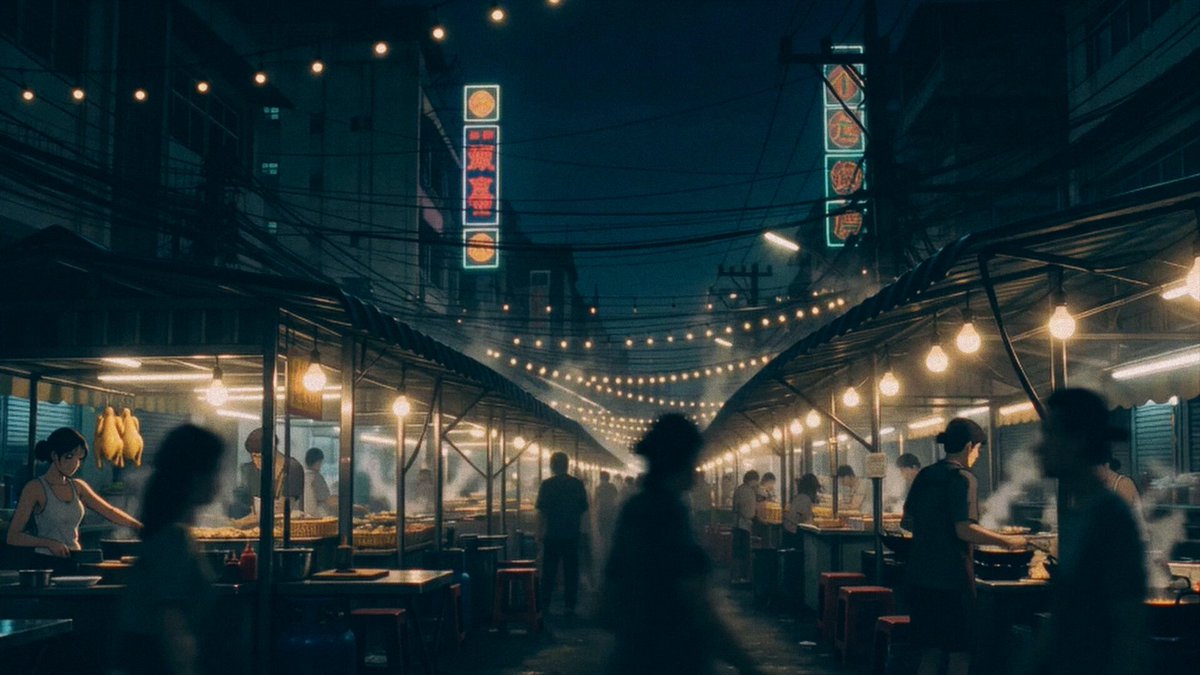
Here is the full flow on a small project: a thirty-second piece about a night market.
- Write six beats. Arrival, browsing, a shared meal, laughter, walking away, wide closing shot. Six shots, roughly five seconds each.
- Build references. One wide establishing still, two character stills per person with two angles each.
- Write a base prompt block. "Night market alley, warm practical lights, wet pavement reflections, shallow depth of field, gentle handheld feel, no text, single subject where applicable."
- Append one changing clause per shot. "Two people browsing a food stall, medium shot from behind." etc.
- Generate three variations per shot. Twelve total clips for six shots.
- Select. Keep two shots with strong alternatives for safety.
- Assemble on music. Trim to the beat, order for escalation, cut the weakest half-second from every clip.
- Repair list. Probably two shots: hands interacting with food, and the closing wide that may not match the palette.
- Regenerate the two problem shots with adjusted constraints. Add "hands visible, no overlapping subjects" to the first; add the exact palette description to the second.
- Sound pass and export. Cut in effects, room tone, music bed, and export at the delivery aspect ratio.
Total generation count for a thirty-second piece: around eighteen to twenty-two clips, of which twelve to fifteen make the final cut. That ratio is normal and healthy. If you are generating fifty clips for six shots, your prompts are too vague; if you are generating six and expecting all to work, your tolerance is too optimistic.
Common Failure Modes and Their Fixes
Morphing faces. Cause: too much motion combined with weak reference. Fix: start from a still frame and reduce camera movement.
Shots that ignore the prompt. Cause: prompt overloaded with conflicting instructions. Fix: cut to one subject, one action, one camera move.
Inconsistent color between shots. Cause: no shared palette language. Fix: reuse an identical lighting and grade clause in every prompt, then correct in post.
Everything looks the same. Cause: identical framing across shots. Fix: alternate wide, medium, and close, and vary angle even when the scene doesn't change.
Plastic skin and dead eyes. Cause: style prompts that push too hard toward perfection. Fix: add grain, imperfect lighting, and natural texture language.
Clips that feel slow. Cause: you are using the full generated duration. Fix: trim the head and tail of every clip; generated motion almost always has a weak entry and exit.
FAQ
Do I need to learn prompt syntax or special commands?
No. Natural language works. What you need is discipline about ordering, constraints, and consistency clauses, not secret keywords.
How many variations should I generate per shot?
Three is the practical sweet spot for most work. Two feels risky, and beyond five you start losing the ability to judge them objectively.
Is image-to-video always better than text-to-video?
Not always, but it is more controllable whenever a recurring subject or specific composition matters. For abstract, stylized, or establishing shots, text-to-video is often faster and just as good.
How do I keep a character consistent across many shots?
Use at least two reference angles, generate a locked still for each scene before animating it, write a continuity sheet you paste into every prompt, and design shots that tolerate small facial variation.
How long should generated clips be?
Plan for four to six seconds and extend only when necessary. Short clips cut together better and give you more control over pacing.
Can I mix models within one project?
Yes, and most experienced editors do. Match the engine to the shot type, then unify the result with color correction and sound design.
What is the biggest beginner mistake?
Generating before planning. A ten-minute shot list prevents hours of scattered regeneration.
Where to Focus First
If you take one idea from this guide, make it this: prompt flow is a planning discipline that happens before generation, not a writing trick applied during it. Build a shot list, create two-angle references, maintain a stable base prompt with small changing clauses, generate in small batches, and treat the edit as the place where quality actually gets decided. The tools will keep improving on their own. The workflow is the part you have to build, and it is the part that makes everything else worth using.
