
Why the workflow matters more than the model
Every few weeks a new generative video model appears with a demo reel that makes the previous generation look dated. The natural reaction is to switch tools, chase the new look, and start over. Teams that ship consistently do something different: they treat the model as a replaceable component inside a stable pipeline. When a better engine arrives, they swap it in without rewriting their process.
That distinction is the difference between a hobby and a production habit. A single model rarely handles an entire video well. Text-to-video engines are brilliant at motion and physics but weak at precise framing. Image-to-video tools preserve composition beautifully but can produce stiff performances. Video-to-video and style transfer passes fix color and texture but smear fine detail. The craft is in chaining these capabilities so each stage does what it is best at.
This guide lays out a neutral, tool-agnostic workflow for AI video production. It covers pipeline stages, how to match generation modes to shot types, how to build a reusable style system, prompt architecture, continuity control, quality gates, compute planning, and finishing. Nothing here depends on a specific vendor, and everything can be adapted whether you are a solo creator or part of a small studio.
The anatomy of a modern AI video pipeline
A reliable pipeline has six stages. Skipping any of them is what produces the familiar disappointment of a beautiful clip that cannot be edited into anything coherent.
Stage 1: Brief and shot list
Before generating anything, write a one-page brief: subject, tone, runtime, aspect ratio, delivery platform, and the emotional arc. Then break it into a shot list with one line per shot describing action, framing, and duration. Ten to twenty shots is a healthy range for a thirty-second piece. The shot list becomes your checklist and your budget document, because each shot has a predictable render cost.
Stage 2: Look development and style frames
Generate or source still frames that define the visual language: palette, lens character, grain, contrast, and lighting direction. Approve these before any motion work. Still frames are cheap; video renders are not. A style frame set of six to ten images prevents a week of misaligned generation.
Stage 3: Generation passes
This is where the bulk of the work happens. You will produce multiple takes per shot, usually with different seeds and slightly varied prompts. Expect a hit rate between ten and thirty percent for complex motion. Plan for it rather than being surprised by it.
Stage 4: Motion and temporal repair
The best take often has a flaw: a hand melts, a background warps, a face drifts. Repair passes include interpolating frame rate, masking and regenerating a region, or compositing a second generation on top of the first. This is the stage most beginners skip, and it is the reason their output looks amateurish.
Stage 5: Finishing
Upscale to delivery resolution, stabilize, grade, add sound design, music, and subtitles. AI video at native resolution often lacks the micro-texture that makes footage feel photographic; a gentle sharpen, grain pass, and grade fixes most of it.
Stage 6: Delivery and archiving
Export platform-specific masters, then archive the project with prompts, seeds, model versions, and reference images. In three months you will want to recreate a look, and a documented archive saves you days.
Matching generation modes to shot types
The single biggest quality lever is choosing the right generation mode per shot. Most disappointing AI video comes from using one mode for everything.
Text-to-video
Use it for establishing shots, landscapes, abstract transitions, and any shot where the exact composition matters less than motion and atmosphere. It excels at wind, water, smoke, crowds, and camera movement. It struggles with specific faces, readable text, and complex hand interactions.
Image-to-video
Use it when composition, product accuracy, or character likeness is non-negotiable. Starting from a strong still locks the frame and lets the model focus on motion. It is the default choice for product spots, character close-ups, and any shot tied to a brand asset.
Video-to-video and style transfer
Use it for restyling existing footage, matching a live-action plate to a generated world, or smoothing inconsistencies between shots. It is also the cheapest way to add a consistent grade across a sequence generated by different engines.
Hybrid sequences
A pragmatic approach: open with a text-to-video establishing shot, cut to image-to-video for character and product beats, then use video-to-video for transitions. The viewer perceives one continuous world because the cut rhythm hides the handoffs.
Building a reusable style system
Consistency across a series is worth more than novelty in a single clip. A style system is the mechanism that delivers it.
Dataset hygiene
If you are training or adapting a model on your own material, curate ruthlessly. Twenty to forty high-quality images beat two hundred mixed ones. Remove images with conflicting lighting, watermarks, heavy compression, or off-brand color. Caption each image with the attributes you want to control: subject, medium, lens, lighting, mood. Bad captions teach the model to ignore your prompts.
Train small, test early
Start with a small training run, generate a test grid across five prompts, and evaluate before scaling up. Look for three signals: does the style hold without being prompted, does it obey prompt variation, and does it avoid baking in unwanted content from the dataset.
Version your style
Treat each style iteration as a version with a changelog. Note the dataset, settings, and prompt template. When a client asks for "the look from the second cut," you can reproduce it exactly instead of guessing.
Prompt architecture for video
Video prompts are not long image prompts. They describe change over time, and they need to specify what the camera is doing.
Structure: subject, action, camera, light, texture
A dependable template looks like this: subject and wardrobe, then a single clear action, then camera behavior, then lighting, then medium and texture. Keep it to one action per shot. Two actions in one prompt produces a muddled compromise.
Camera language
Use precise terms: slow dolly in, handheld follow, static wide, orbit left, crane up, rack focus from foreground to background. Camera instructions have an outsized effect on perceived production value because they create intentional movement rather than drifting motion.
Negative prompts and failure modes
Maintain a reusable negative list for the artifacts you keep seeing: warped hands, extra limbs, text overlays, jitter, duplicated faces, oversaturated skin. Reuse it across shots; it is one of the few settings that can be standardized.
Seed discipline
Record the seed for every approved take. Reseeding with the same prompt is the fastest way to explore variations that stay close to an approved look.
Consistency across shots
Viewers forgive imperfect physics. They do not forgive a character whose jacket changes color between cuts.
Character sheets and reference images
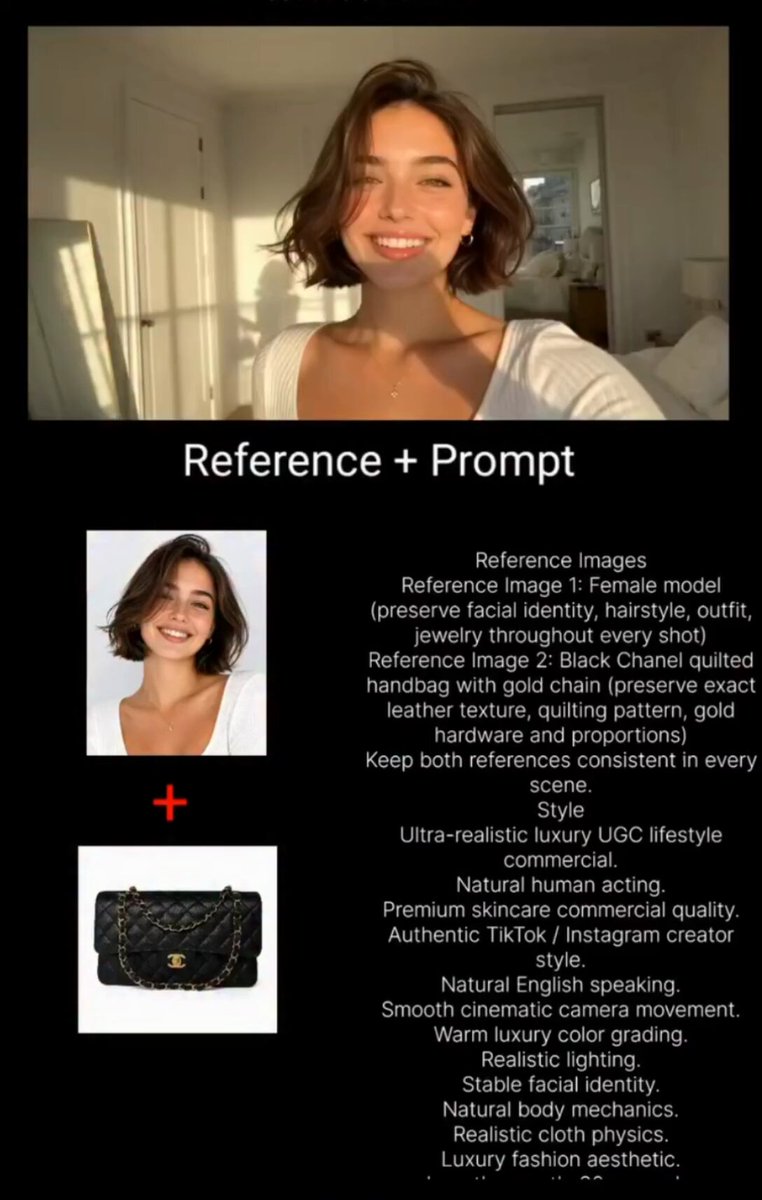
Build a character sheet with four angles and two expressions, generated or photographed. Feed the same reference into every shot featuring that character. Keep wardrobe, hair, and accessories in the prompt as fixed tokens rather than describing them anew each time.
Location bibles
For recurring locations, save a set of approved wide, medium, and detail frames. Generate new shots from those references so architecture, signage, and light direction stay stable.
A continuity checklist
Before approving a shot, check: character likeness, wardrobe, props, time of day, light direction, screen direction, and color temperature. Seven checks, thirty seconds each, saving hours of re-rendering.
Quality control and iteration loops
Good AI video teams are not better prompters; they are better reviewers. They reject faster and iterate in tighter loops.
Review gates
Set three gates: style frames approved, motion approved, finish approved. Nothing proceeds past a gate without sign-off. Without gates, projects drift and revision cycles multiply.
Contact sheets and proxies
Generate proxies at low resolution and assemble contact sheets of four to nine takes per shot. Reviewing a grid is dramatically faster than watching clips one at a time. Only promote the best take to full resolution.
When to re-roll, re-prompt, or re-stage
Re-roll when the prompt is right but the take is unlucky. Re-prompt when the composition keeps missing the intent. Re-stage when the shot itself is the problem — for example, asking a model to render a complex two-person interaction in a single wide. Break it into two shots instead.
Planning compute and render budget
Render planning is unglamorous and decisive. Teams that model their workload finish on time; teams that improvise run out of capacity mid-project.
The resolution ladder
Develop at low resolution, approve at medium, finish at full. Roughly eighty percent of your generation volume should happen at the lowest usable resolution. This single habit can cut total render time by more than half.
Batching and queue management
Submit generations in batches and keep the queue full overnight. Track three numbers per project: takes per approved shot, average render time, and retry rate. Once you know them, estimating a new project becomes arithmetic rather than hope.
Speed versus fidelity
Faster models with lower fidelity are ideal for exploration; slower, higher-fidelity models are for hero shots. Most projects need a mix. Decide per shot rather than per project.
Sound, subtitles, and delivery specs
Audio is where AI video most often falls apart, and it is also the cheapest place to gain perceived quality.
Sound design first, music second
Lay in ambience and effects before the score. A door, footsteps, cloth movement, and room tone do more for realism than a dramatic track. Generate or source effects, then time them to visible contact points in the frame.
Voice and lip sync
If you need dialogue, generate voice separately, then align mouth movement to the audio rather than the reverse. Keep sentences short. Long monologues expose synchronization errors.
Subtitles and accessibility
Auto-transcribe, then proofread. Burn in or export sidecar files depending on the platform. Check line length, reading speed, and safe margins for each aspect ratio.
Platform masters
Deliver vertical, square, and widescreen versions from the same timeline. Reframe rather than crop blindly, and re-check that subtitles and key action stay inside safe areas.
Common mistakes that stall AI video projects
- Generating before writing. Without a shot list, you accumulate pretty clips that do not cut together.
- Chasing one model. No engine wins at everything. Diversify by shot type.
- Ignoring resolution strategy. Full-resolution exploration burns time without improving creative decisions.
- No reference library. Rebuilding characters and locations from scratch each session guarantees drift.
- Undocumented prompts and seeds. You cannot reproduce an approved look by memory.
- Neglecting the repair pass. Fixing a single warped hand is faster than regenerating a whole shot.
- Treating audio as an afterthought. Poor sound defeats excellent visuals instantly.
FAQ
How many takes should I plan per shot?
Budget five to ten for simple shots and fifteen or more for complex motion, crowds, or hands. If your approval rate is below ten percent, the prompt or the shot design needs changing, not more takes.
Do I need custom training to get a consistent look?
Not always. A strong style frame set, fixed prompt tokens, and a consistent finishing grade can carry a short project. Custom training becomes worthwhile when a series runs past a handful of episodes or when a brand look must be reproducible by other people.
Which is better, text-to-video or image-to-video?
Image-to-video wins whenever composition or likeness matters. Text-to-video wins for atmosphere, scale, and speed when the exact frame is flexible. Most finished pieces use both.
How do I handle text and logos in generated footage?
Avoid asking the model to render them. Generate the plate, then composite accurate typography and logos in the edit where you have full control over legibility and brand rules.
What resolution should I generate at?
Generate at the lowest resolution that lets you judge composition and motion, then upscale only approved takes. Reserve full-resolution generation for hero shots and final passes.
How do I keep characters consistent across many shots?
Use reference images, fixed prompt tokens for wardrobe and features, and a continuity checklist at every review gate. Consistency is a process outcome, not a single setting.
Can I mix footage from different engines in one video?
Yes, and you probably should. Cuts, grade, grain, and sound design unify disparate sources. Keep shot lengths short near engine transitions and apply one unifying grade across the sequence.
How long should an AI-generated shot be?
Two to five seconds is the sweet spot. Longer clips accumulate drift in faces, hands, and backgrounds, and they are harder to repair. Build longer sequences from shorter shots.
Putting it into practice
Start small and deliberately. Choose a thirty-second concept, run it through all six pipeline stages, and document everything: shot list, style frames, prompts, seeds, versions, and the final grade. The output will not be perfect, but you will finish with something more valuable than a single clip — a repeatable process.
Then improve one variable at a time. Tighten your style frame set. Standardize your negative prompt list. Introduce a repair pass on the two weakest shots. Add a proper sound design layer. Each improvement compounds, and within a few projects the quality gap between you and someone randomly generating clips becomes obvious to any viewer.
Finally, stay engine-agnostic. Keep your prompts, references, and finishing chain portable so that when a stronger model arrives, adopting it is a configuration change rather than a rebuild. The teams that endure in generative video are not the ones with the newest tool. They are the ones with the clearest workflow.
