

Why short-form video rewards a repeatable production system
TikTok and Instagram Reels do not reward one perfect upload. They reward a catalog. Every clip is tested against a small slice of viewers, and only the ones that hold attention get pushed to a wider audience. That dynamic has two consequences: you have to post often enough to give the algorithm something to work with, and you have to keep quality high enough that the clips it does promote are worth watching.
Creators who survive that pressure are rarely the ones with the biggest ideas. They are the ones who turned production into a pipeline — a repeatable way to capture ideas, generate assets, assemble edits, publish, and then read the numbers.
AI fits into that pipeline best when it removes the slow parts rather than replacing the creative parts. Storyboarding, b-roll generation, voiceover retakes, captioning, and reformatting are all tedious and largely mechanical. Hook writing, angle selection, pacing, and tone are not. Teams that hand the first group to AI and keep the second group human consistently outperform teams that try to automate everything or nothing.
This guide lays out a practical, tool-agnostic workflow for building short-form video with AI: how to split the work, which generation method fits which shot, how to keep a visual identity consistent across dozens of clips, and where the most common failures happen.
How AI fits into a short-form pipeline
Before selecting a single tool, map the work. A typical 30-second vertical video breaks into five stages.
Planning and research. Finding a topic, checking what already performs in the niche, writing the hook, drafting the script. AI helps with ideation volume and pattern spotting, but the hook still needs a human judgment call about what feels fresh.
Asset generation. Visuals, voiceover, music, sound effects. This is where generative video models do the heaviest lifting — text-to-video for conceptual shots, image-to-video for controlled shots, avatar tools for talking-head formats.
Assembly. Cutting, pacing, transitions, captions, sound design. AI-assisted editors and auto-captioning tools compress this stage dramatically.
Publishing. Aspect-ratio exports, cover frames, captions, hashtags, and platform-specific quirks.
Analysis. Retention curves, watch time, saves, shares, and comments. AI can summarize these, but the interpretation is yours.
A useful rule of thumb: automate stages that are repetitive but low-risk (captions, b-roll, resizing), semi-automate stages with creative decisions embedded (scripting, voiceover), and keep full manual control over anything that defines your identity (hook style, on-camera presence, editing rhythm).
It also helps to decide early whether you are producing faceless content, avatar-led content, or hybrid content where you appear on camera and AI fills the gaps. Faceless workflows are the easiest to scale but the hardest to differentiate. Avatar-led workflows scale well and are getting convincing, yet they still struggle with emotional nuance and improvisation. Hybrid workflows are the slowest per video but usually produce the strongest retention, because a real person reacting to a real moment is still the most reliable attention driver on a feed.
Choosing the right generation approach per shot
There is no single best AI video method. Different shots call for different approaches, and mixing them is normal.
Text-to-video: fast, flexible, unpredictable
Text-to-video works best for atmospheric shots where nothing specific has to be true: a city at dusk, rain on glass, clouds moving over a mountain range, abstract transitions, motion backgrounds behind text. It is fast and cheap per attempt, but it gives you the least control. Expect to generate several variations to get one usable clip, and avoid asking for complex actions, readable text, or precise hand movements — those remain the weak points of most models.
Image-to-video: the workhorse for consistent visuals
If you need a specific subject, product, or location, start from a still image. Generate or photograph the frame you want, then animate it. This gives you far more control over composition, lighting, and identity, and it makes consistency achievable because you are reusing the same source frames across clips. Most polished AI-driven brand accounts are built primarily on image-to-video, not pure text prompts.
Avatar and voice-driven formats
Talking-head avatars are useful for explanation content, listicles, and localized versions of an existing script. The quality bar here is high: viewers forgive stylized visuals but notice unnatural mouth movement and flat delivery immediately. If you use an avatar, treat the script as the product and keep shots short, with cutaways every few seconds to hide the uncanny moments. Voice cloning, where permitted and properly disclosed, can speed up multi-language versions of the same video.
Reformatting long content into shorts
One of the highest-leverage uses of AI is not generation at all — it is decomposition. Tools that scan a long video or podcast and pull candidate moments can produce five or ten short clips from material you already own. The output always needs manual trimming, but the time saved on logging and rough cuts is substantial.
Building a consistent visual identity across clips
The fastest way to look amateurish is to have every clip look like it came from a different channel. Consistency is not about a logo; it is about recurring visual grammar.
Start by writing a compact style guide you can paste into prompts. Include the color palette, lighting direction, lens feel, grain level, and the general mood. Something like "soft window light from the left, muted teal and warm amber palette, 35mm feel, subtle grain, shallow depth of field" does more for visual cohesion than any amount of post-processing.
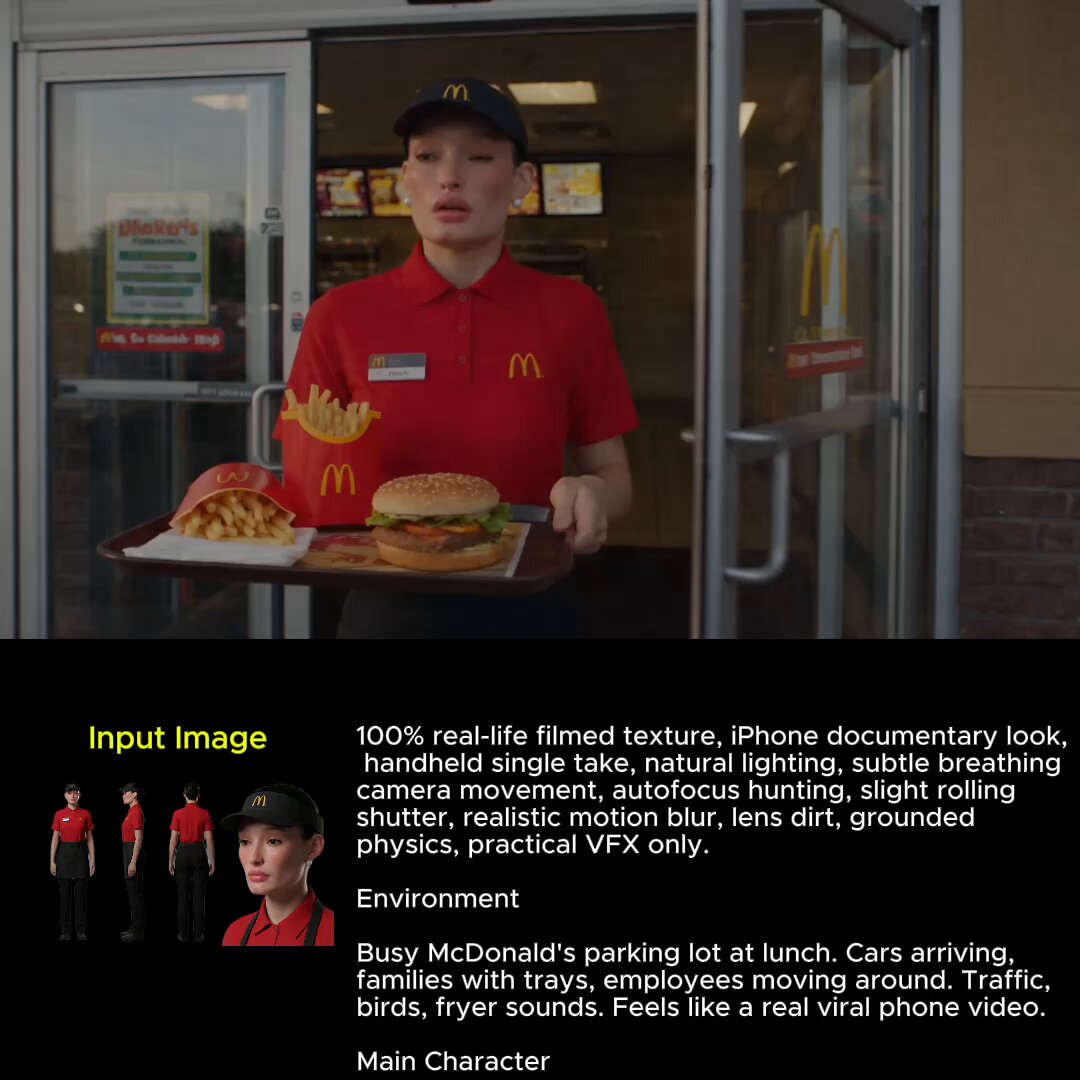
Next, build a character or product sheet. For recurring characters, generate a small set of reference stills from multiple angles — front, three-quarter, profile — and reuse them as the starting frame for every shot. That single habit eliminates most of the drift that makes AI characters look like different people between cuts. For products, use clean reference photos against neutral backgrounds so the model has less to invent.
Finally, lock recurring elements: the same opening frame layout, the same caption font and position, the same transition style, the same music family. Viewers recognize rhythm before they recognize branding, and rhythm is what turns a series of clips into a channel.
Prompting for vertical video: hooks, pacing, framing
Vertical video punishes slow starts. The first 1.5 seconds decide whether the rest of the clip is seen at all, so the opening frame needs a reason to exist: a surprising visual, a bold claim, a face mid-expression, or motion already in progress.
When prompting for 9:16 output, describe the framing explicitly. Keep the subject in the upper two-thirds so platform interface elements do not cover it, and avoid placing essential detail at the very bottom of the frame. Do not ask the model to render text — generate clean footage and add typography in the editor, where it stays readable and editable.
Shot length matters more than shot beauty. Vertical edits cut fast: 1.5 to 3 seconds per shot is typical for high-retention content. Generate clips of four to five seconds and trim them down rather than trying to generate exactly the length you need; you want handles for the edit.
Be specific about motion. "Slow push in," "handheld follow," "steady pan left" produce more consistent results than vague requests for something dynamic. When a shot matters, generate three or four takes with slightly different motion descriptions and pick the one with the cleanest start and end frames — those frames determine how well the clip cuts against its neighbors.
A step-by-step AI workflow from idea to export
Here is the workflow that holds up over dozens of uploads.
Step 1 — Build a hook bank
Maintain a running document of hooks grouped by format: contrarian takes, numbered lists, before-and-after, mistake confessions, and curiosity gaps. Aim for 30 or more at any time. AI can help you generate variations, but seed it with your own best-performing openings so the tone stays yours.
Step 2 — Write a shot list before generating anything
A 30-second video should have 8 to 12 shots. Write each one as a single line: what is on screen, what it does for the story, and how long it lasts. This prevents the classic failure mode where you generate beautiful clips and then try to invent a narrative around them.
Step 3 — Generate in batches, review in a grid
Generate all the visuals for one video in one session, then review them together in a grid view. Side by side, inconsistency jumps out immediately — mismatched lighting, drifting character features, jarring color shifts. Fixing those at the review stage is much cheaper than fixing them in the timeline.
Step 4 — Layer voice, captions, and sound
Record or generate the voiceover first, then cut visuals to the audio rather than the reverse. Auto-captioning handles the first pass, but always edit for accuracy and line breaks; captions that split phrases badly read as noise. Keep background music well under the voice, and use sound effects on cuts to give the edit a sense of rhythm.
Step 5 — Edit for retention, not for beauty
Watch your own draft twice. The first pass is for technical errors. The second is for drop-off points — the moments where you would swipe away. Cut them without sentiment. A beautiful two-second establishing shot that nobody watches is worth less than a jump cut that keeps the pace.
Step 6 — Export platform-specific versions
Export separate files for each platform rather than reposting one file everywhere. Adjust safe zones, caption placement, and cover frames per platform. If the clip runs long, trim rather than compress; denser edits outperform slower ones on vertical feeds.
Cross-posting TikTok and Instagram without looking recycled
The same clip can work on both platforms, but only if you adapt it. The most common giveaway that a video was reposted is a visible watermark from another app. Always export clean.
Beyond that, watch three things. First, safe zones differ, so caption and text placement should be checked on both. Second, caption copy works differently: TikTok captions often carry a punchline or a call for discussion, while Instagram captions can hold more context and a clearer prompt for comments. Third, cover images matter more on a grid-based profile, so pick a frame that reads clearly as a thumbnail.
Keep the underlying structure identical. A clip that performs on one platform usually performs on the other within a factor of two, and small differences in performance are usually about timing, sound trends, and audience overlap rather than the content itself.
Quality-control checklist before publishing
Run this list on every upload until it becomes automatic.
- The first frame is visually interesting with sound off.
- The hook is stated or shown within the first two seconds.
- No AI-generated on-screen text; all typography was added in the editor.
- Captions are accurate, correctly broken, and inside platform safe zones.
- Character or product features are consistent with previous clips.
- Audio levels are consistent, with music clearly beneath the voice.
- Aspect ratio and duration match the platform's preferred specs.
- The cover frame reads clearly at thumbnail size.
- The ending has a reason to loop or a clear next step.
Common mistakes and how to fix them
The most frequent problem is trying to make AI carry the creative load. Generated footage without a point of view produces clips that look expensive and feel empty. The fix is to write the script and the hook first, then decide which shots AI can produce and which need a camera, a screen recording, or a simple graphic.
The second problem is inconsistency. Characters shift appearance, color grading drifts between clips, and the channel starts to feel like a compilation rather than a series. Reference images and a written style guide solve most of it.
The third is overproduction. Long intros, elaborate transitions, and slow builds all cost retention. Vertical audiences reward density.
The fourth is ignoring data. If your retention curve drops off a cliff at three seconds, no amount of editing polish will help — the problem is the hook. If it holds until the halfway mark and then falls, the payoff is arriving too late. Read the curve, make one change, and test again.
Finally, avoid using AI to dodge decisions. Tools can generate options; they cannot tell you which option is on-brand, funny, or true. That judgment is the part of the job that keeps viewers coming back.
FAQ
Do I need expensive tools to start?
No. A basic plan on one video generation tool, a free editor, and an auto-captioning app covers the majority of short-form production. Add specialized tools only when a specific bottleneck shows up repeatedly.
How many videos should I publish per week?
Pick a number you can sustain for three months, not one you can manage for two weeks. Three to five per week is a common sweet spot for solo creators, but consistency beats volume in almost every case.
Will viewers notice that AI was used?
For faceless b-roll and abstract visuals, usually not, and it rarely matters. For human faces and voices, viewers notice quickly. If you use avatars or cloned voices, keep the script strong and disclose synthetic media where platform rules or audience expectations require it.
How long should each clip be?
Start with 20 to 35 seconds for most niches. The right length is however long the payoff needs, no longer. If a clip can be 15 seconds and still land, make it 15.
Can I reuse the same AI footage across videos?
Yes, and you should. Reusing establishing shots, backgrounds, and transitions builds visual familiarity and cuts production time. Just avoid repeating the same full sequence back to back.
What should I measure first?
Watch time and average view duration. Saves and shares come next, since they signal that the content was worth keeping. Views alone tell you very little about whether the format is working.
Where does human work still matter most?
The hook, the script, the edit rhythm, and the final quality check. Those four areas decide whether a video performs, and none of them are solved by generation quality alone.
