
Why AI Video Has Become Practical for Learning and Entertainment
Two very different audiences now share the same production pipeline. A teacher needs to make an abstract idea finally click. A creator needs to hold a scrolling viewer's attention for thirty seconds. Both are served by the same shift: generating footage, motion, voice, and music has become fast enough to sit inside ordinary iteration rather than being a special project with its own budget line.
The practical consequence is that the bottleneck has moved. It is no longer rendering power. It is clarity of intent — knowing what you want the viewer to understand or feel, and structuring the work so the model can deliver it. Teams that treat AI video as a magic button get generic output. Teams that treat it as a fast, slightly unpredictable collaborator get finished videos in a day.
This guide covers a repeatable workflow that works for both instructional content and entertainment, the prompt patterns that consistently improve results, and the mistakes that waste the most time.
Matching the Generation Approach to Your Content
Before writing a single prompt, decide which generation category your project belongs to. This single decision prevents most rework.
Text-to-video, image-to-video, and hybrid pipelines
Text-to-video is fastest for abstract or illustrative sequences: a molecule assembling itself, a historical city at dawn, a graph coming alive. You describe the shot and the model invents everything.
Image-to-video is more controllable. You supply a starting frame — a diagram, a character design, a photograph — and the model animates from it. For education, this is almost always the better choice, because the visual accuracy of the first frame is guaranteed rather than hoped for. For entertainment, it lets you lock a character's look before the scene ever moves.
Hybrid pipelines combine both: generate a rough text-to-video pass to explore composition, then rebuild the winning shots with image-to-video for control. It costs an extra generation round but saves hours of picking through near-misses.
When to animate and when to record
Not every shot should be synthetic. Talking-head explanation, demonstrations of physical objects, and anything requiring genuine emotional nuance are still faster and better with a camera. Use AI for what cameras cannot easily reach: impossible scale, historical settings, cutaway views, animated metaphor, and rapid variation of the same scene.
A useful rule: if a shot exists mainly to convey information through motion or transformation, generate it. If a shot exists to convey a person's credibility, record it.
A Repeatable AI Video Workflow, Step by Step
Step 1: Define the single objective
Write one sentence stating what the viewer should know or feel by the end. "By the end, the viewer understands why inflation makes savings lose value." "By the end, the viewer is desperate to see what is behind the door."
Every later decision — pacing, shot length, music, whether to include a joke — gets tested against that sentence. Without it, revisions turn into taste arguments with no resolution.
Step 2: Write for the ear, not the page
Read your script aloud. Anything you stumble over will sound worse coming out of a synthetic voice. Short clauses, active verbs, and one idea per sentence survive text-to-speech far better than academic phrasing.
For instructional video, aim for roughly 130 to 150 spoken words per minute. For entertainment, faster is usually better, but only when the visuals are also moving. A rapid narration over a static shot feels frantic; a slow narration over a static shot feels dead.
Step 3: Storyboard and build a shot list
You do not need drawings. A table with five columns is enough: shot number, duration, what the viewer sees, what the viewer hears, and the generation method (text-to-video, image-to-video, archive, or live action).
Keep shots between two and five seconds for entertainment and four to eight seconds for instruction. Shorter shots read as energy; longer shots read as explanation. Most first drafts fail because every shot is eight seconds long regardless of purpose.
Step 4: Generate, review, regenerate
Generate in small batches grouped by location and lighting condition, not in script order. Models drift when you jump between wildly different scenes, and grouping keeps the look coherent.
Review with three questions: Is it usable? Is it on-message? Is it consistent with the neighbouring shots? If a clip is merely acceptable, regenerate once. If it is wrong in concept, rewrite the prompt instead of rolling again. Repeated rolling on a bad prompt is the single largest source of wasted time.
Keep a running document of prompts that worked, with the seed or reference image if the tool exposes one. Your tenth video will be dramatically faster than your first because of this file.
Step 5: Assemble, caption, and localize
Edit on a timeline, not inside the generator. Add music and sound design, then caption everything. Captions are not optional: they serve viewers watching without sound, viewers in noisy environments, and search engines.
If you plan to localize, export a caption file and translate it before dubbing. Translating captions first gives you a script that is already timed, which makes synthetic dubbing far more natural.
Prompt Patterns That Improve Output Quality
Structure every prompt the same way
A reliable template: subject, action, environment, camera, lighting, style, and constraints. For example: "A cross-section of a human heart, valves opening and closing, dark studio background, slow push-in, soft rim lighting, clean medical illustration style, no text overlays."
Consistent structure makes it easy to see which variable caused a bad result. If you improvise prompt order every time, you cannot diagnose anything.
Consistency across shots
Character and object continuity is the hardest problem in AI video. Three techniques help more than any others:
- Lock a reference image. Generate or select one strong frame of your subject and use it as the starting image for every subsequent shot.
- Repeat descriptors verbatim. If the jacket is "charcoal wool overcoat" in shot one, it must be exactly that phrase in shot seven.
- Change one variable at a time. Keep camera and lighting language identical while you change only the environment.
Style continuity follows the same logic. Define a short style block — colour palette, lens feel, grain, animation style — and paste it into every prompt unchanged.
Motion and camera language
Vague words produce vague motion. "Cinematic" tells the model almost nothing. Use concrete terms: slow dolly in, handheld follow, static wide, overhead top-down, rack focus from foreground to background, whip pan.
For educational sequences that must stay readable, prefer slow, single-direction camera moves. Fast or compound movement makes text and diagrams unreadable and forces the viewer to rewatch.
Education-Specific Techniques
Visualizing abstract concepts
AI video excels at three instructional patterns:
- Scale change. Zoom from a single cell to a whole organism, or from a household budget to a national economy. Scale shifts make magnitude intuitive in a way paragraphs cannot.
- Process animation. Show a sequence of steps as continuous motion — water cycling through an ecosystem, a bill becoming law, a query moving through a database.
- Counterfactual comparison. Show two versions of the same scene side by side to demonstrate cause and effect.
Accuracy checks and review loops
Generative models will confidently produce plausible nonsense: extra fingers, wrong chemical structures, invented historical details. Build a review step with a subject-matter expert who watches the finished cut with a notepad, not the script.
Where accuracy is critical — medical, legal, engineering, safety — consider generating stylized backgrounds and diagrams while keeping all factual labels and figures as overlaid graphics you control. The model supplies atmosphere; you supply truth.
Entertainment-Specific Techniques
Hooks, pacing, and payoff
The first two seconds decide everything. Start with motion, an unusual image, or an unresolved question — never with a logo, a title card, or a slow establishing shot.
Structure short entertainment videos as hook, escalation, turn, payoff. AI generation makes escalation cheap: the same character in progressively stranger situations costs almost nothing extra to produce.
Character continuity on a budget
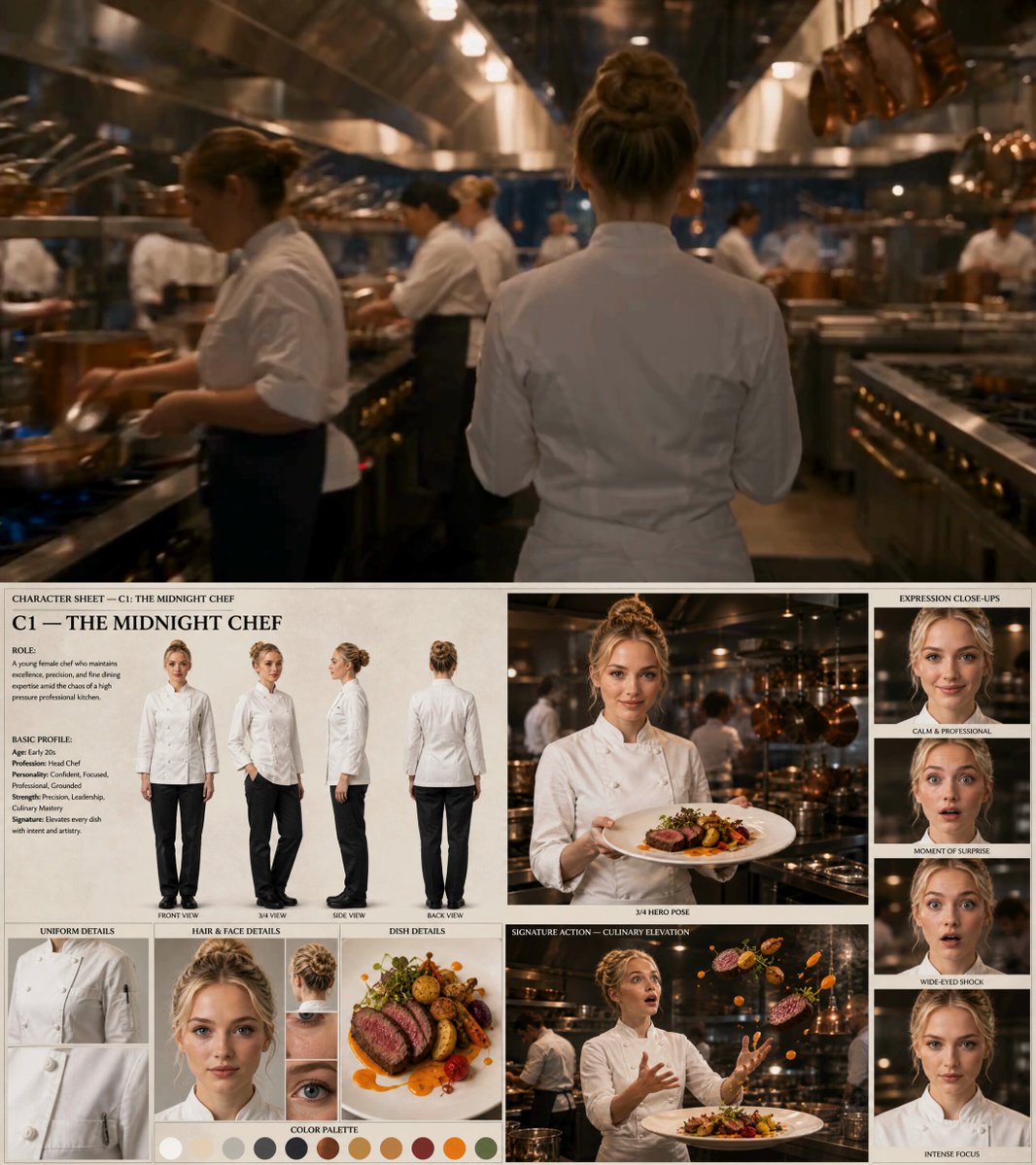
If you plan a series, invest early in a character sheet: front, three-quarter, and profile views, plus two or three expressions. This asset pays for itself across every future episode and prevents the slow drift that makes recurring characters feel like strangers by episode five.
Also decide your rules for voice. A consistent synthetic voice with consistent pacing builds recognition faster than an expressive but different voice in every video.
Choosing Tools Without Getting Locked In
Tool choice matters less than workflow, but a few criteria separate comfortable setups from frustrating ones:
- Control over the first frame. Image-to-video support with reference images is close to essential for any recurring subject.
- Output resolution and aspect ratio options. Vertical for social, widescreen for teaching, square for some platforms.
- Licensing clarity. Know whether you can use output commercially and how generated likenesses are handled.
- Iteration cost and speed. A slightly weaker model that returns results in thirty seconds often beats a superb model that takes ten minutes, because iteration is where quality comes from.
- Export formats and captions. SRT export, clean audio stems, and no watermarks on paid plans.
Test new tools on a real small project rather than a demo. Two hours with your own content tells you more than any feature list.
Common Mistakes and How to Avoid Them
Overwriting the prompt. Seven clauses of description produce mush. Start minimal, add one element at a time.
Ignoring audio until the end. Music and sound design change pacing decisions. Temp in a track early.
Uniform shot length. Vary it deliberately. Long, short, short, long is a rhythm; all-equal is a metronome.
Trusting text rendering. On-screen text generated by video models is frequently malformed. Add titles and labels in the editor.
Skipping the edit. The generator is a camera, not an editor. Weak AI clips cut tightly against strong music frequently outperform beautiful clips left long.
No naming convention. Download folders fill with hundreds of files called output_final_2. Rename on export using scene and shot numbers, or you will lose the good take.
Publishing, Accessibility, and Review
Publish with captions, a transcript, and a descriptive title. Transcripts improve search visibility and make content usable in study settings.
For educational material, check institutional policy on synthetic media disclosure. Many schools and universities now expect a brief note that visuals were generated. A single line in the description satisfies this in most cases and builds trust rather than eroding it.
For entertainment, check platform policies on synthetic likeness and disclosure requirements. Rules differ and change; verify before publishing rather than after a takedown.
Frequently Asked Questions
How long does a two-minute video take? With a prepared script and shot list, expect three to six hours for a first pass and one to two hours for revisions. The script and storyboard stage is where time is saved.
Can I use AI video for graded coursework? That depends on your institution's policy. Disclose generation, and treat the video as a presentation of your research rather than a substitute for it.
Why do my characters change between shots? Almost always because each shot was generated from text only. Switch to image-to-video with a single locked reference and repeat descriptors verbatim.
Is synthetic narration good enough for teaching? For scripted explanation, yes, if the script is written for speech. For motivational or highly emotional delivery, a human voice still wins.
How do I keep a series visually consistent? Write a style block and a character sheet once, store them, and paste them unchanged into every prompt. Consistency is a process, not a model feature.
What about long videos? Generate short, coherent sequences and edit them together. Chasing a single long generation usually produces drift and wasted attempts.
A Short Checklist Before You Export
Confirm the opening two seconds contain motion or a question. Confirm every shot length was chosen, not defaulted. Confirm captions are burned in or attached. Confirm text overlays were added in the editor, not generated. Confirm the audio is mixed so narration sits clearly above music. Confirm the file is named, the prompt log is saved, and the style block is stored for the next project.
Run that list once and you have a video. Run it twenty times and you have a production system that serves classrooms, clients, and audiences without starting from zero each time.
