
Why character consistency is the real bottleneck in AI video
Generative video models have become remarkably good at producing a single beautiful shot. Give a text prompt to a modern model and you will often get convincing skin texture, believable motion blur, and lighting that feels cinematic. The trouble starts on the second shot. The face shifts. The jawline widens. The hair color drifts from auburn to copper to something closer to brown. By the fourth or fifth scene, the character you carefully described has quietly become a different person wearing similar clothes.
This problem is called character drift, and it is the single biggest obstacle between a collection of impressive clips and an actual narrative. Audiences forgive stylized visuals, imperfect lip sync, and slightly artificial motion. They do not forgive a protagonist who changes face between cuts. Continuity is the invisible scaffolding that lets viewers relax into a story, and once it breaks, attention snaps to the mechanics of the production instead of the emotion of the scene.
Text-to-video alone struggles here because language is a lossy format for identity. A phrase like "a woman in her thirties with sharp cheekbones and wavy dark hair" leaves enormous room for interpretation. Every new generation samples a slightly different point in that space. Multi-image fusion solves the problem by giving the model something far more specific than words: visual anchors that pin down identity across every frame you generate.
This guide walks through the full workflow, from building a character reference set to constraining motion without freezing expression, plus the decision criteria and troubleshooting checks that separate a usable pipeline from a frustrating one.
How character drift actually happens
Before fixing drift, it helps to understand where it comes from. Drift is rarely a single bug. It is the accumulation of small sampling decisions that compound over a sequence.
Prompt sensitivity
Text encoders are highly sensitive to token changes. Swap "walking" for "striding," change the camera angle from "low" to "medium," or add a new prop, and the attention weights inside the model shift. Those shifts ripple into facial features, because the model has no separate memory slot for identity. Everything is entangled in one conditioning signal.
Scene context leakage
When you describe a new environment, the model absorbs environmental cues into the subject. A rainy street scene adds wetness and cooler skin tones. A warm interior pulls the whole palette toward amber. Over several shots, the character's apparent complexion and hair tone follow the lighting of the room rather than staying fixed.
Seed and sampling variance
Even with an identical prompt, a different random seed produces a different face. Some creators try to lock a single seed across all shots, which helps slightly, but it also flattens variety in pose and motion. You end up with a character who looks the same but moves like a mannequin.
Motion model interference
Image-to-video stages introduce their own drift. A model that is excellent at animating cloth and hair may slightly re-sculpt a nose or chin while doing so. Stack several motion passes and the cumulative error becomes visible.
Spotting drift early
Watch for these signals in your first review pass:
- Eye spacing and eyebrow shape changing between shots.
- Hairline position creeping up or down.
- Skin tone becoming warmer or cooler depending on the scene.
- Age shifting by several years across a short sequence.
- Wardrobe details that mutate, such as a collar losing its shape or a jacket gaining a zipper.
Catching these at the keyframe stage costs minutes. Catching them after a full animation pass costs hours.
The multi-image fusion approach, explained
Multi-image fusion means conditioning generation on several reference images of the same character rather than a single portrait or a text description alone. The model extracts a shared identity signal from the group and applies it to new scenes.
What identity anchoring means in practice
Think of identity as a set of stable invariants: the geometry of the face, the relationship between eyes and brow, the shape of the mouth at rest, the way hair parts. A single reference image captures those invariants from one angle under one lighting setup. Several images capture them from multiple angles and expressions, so the model can separate what is constant from what is incidental.
A useful analogy is a police sketch versus a photo set. A sketch is one interpretation. A photo set from several angles lets anyone recognize the person in a crowd.
Why more references are not automatically better
Adding references helps until the set becomes contradictory. If half your images show a character with long hair and half show short hair, the model averages them into an unstable hybrid. The goal is a coherent set with deliberate variation in pose and lighting, not a random folder of everything you have.
Text still matters
Multi-image fusion does not replace prompts. It changes their job. Instead of using text to describe the face, you use text to describe action, camera, mood, and environment. Identity comes from images; direction comes from language. Keeping those roles separate makes both more reliable.
Building a reusable character reference set
A strong reference set is the highest-leverage investment in the entire workflow. Build it once, reuse it across every project that features the character.
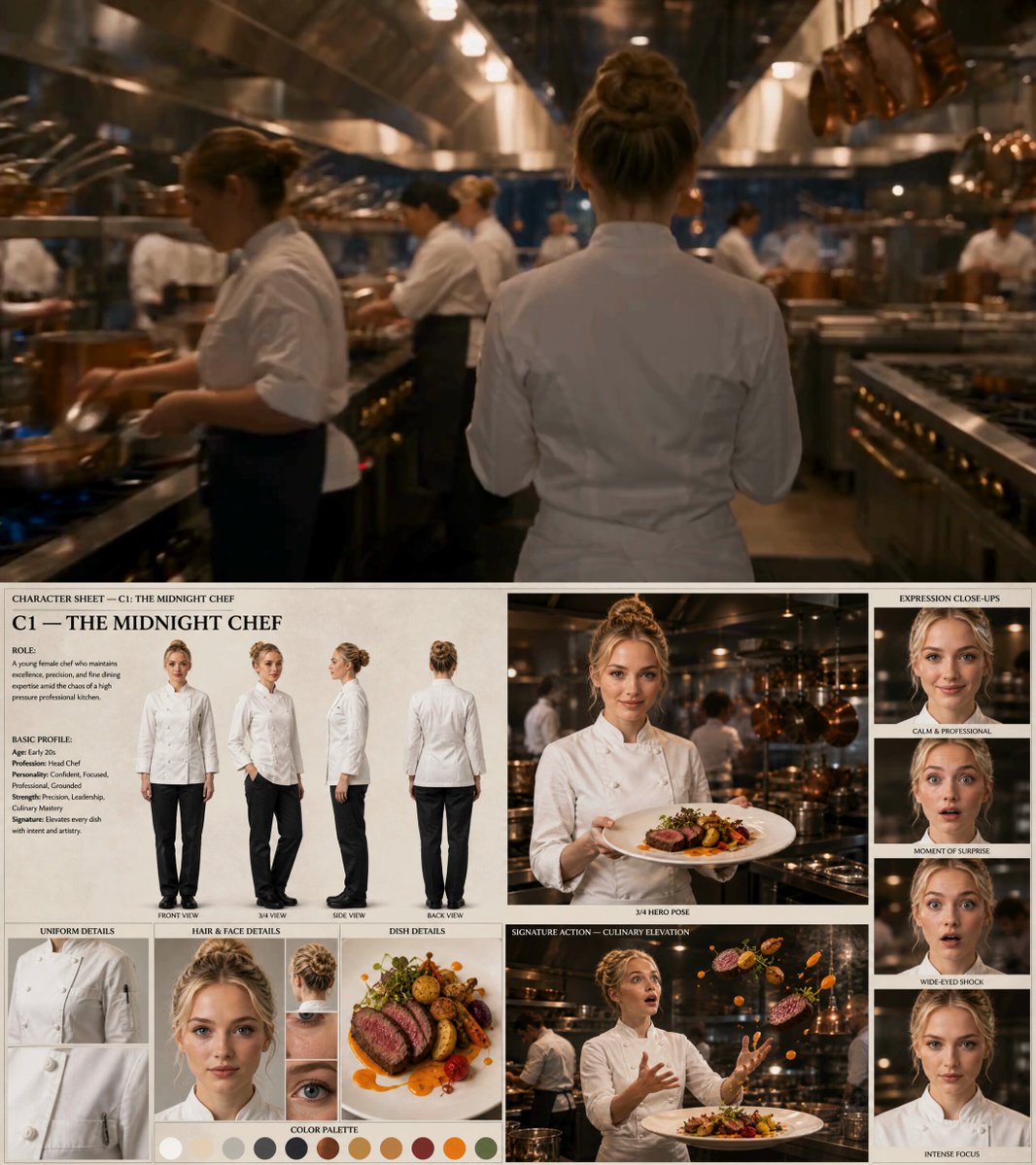
Shoot list for a baseline set
Aim for eight to twelve images that cover:
- A neutral frontal portrait with even lighting.
- A three-quarter view from each side.
- A profile view from each side.
- A slight upward angle and a slight downward angle.
- Two or three emotional states: calm, smiling, intense.
- A full-body or waist-up shot for proportions and wardrobe.
If you are generating the reference set with an image model, keep the same seed family and iterate on pose rather than restarting from scratch each time. Consistency in your own references compounds into consistency in your video.
Lighting and expression coverage
Include at least one soft-light and one harder-light reference. This teaches the model how the face behaves under different illumination, which reduces the temptation to reinvent features when a scene calls for dramatic light. Similarly, include a closed-mouth and an open-mouth expression so the model understands how the jaw and cheeks move.
Resolution and cropping
Keep faces large in frame. A tiny face in a wide landscape gives the model very few pixels to learn from. Crop tighter than you think you need, then let the composition of the final shot come from the camera prompt.
Common mistakes when gathering references
- Wildly different ages. Mixing a youthful photo with a mature one creates a character who looks permanently uncertain.
- Inconsistent grooming. Beards, glasses, and hairstyle changes should be treated as separate character variants.
- Heavy filters. Beauty smoothing removes exactly the micro-details that make a face recognizable.
- Busy backgrounds. Cluttered backgrounds leak into the identity signal. Use plain or softly blurred settings.
A practical workflow from reference sheet to finished sequence
Here is a repeatable pipeline you can run for a short film, a product story, or a social series.
Step 1: Write a character bible
Before generating anything, write one page describing the character. Include age range, build, hair, wardrobe, signature accessories, posture, and emotional register. This is not for the model; it is for you. Every creative decision later should be checkable against this document.
Step 2: Generate keyframes before motion
Produce a still image for each shot using your reference set. Review all keyframes side by side as a contact sheet. This is where drift is cheapest to fix. Ask a simple question for each frame: would a viewer recognize this as the same person from the previous frame? If the answer is anything less than an immediate yes, regenerate before moving on.
Step 3: Constrain motion, not identity
When you animate a keyframe, use the still as the visual anchor and describe only the movement, camera behavior, and pacing. For example: "slow dolly in, she turns her head to the left, hair moves gently, subtle breathing." Avoid re-describing her appearance. Repeating identity language invites the model to re-interpret the face.
Step 4: Keep shot lengths modest
Long continuous generations accumulate drift. Two to four second shots that cut together give you more control and more chances to correct. If you need a long take, generate it in segments and stitch.
Step 5: Assemble and run a drift audit
Edit the sequence, then watch it twice at normal speed and once frame by frame at every cut. Mark any shot where identity wobbles. Regenerate only those shots, keeping everything else locked.
Step 6: Build a library
Save your reference sets, prompts, and settings with descriptive names. Reusing a proven character package across episodes is where the workflow pays off, because a new script becomes a matter of action prompts rather than identity reconstruction.
Choosing the right tool for the job
Not every model handles multi-image conditioning equally well, and the differences matter more than marketing comparisons suggest.
Evaluation criteria
- Reference count. How many images can the model accept, and does quality degrade with more?
- Identity weight. Can you control how strongly the reference set influences output?
- Motion quality. Does animation preserve facial geometry, or does it subtly re-sculpt?
- Shot length stability. How long before drift becomes visible?
- Style transfer. Can the model hold identity while changing art direction?
- Iteration speed. Fast drafts matter more than final-render quality during blocking.
A simple test protocol
Generate the same character in five different scenes: a bright exterior, a dim interior, a close-up, a full-body shot, and a profile turn. Compare identity retention across all five. A model that holds up across that spread is a better foundation than one that wins on a single glamour shot.
Mixing models across a pipeline
It is entirely reasonable to keyframe with one model and animate with another, as long as you verify that the animation stage does not alter the face. Test this with a single clip before committing a whole sequence.
Continuity tactics beyond the face
Identity is more than a face. Audiences track wardrobe, props, and environment as part of the same continuity contract.
Wardrobe as a signature
Pick one or two defining garments and keep their color, cut, and texture stable. A consistent jacket reads as identity even in wide shots where the face is small. Save wardrobe changes for deliberate story beats.
Props and hands
Hands are notoriously unstable in generated video. Keep props simple, keep hand actions brief, and avoid complex manipulation in close-up unless the model has demonstrated reliability.
Environmental logic
If a scene is set at dusk, the next shot in the same location should not be midday unless time has passed. Track light direction, not just color. A character lit from the left in one shot and the right in the next feels wrong even if viewers cannot articulate why.
Eyeline and screen direction
Maintaining a consistent eyeline across coverage keeps a conversation readable. If your character looks frame-left when speaking to someone, they should continue to look frame-left when the camera cuts to them.
Troubleshooting the most common consistency failures
The face changes only in motion
This usually means the animation stage is re-interpreting the still. Reduce motion complexity, shorten the clip, or lower the influence of any stylistic motion prompt.
The character looks younger or older between shots
Age drift often comes from lighting and lens language. Soft, diffused light reads younger; hard, directional light with visible texture reads older. Normalize your lighting descriptions across shots in the same scene.
Skin tone shifts with the environment
Add a reference image with neutral lighting and describe skin explicitly as unaffected by colored light. Warm and cool rim light can stay, but the base tone should hold.
Hair changes shape or volume
Hair has no fixed geometry, so models improvise. Lock the hairstyle in your reference set and keep motion prompts gentle. Avoid strong wind effects unless you are willing to regenerate.
The character looks right alone but wrong opposite another character
Two-character scenes stress identity conditioning. Generate each character separately first, then bring them into a shared frame with both reference sets attached. If the model cannot handle two identities, use over-the-shoulder coverage and cuts rather than a single wide shot.
Everything drifts after several successful shots
This is cumulative error. Break the sequence into smaller blocks, reset with a keyframe that matches your reference set, and re-anchor before continuing.
Quality control checklist before you publish
Run this list on every project:
- Contact sheet review of all keyframes side by side.
- Drift audit at every cut, frame by frame once.
- Wardrobe and prop continuity verified across scenes.
- Lighting direction tracked within each location.
- Reference set saved with prompts and settings for reuse.
- Two-character scenes checked separately for identity bleed.
- Final watch at normal speed with sound, since audio masks small visual inconsistencies.
FAQ
How many reference images do I really need?
Six to twelve well-chosen images are typically enough. Coverage across angles and expressions matters far more than raw count. Beyond that, contradictory references can hurt more than help.
Can I keep a character consistent across different visual styles?
Yes, up to a point. Identity and style are separable if the model supports style control. Expect some loss of likeness when you push toward highly stylized art directions, so generate a few test frames before committing to a full sequence.
Is a fixed seed enough on its own?
No. A fixed seed helps stabilize sampling but does not encode identity. Multi-image references plus a locked seed is a stronger combination.
Should I describe the face in my prompts?
Only minimally. Let the reference images carry identity and use text for action, camera, and mood. Repeating detailed facial descriptions tends to fight the references.
How do I handle a character who must age or change appearance?
Treat each stage as a separate reference set. Build a young version and an older version, then generate the transition shots deliberately rather than letting drift do it accidentally.
What is the fastest way to improve consistency today?
Build a proper reference set and start keyframing before animating. Most consistency problems disappear at the still-image stage, where iteration is cheap and feedback is immediate.
Putting it all together
The gap between a demo clip and a watchable story is almost always continuity. Multi-image fusion gives you a practical way to hold a character's identity steady while the scene, camera, and emotion change around them. The workflow is not complicated, but it is disciplined: build a coherent reference set, lock identity at the keyframe stage, describe motion rather than appearance, audit every cut, and save your character packages for reuse.
Do that consistently and the technology stops being the story. Viewers stop noticing the seams and start following the character, which is exactly where you want their attention.
