
Why Character Consistency Is the Hardest Problem in AI Video
Anyone who has generated more than a handful of clips has met the same wall. A character looks perfect in shot one, then returns in shot two with a slightly different jaw, a different nose, a different apparent age. The performance may be fine, the lighting gorgeous, and the camera move exactly what you wanted, yet the scene collapses because the audience stops believing it is watching the same person.
This is not a cosmetic problem. In a feature, a recast between scenes would be a catastrophe. In a short film, the audience has even less time to build a mental model of who they are watching, so drift becomes obvious almost immediately. Ten minutes of runtime with twenty or thirty shots gives a viewer plenty of opportunities to notice that your lead has quietly morphed into a cousin.
The root cause is that generative video models do not store a character. They sample from a distribution of plausible faces, guided by whatever conditioning you provide. A text prompt describing a woman in her thirties with dark curly hair and a scarred eyebrow describes a category, not a person. Even a seed value only fixes the randomness of one generation run, not the identity across a whole sequence of prompts, camera angles, and motions.
That is why consistency has become the defining craft problem of AI filmmaking. Motion quality, resolution, and render speed have all improved dramatically, but identity retention across a shot list still separates a watchable short film from a demo reel. Multi-image fusion is the most practical answer available today, and understanding how it works will change how you plan, shoot, and edit.
What Multi-Image Fusion Actually Does
Multi-image fusion changes the input side of the problem. Instead of conditioning a video model on a single reference image, you supply a curated set of images of the same character from multiple angles, expressions, and lighting conditions. The pipeline encodes each image into a representation of identity, then fuses those representations into one conditioning signal that steers every generated frame.
The mental model that helps most is casting. A single headshot gives a model one data point and lots of unknowns. What does the back of the head look like? What is the profile? How does the face change when the character laughs or frowns? Fusion answers those questions in advance, so the model is not forced to invent the answers differently in every shot.
It helps to separate three things that are often confused:
- Text conditioning describes attributes in words. Useful for wardrobe, mood, and action, weak for exact faces.
- Image conditioning anchors appearance. A single reference is a strong starting point but ambiguous in the dimensions the photo does not show.
- Multi-image fusion builds a fuller identity prior by combining several references, usually with a weighting or attention mechanism that decides which features dominate.
Two practical consequences follow. First, reference quality matters more than reference quantity. Twelve mediocre, inconsistently lit photos can produce a mushier identity than five clean ones. Second, fusion is not a magic lock. If your references contradict each other, the model averages the contradiction into a face that looks like nobody in particular. Curating a reference set is a design decision, not a data dump.
Building a Reference Set That Works
The reference pack is the single highest-leverage asset in an AI short film. Treat it like a casting package you would hand to a costume department, not a folder of random generations.
Angles and coverage
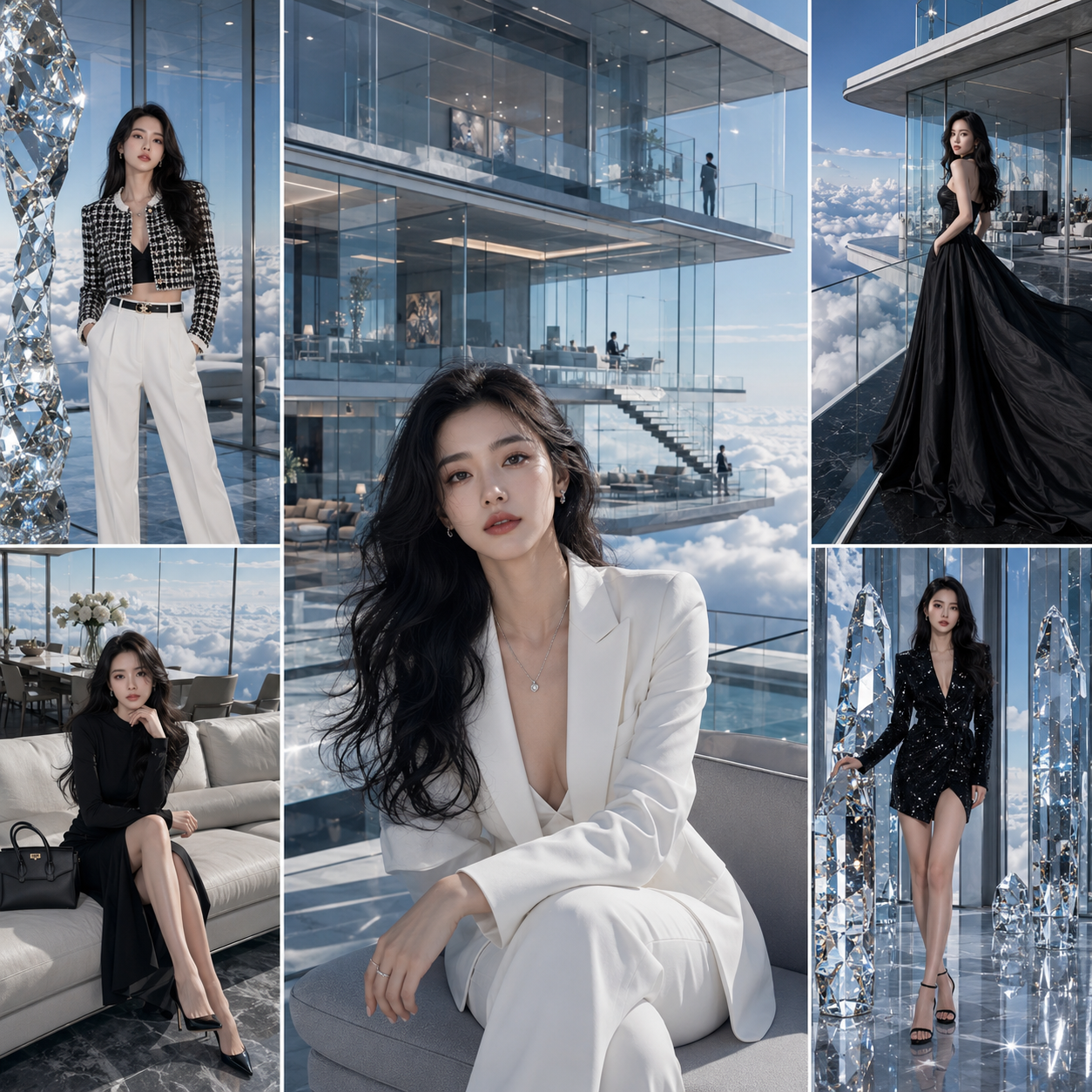
Start with a canonical front view in neutral light, eyes to camera. Add three-quarter views from both sides, a true profile, and at least one shot from behind or over the shoulder. That set answers the geometry questions that cause the worst drift: how wide the face is, where the hairline sits, how the ears read, how the neck meets the jaw.
Lighting and color
Keep the pack internally consistent. Mixed color temperature between references teaches the model that your character changes skin tone, which then shows up as flicker between shots. If your film is graded cool and moody, decide that once and apply it to the reference pack, the prompt language, and the edit. If you plan a strong stylistic look, bake it into the references rather than hoping post-production will unify mismatched footage.
Expression and wardrobe
A neutral expression plus two or three emotional extremes, such as a laugh and a tense close-mouthed look, gives the model somewhere to go without inventing a new face for every emotion. Wardrobe is best handled as a separate layer: decide whether the character wears one outfit for the whole film or several, and if several, produce a clean reference for each look so costume changes read as intentional rather than as identity failure.
What to leave out
Exclude anything low resolution, heavily compressed, watermarked, or distorted by an extreme lens. Avoid references containing two people, because the model may fuse features from both. Avoid contradictory hairstyles or ages unless the script genuinely requires a transformation. And avoid references where the face is partly hidden by hands, hair, or heavy shadow, since the encoder will treat that occlusion as permanent information.
A workable target is six to twelve images at a minimum of roughly a thousand pixels on the short side, all facing the same direction in terms of style, all showing the same person at the same apparent age.
A Step-by-Step Workflow for a Short Film
Step 1: Write a character bible
Before generating anything, write down age range, build, hair, wardrobe, distinguishing marks, and one or two behavioral traits. This document is what keeps a team aligned and what you will compress into anchor phrases later.
Step 2: Cast the face
Generate or photograph candidate faces until one lands. Do not rush this step. Every hour spent here saves several hours of re-rendering later, because a strong hero image makes every downstream reference easier to produce.
Step 3: Expand into a reference sheet
Use image variation, inpainting, or a controlled image-to-image pass to build additional angles from the hero image. Keep the model and settings consistent across the sheet so the only variable is the camera angle.
Step 4: Normalize the pack
Crop tight, match exposure and color, and remove distracting backgrounds if your tooling allows. Consistent framing across references helps the fusion step weight features sensibly instead of reacting to background clutter.
Step 5: Save an identity profile
Most fusion-capable pipelines let you store the fused identity so it can be reused. Name it clearly and version it. Something like lead-female-v03 communicates more than final-final-2.
Step 6: Run a three-shot pilot
Before committing to a full production, test the identity in a wide shot, a medium shot, and a close-up, plus one shot with movement. Close-ups expose drift fastest, and any motion that turns the head will reveal whether the model has a stable understanding of the profile.
Step 7: Lock the pack
Once the pilot passes, freeze it. Changing references midway through a shot list is the fastest way to create a visible continuity break in the middle of a scene.
Step 8: Change only when the script demands it
Aging, injury, or a deliberate disguise can justify a new pack. Note the version in your shot log so the change is a choice rather than an accident.
Prompting and Shot Design Around a Locked Identity
Once identity is conditioned, your prompts should stop describing the face. Describe action, intention, camera, and environment. Repeating facial detail in the prompt competes with the fusion signal and often pushes the result toward a generic version of the description rather than the specific character you locked.
Useful anchors are short and stable: a name, a wardrobe item, one signature detail. Then spend your prompt budget on what the shot needs to do dramatically. A line like slow push-in as she reads the letter and her expression hardens gives the model a performance, while the fusion profile supplies the face.
Shot design matters more than most people expect. If identity is fragile, cover the scene with inserts, over-the-shoulder framings, hands, and silhouettes, and reserve full-face close-ups for the moments that need them. This is normal film grammar, not a workaround, and it reduces the number of high-risk generations you need to get right.
Motion is where identity often breaks. Rapid head turns, violent camera shake, and heavy occlusion all force the model to synthesize unseen angles quickly, which is when morphing appears. Slower, motivated movement keeps the face readable and gives the fusion conditioning room to hold.
Continuity also means light. If shot one is lit by a window on the left and shot two puts the key on the right, viewers read the change as a different scene. Track key direction, color temperature, and lens feel per scene, and reuse that language in every prompt for that scene. Finally, keep a reference frame for the first frame of each shot whenever your tool supports image-to-video. A strong starting frame does more for identity than any adjective.
Common Failure Modes and How to Fix Them
Face drift between shots
Tighten the reference pack, raise the consistency strength if the tool exposes it, and shorten the prompt so it stops fighting the fusion signal. Also check that all references show the same apparent age.
Identity bleed between two characters
Never put two characters into the same reference image, and keep their profiles strictly separate. When they share a frame, generate them in separate passes and composite, or accept a wider shot where the details are less scrutinized.
Melting during motion
Shorten the clip, slow the movement, reduce the amount of the face that rotates away from camera, and anchor the first frame with a clean still. Regenerating a shorter segment is usually faster than trying to repair a long broken one.
Costume confusion
Wardrobe drift often looks like identity drift. Build a separate wardrobe reference for each look and combine it with the identity profile, rather than expecting the identity pack to carry clothing information it never contained.
Plastic, over-smoothed skin
If the result looks airbrushed, ease off any beauty or stylization strength, add grain or texture in post, and check whether your references are themselves over-processed. The model reproduces the texture it is shown.
Style clash across scenes
Style drift is a discipline problem. Pick a look, apply it to the reference pack, and describe it consistently. Changing style language between scenes will make the same face read as a different film, even if the identity holds.
Choosing Tools and Decision Criteria
Tools change quickly, so evaluate capabilities rather than brand names. Ask the following questions before committing a project to a pipeline.
- How many reference images can it accept, and does it actually fuse them or just use the first one? A tool that silently ignores extra references will waste your preparation.
- Is there a consistency or identity strength control? You want a dial, not a binary.
- What is the maximum clip length and does longer output stay coherent? Identity often degrades toward the end of long generations.
- Can you fix the first frame? Image-to-video conditioning is one of the most reliable identity anchors available.
- How expensive is iteration? You will discard most generations. A cheaper model that lets you run twenty takes can beat a premium model that allows three.
- What are the licensing and commercial terms? Especially relevant for client work.
- Does it fit your hardware reality? Local generation offers control and privacy; hosted services offer speed and lower setup cost.
A sensible default stack is an image generator for building the reference sheet, a fusion-capable video model for shots, and an upscaler plus a compositor for finishing. Test any new combination with a three-shot pilot before you build a pipeline around it.
Scaling Consistency Across a Full Production
When a project grows past a few shots, process beats talent. Create a folder per character containing the locked reference pack, the character bible, and the version history. Keep prompts in a shot log alongside the generated file names so you can trace what produced a good take.
Build a continuity sheet per scene listing wardrobe, key light direction, time of day, and any props that must persist. Before upscaling anything, watch the whole cut at low resolution. Drift is much easier to spot in motion at small size than in a static high-resolution frame, and catching it early saves rendering time.
Assign one person to own identity lock. On teams, drift usually appears when two people generate the same character from slightly different references. A single owner for the pack, with changes documented, prevents most of it.
Finally, remember that sound carries continuity. Consistent dialogue tone, room ambience, and a recurring musical motif can bridge a shot that is visually slightly off. Editors have used this trick for a century, and it works just as well with generated footage. Cut on motion, keep close-ups short when they are weakest, and let the audience fill gaps with the performance you have built.
FAQ
Do I need real photographs of a person?
No. Fully synthetic reference packs work well, provided the images are internally consistent in style, lighting, and apparent age. What matters is coherence, not origin.
How many reference images are enough?
For most characters, six to twelve well-chosen images cover front, three-quarter, profile, and back views. Adding more only helps if the new images add genuinely new information.
Can a single reference image work?
It can, but expect more drift, especially in profile and from behind. A single reference is a starting point, not a lock.
What if two characters appear in the same shot?
The safest approach is to generate each character separately using their own profile and composite the results, or to frame the shot wide enough that fine facial detail is not the point.
Does multi-image fusion work for stylized animation?
Yes, as long as the stylization is consistent across the reference pack. Mixing a photorealistic reference with a cartoon reference produces an averaged look that matches neither.
How do I rescue one shot that drifted?
Return to the locked pack, regenerate with the same settings and a cleaner first frame, shorten the clip, and reduce head rotation. Repairing a single shot is far cheaper than rebuilding the pack.
Do I need an expensive workstation?
Not necessarily. Hosted pipelines handle the heavy lifting, and a mid-range machine can manage reference preparation, compositing, and editing. Local generation is a control and privacy choice more than a requirement.
How long does the workflow take?
Expect the reference pack and pilot to consume the largest share of setup time, often a few hours for a lead character. Once locked, each shot becomes a matter of prompt iteration and review, which is where a disciplined shot list pays off.
