
Why the First Three Seconds Decide Everything
Short-form feeds are not a stage. They are an auction. Every time a viewer opens a feed, dozens of clips compete for the same half-second of attention, and the viewer's thumb is already moving before your logo, your intro, or your carefully written opening line has a chance to land.
This is the practical reality behind hook and reel strategy. A hook is not a gimmick bolted onto the front of a video. It is the load-bearing wall of the entire piece. If the hook fails, nothing else matters — not the lighting, not the edit, not the script you spent two days refining. The clip simply disappears into the scroll, and the algorithm quietly notes that people are not staying.
Retention data across short-form platforms tells a consistent story. A significant portion of viewers decide whether to keep watching within the first two to three seconds, and the most dramatic drop-off happens almost immediately. The retention curve of a successful short looks like a steep cliff followed by a long, gently sloping plain. The retention curve of a failed short looks like a cliff with nothing after it.
What makes this manageable rather than terrifying is that hooks are a craft, not a personality trait. They can be studied, templated, tested, and improved. And with modern AI-assisted production tools, the cost of producing five hook variants instead of one has dropped far enough that systematic testing is now realistic for solo creators, not just studios.
This guide walks through the whole chain: how hooks work psychologically, how to script everything that comes after them, how to use AI production tools without flattening your voice, how each platform changes the edit, and how to decide whether a hook actually performed or just felt good.
What a Hook Actually Does — and What It Doesn't
A hook has three jobs, and confusing them is one of the most common reasons a clip underperforms.
The three jobs of a hook
Stop the scroll. The first job is mechanical. Something in the first frame — motion, contrast, a face, unexpected text, a visual anomaly — has to interrupt the automatic swipe pattern.
Set an expectation. The second job is directional. Within a second or two, the viewer should understand what kind of video this is and what they will get if they stay. Ambiguity is not intrigue; it is a reason to leave.
Create an open question. The third job is emotional or cognitive. The viewer needs a small unresolved tension that only the rest of the video can resolve. That tension can be curiosity, amusement, recognition, mild discomfort, or the anticipation of a payoff.
Hooks that oversell and lose trust
A hook can succeed at stopping the scroll and still damage the channel. Overpromising — "this changed everything," "nobody talks about this," "the truth they hide from you" — pulls viewers in but produces a specific kind of disappointment when the payoff is thin. The viewer may finish the clip, but they will not follow, save, or return. Over time, an account built on exaggerated hooks develops a reputation for noise rather than value, and the audience that stays is the audience least likely to convert into anything meaningful.
The practical rule: your hook should be the most interesting true thing about the video, not a lie you have to spend thirty seconds walking back. If the honest version of your hook feels weak, the problem is usually upstream, in the idea itself.
Hook Patterns You Can Adapt to Almost Any Niche
Rather than inventing a hook from scratch every day, build a small personal library of patterns and rotate through them. The patterns below work across education, product, fitness, food, finance, travel, and entertainment content.
| Pattern | Structure | Best For |
|---|---|---|
| Mid-action open | Start in the middle of the most kinetic moment | Demos, sports, cooking, craft |
| Contrarian claim | State the opposite of common advice | Opinion, expert commentary |
| Numbered promise | "Three reasons your X keeps failing" | Tutorials, listicles |
| Before/after flash | Show the end state, then rewind | Transformation, design, fitness |
| Direct question | Ask the exact question the viewer has | Problem-solving, service content |
| Visual anomaly | Something slightly wrong in frame | Storytelling, humor, curiosity |
| Negative framing | "Stop doing this if you want X" | Advice, habits, mistakes |
| Silent text hook | Bold on-screen text with no voiceover | Quiet feeds, muted autoplay |
Text hooks versus spoken hooks
Every short-form platform autoplays muted for at least some viewers, which means your text hook carries the full burden for a portion of your audience. Treat on-screen text as a first-class element: large enough to read on a phone at arm's length, on screen within the first frame, and never more than about six to eight words.
Spoken hooks matter for the viewers who do have sound on, and they follow slightly different rules. Speech is linear, so a spoken hook can afford a little more nuance. But it also cannot be buried under music, ambient noise, or a slow build. If the first sentence of your voiceover is throat-clearing, cut it.
The test for any hook idea
Before you produce anything, say your hook out loud and then ask three questions. Would this stop me if I were scrolling with no context? Does it promise something specific enough to be kept? Can I deliver it in the time I have? If any answer is no, iterate on the hook before you spend time on the rest of the video.
Retention Architecture: Scripting Everything After the Hook
The hook buys you a few seconds. Retention earns the rest. The most reliable way to hold attention is to treat the video as a sequence of small promises, each resolved just as the next one opens.
Open loops and re-hooks
A re-hook is simply a second hook planted partway through. On a twenty-second clip, place one around the six- to eight-second mark. On a sixty-second clip, expect to need two or three. Re-hooks can be a visual change, a tonal shift, a new question, an unexpected cut, or a verbal signal like "but here's the part that matters."
Open loops are what make re-hooks work. Instead of resolving everything at once, reveal information in an order that keeps a question alive. "You need three things" creates a loop that stays open until the third item lands.
Pacing and the second-by-second map
Write a simple timeline before you edit. Mark where the hook ends, where the first re-hook lands, where the main payoff arrives, and where the call to action sits. Then check your edit against it.
- 0–3s: hook, motion, on-screen text
- 3–8s: context or first insight, first re-hook near the end
- 8–20s: core value, visual variety, second re-hook if needed
- 20–35s: payoff, twist, or emotional resolution
- final 3–5s: single, low-friction call to action
The payoff must match the promise
The fastest way to lose an audience you just won is to under-deliver. If the hook promised a specific technique, show the technique. If it promised a mistake, name the mistake plainly. Vague endings — "and that's why you should always be learning" — read as filler and get punished with a swipe.
AI-Assisted Production Without Losing Your Voice
AI video tools have changed what a single creator can ship in an afternoon. They have not changed what audiences respond to, which is still specificity, personality, and clarity. Used well, AI handles the mechanical load so you can spend more of your energy on the hook and the script.
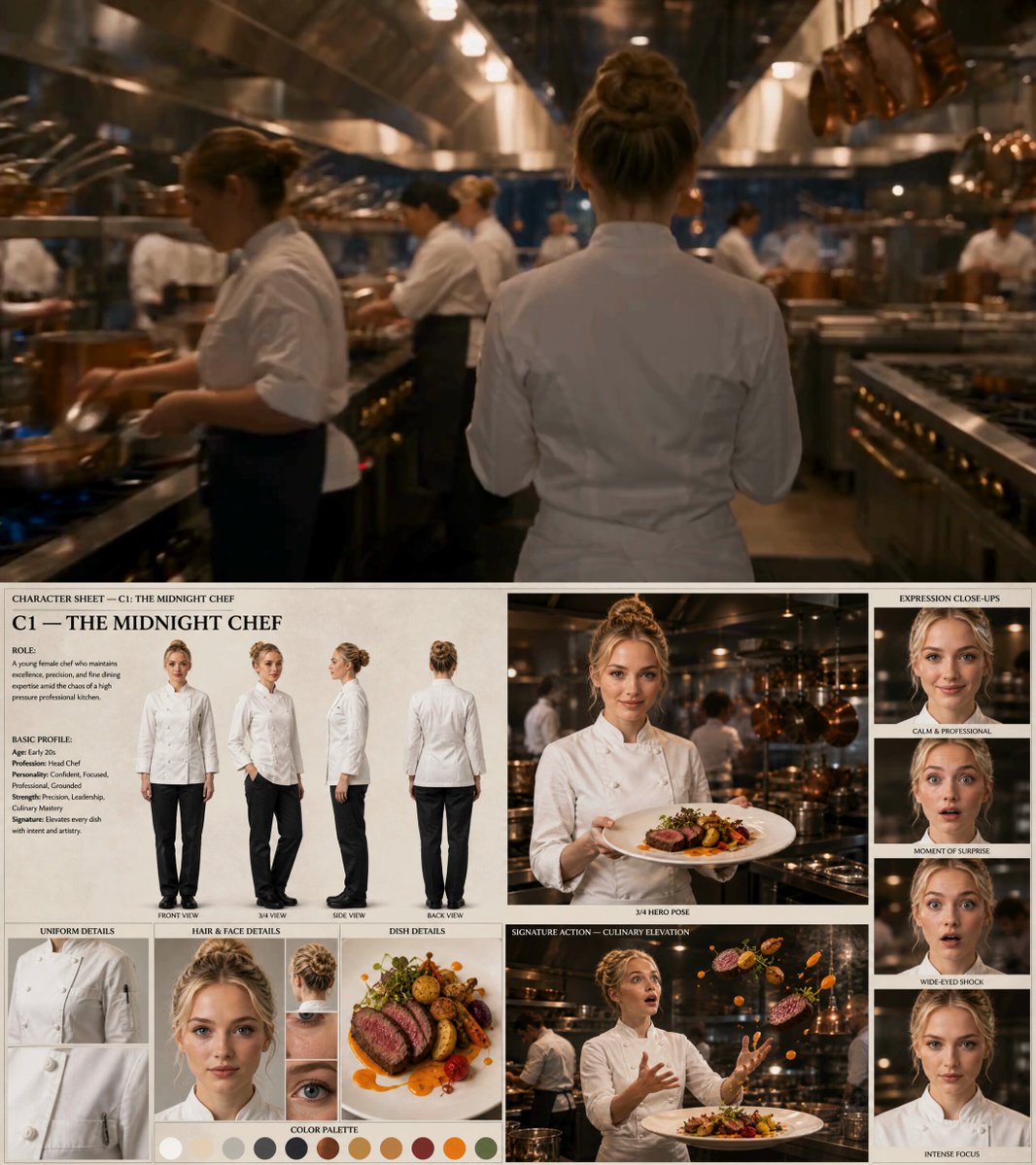
Keeping characters and visual style consistent
When you generate multiple shots, consistency is the hardest problem. A face that drifts between clips breaks immersion faster than imperfect lighting. Practical approaches that work:
- Build a written visual bible: character description, wardrobe, palette, lens feel, lighting direction.
- Reuse the same seed or reference image whenever the tool supports it.
- Generate a small batch of establishing frames first, approve one, and treat it as the anchor for everything else.
- Keep camera language consistent — if you establish a handheld feel, do not switch to a locked-off tripod look mid-scene without a reason.
Shot planning, storyboards, and B-roll
AI generation is at its best when it is not asked to invent the story. Write your shot list by hand, then generate. A useful schedule for a thirty-second clip is eight to twelve shots, most of them one to two seconds. That rhythm keeps visual energy high and gives the edit plenty of options when a generated shot does not hold up.
B-roll generated for texture and atmosphere is often more valuable than generated footage that tries to carry the narrative. Use AI for environments, motion overlays, product close-ups, and abstract transitions, and use real footage for anything that needs to feel unmistakably human.
Voice, captions, and sound design
Synthesized voice has improved dramatically, but it still benefits from direction: give the script punctuation that signals pauses, keep sentences short, and avoid technical vocabulary you would not say aloud. If you can record your own voice, do — it remains one of the cheapest differentiators available.
Captions are non-negotiable. Burn them in, keep them inside the safe zone, and avoid covering faces or key visual details. For sound, a simple structure works: a low bed of music for energy, a subtle accent on the hook, a soft transition sound on each cut, and a clean tonal shift at the payoff.
Platform-Specific Adjustments That Change the Edit
The same idea often needs a different edit on each platform. Plan for this at the script stage, not after you have exported.
| Platform | Typical Length | Key Adjustment |
|---|---|---|
| Reels | 15–45s | Strong visual hook, text-first, vertical framing, save-worthy payoff |
| Shorts | 20–60s | Slightly more explanation tolerated, strong title text |
| TikTok | 10–60s | Native tone, fast re-hooks, comment-baiting is risky |
| 30–90s | Slower pace, credibility framing, clear takeaway | |
| 15–60s | Aesthetic consistency, evergreen framing, text overlay heavy |
Two structural notes apply everywhere. First, safe zones differ and interface elements cover different parts of the frame, so keep the top and bottom edges clear of critical text. Second, silent autoplay is the default in many placements, so a clip that only works with sound is a clip that is losing a portion of its potential audience by design.
A practical habit: create one master edit with clean audio and no burned-in text, then export platform-specific versions from it. This keeps your archive organized and makes retrofitting a clip to a new platform a ten-minute job rather than a rebuild.
A Seven-Step Production Pipeline You Can Repeat
The value of a pipeline is that it lets you stop making decisions you have already made. Here is one that works for a solo creator shipping several clips a week.
- Idea capture. Keep a running list of questions your audience asks, mistakes you see, and moments that surprised you. Ideas come from friction, not brainstorming sessions.
- Hook-first scripting. Write five hook variants before writing anything else. Choose two to produce and keep the rest for a later test.
- Beat sheet. Map the timeline: hook, re-hook, payoff, call to action. Keep it under ten bullet points.
- Asset production. Record or generate footage against your shot list. Generate more than you need, especially for fast cuts.
- Assembly edit. Cut to the beat sheet first, without worrying about polish. Watch it once with the sound off.
- Polish pass. Captions, sound design, color, safe-zone check, and a final read of the text overlay for typos.
- Publish and log. Note the hook pattern, the length, and the first-24-hour retention. This log becomes your most valuable creative asset.
Step seven is the one most creators skip, and it is the reason so many accounts plateau. Without a log, you are guessing every week. With a log, patterns emerge within a month.
Testing Hooks Systematically Instead of Guessing
Hook testing does not require a big audience. It requires discipline about variables.
What to hold constant
When you test hooks, keep the body of the video identical. Change only the first two to three seconds. This isolates the variable you actually care about and makes the result readable.
Metrics worth tracking
- Three-second view rate — the cleanest signal of hook strength.
- Average watch time and completion — tells you whether the body delivers on the hook.
- Saves and shares — the strongest indicator of perceived value.
- Follows per thousand views — a proxy for whether people want more of this voice.
- Comment sentiment — read the first twenty comments; confusion means your hook promised something the video did not clearly deliver.
Decision criteria
A simple rule set works better than intuition. If three-second view rate is high and completion is low, your hook is strong and your body sags — rewrite the middle. If three-second view rate is low but completion is high among those who stay, your hook is the problem, not the content. If both are strong but shares are weak, the video is watchable but not useful or surprising enough to pass along.
Run tests in small batches and give each variant enough impressions to be meaningful. Two clips are an anecdote. Six to ten clips across the same hook pattern start to look like evidence.
Common Mistakes That Quietly Kill Retention
Most retention problems are structural, not stylistic. These are the ones that show up again and again.
Slow starts. Establishing shots, logo animations, and "hey guys, welcome back" openings are all borrowed from long-form and all cost you viewers in short-form.
Mismatched energy. A calm voiceover over frantic cuts feels broken. Decide on a tempo and commit to it across visuals, voice, music, and text animation.
Text overload. When every frame carries a full paragraph, the viewer stops reading and starts scrolling. One idea per title card.
No visual change. Even a strong script gets stale if the frame never changes. Plan a visual shift every one to three seconds.
Buried payoff. If the most interesting moment happens at the very end, move a hint of it to the first second. Show the result, then explain how you got there.
Generic calls to action. "Follow for more" is noise. "Follow if you want the second part" gives a reason.
Ignoring the first frame as a thumbnail. Many platform surfaces display your first frame as a static image. Choose it deliberately.
Chasing trends that do not fit. A trending sound or format only helps if it aligns with your topic and tone. Otherwise it reads as borrowed energy.
FAQ: Hooks, Reels, and AI Workflows
How long should a hook be? One to three seconds for the visual and first line of text combined. If your hook needs six seconds to make sense, it is a setup, not a hook, and the real hook is hiding inside it.
Do I need to show my face? No. Text-first hooks, hands-only demos, screen recordings, and generated visuals all work. Face-forward clips tend to build trust faster, but they are not a requirement for retention.
Is it acceptable to reuse the same hook structure repeatedly? Yes, and it is usually smart. Repetition builds recognition. Rotate among four or five patterns rather than using one exclusively.
How many clips should I test before changing strategy? Give a format at least ten to fifteen published attempts before judging it. Individual clips are noisy; patterns across a set are informative.
Where does AI genuinely help most? Ideation support, shot generation for B-roll, style-consistent imagery, captioning, voice synthesis for drafts, and rapid variant production. It helps least when it is asked to decide what the video is about.
What is the single highest-leverage change most creators can make? Cut the first second. Nearly every underperforming short starts one beat too late.
How important is the caption file? Very. Burned-in captions serve the muted viewer; platform caption files support accessibility and search. Do both when you can.
Can a strong hook save a weak video? Only in the short term. Hooks earn views; delivery earns an audience. The two have to work together, which is why the most effective workflow treats hook writing and body scripting as one continuous process rather than two separate tasks.
