

The Flicker Is the Story
Watch enough AI-generated video and you will notice the pattern. A single clip looks stunning. String several clips together and the magic leaks away: a jacket changes color between cuts, a face shifts profile, light swings across the scene for no reason. The individual frames are fine. The consistency between them is not.
This is the real frontier of AI video, and it is a harder problem than making a prettier frame. Anyone can chase resolution. What separates a usable production tool from a demo is whether a character and an environment stay recognizably themselves across seconds, scenes and different models. This article is about that problem: why it happens, and the production practices that actually keep things stable.
Two Kinds of Precision Being Confused
It helps to separate two very different things people mean by "pixel precision."
The first is fidelity: how sharp, detailed and realistic an individual frame is. This is what most benchmark demos celebrate. It matters, but a sharp frame is easy. A sharp frame that behaves consistently with the one before it is the actual art.
The second is temporal and spatial consistency: a given object or character keeps the same identity, color, texture and lighting as it moves. This is what makes a sequence feel like one world instead of a flickering mood board. It is the property that commercial work depends on, and it is the one that breaks first.
This article is mostly about the second kind.
Why Consistency Is So Hard
Generation models start from noise and render toward a prompt. Nothing intrinsically connects frame eleven to frame twelve. The model is guessing, richly, every time. When you ask it to show "the same hero," there is nothing in the prompt that pins down their eye color, the weave of their coat or how a scar sits on their cheek.
The failure modes are predictable:
- Character drift: the face subtly but recognizably changes identity.
- Texture slip: a shirt pattern or material morphs between edits.
- Light drift: the key light direction and warmth wander, making matched shots feel unrelated.
- Detail dissolving: small elements (buttons, logos, jewelry) come and go.
None of these show up in a single clip. All of them show up the moment you assemble footage, which is why novice projects fall apart in the edit and professional projects hold.
The Reference Set Is the Anchor
The single most reliable fix is to stop relying on words and start relying on images.
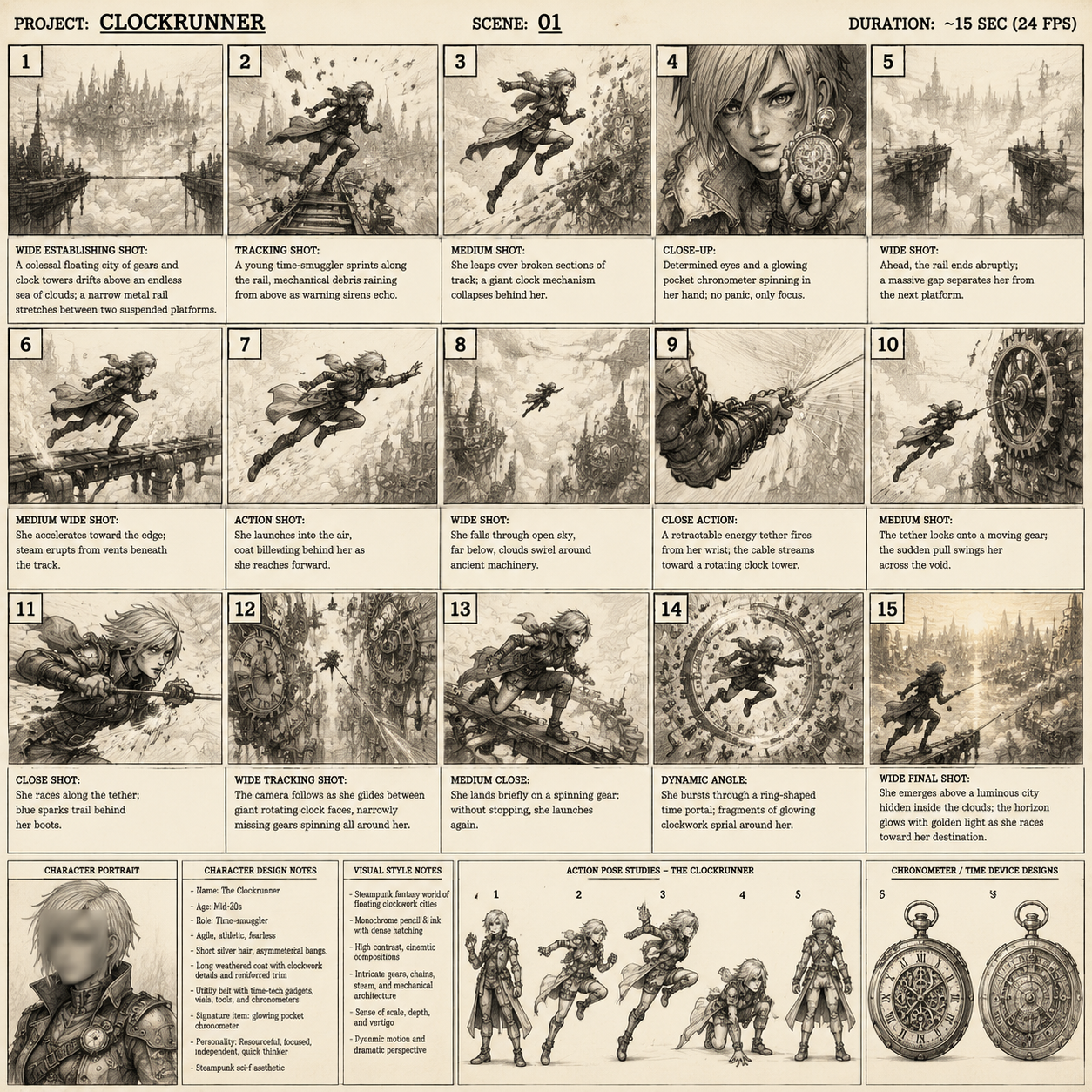
A description cannot hold a character's identity. A set of reference images can. Before you generate anything, build a small library of anchor shots for every recurring subject: a neutral front view, a three-quarter view, a profile, and close-ups that pin the important details — the eyes, the costume texture, the lighting direction. These images become the visual contract for the whole project.
Use the same reference set for every scene, even when you switch between different generation models for different shots. The anchor does the identity work; the model only interprets it. When a scene comes back feeling wrong, first check whether its references drifted, then regenerate against the shared set rather than improvising a new prompt.
Deciding the Look Before You Render
Consistency is as much a production decision as a technical one, and it has to be locked early, not discovered.
Define a small palette and a lighting direction before the first render. A character can be technically identical yet feel different because the light went somewhere else. Fixing the palette up front prevents the most common silent failure, the one where every clip is "correct" but the assembled video reads as random images.
The same goes for camera grammar. Decide whether a scene uses a locked tripod, a slow push-in or a handheld drift, and keep that grammar stable across a sequence. Camera intent is language; inconsistent camera use reads as amateur even when every frame is beautiful.
Visual DNA and the Value of Structured Details
The strongest productions encode the subject as something closer to a structured bundle of features than a prompt. In effect, they extract a "visual signature" from the reference set — the key proportions, colors, textures and elements that define the subject — and feed that signature into every scene alongside the prompt.
This has a huge practical payoff: you can change the style around the subject without losing the subject itself. Want the same character rendered realistically in one scene and stylistically in another? Keep the underlying signature stable and vary only the surrounding direction. That flexibility is what lets a series keep one hero across wildly different looks.
It also helps with scale. If your platform lets you save and reuse these signatures as reusable presets, build a library of them for your recurring characters, environments and products. Over a few projects, that library becomes one of your most valuable assets, because it makes your next production start several steps ahead.
Two-Tier Rendering to Protect Quality and Budget
Consistency is not just about the model; it is about how you spend your rendering budget across a pipeline.
The mistake is to run every experiment through the flagship model. Drafting should happen on a fast, economical tier, where you test composition, pacing and layout. Final-grade consistency work — the shots that carry the identity — is done on the premium tier, where you have the control and fidelity to lock it.
Locking the look during the cheap pass is what keeps the premium pass consistent. If you discover the costume is wrong at the final render, you have already spent irrecoverable budget. Confirm the identity in drafts, then spend premium only where identity and fidelity are non-negotiable.
Selective Re-Rendering Instead of Full Regenerates
When a shot does go wrong, the instinct is to regenerate everything. That is the expensive path, and it often introduces new drift.
A better pattern is to isolate the problem. If only a patch of fabric flickers, or an edge wobbles, address that specific region rather than discarding the whole clip. Tools in the family of frame interpolation and image editing exist precisely to patch local issues, and compositing in an editor can repair far more than people assume. The less you regenerate, the more stable the rest of the sequence remains, because you are not re-rolling dice you already won.
In practice I keep a small toolbox of specialized helpers: an interpolation tool to smooth motion, a frame-control model to pin the first and last frame of a transition, and an image editor to fix local artifacts. Each solves one narrow problem, and together they protect the assembled sequence without constant full regeneration.
What to Do About Output Quality Gates
Consistency is easiest to protect with an objective check rather than a vibe check. As you assemble footage, grade every accepted shot against a short checklist:
- Is the identity recognizably the same as the reference set?
- Does the palette and lighting match the locked look?
- Are small signature details (logos, textures, jewelry) present?
- Does the motion inherit naturally from the surrounding shots?
Failing any item means correcting that shot, normally by re-rendering locally or patching in the editor. Building this gate into your routine keeps consistency from quietly eroding over a long project.
The Role of an Authoring Step Between Idea and Render
Here is the shift most worth internalizing. Powerful generators compress the gap between an idea and a render, but they do not remove the need for direction. The teams getting the best results insert an authoring step between the brief and the model: they decompose the scene, decide the camera intent, choose the model and lock the identity before rendering begins.
You can do this without any extra tool. It is the discipline of writing a per-shot spec that says, in effect: "Establishing shot, wide, locked camera, this palette, this character per references, production model A." When the spec precedes the render, the output is controllable. When the render precedes the spec, you are gambling.
Toolkit Discipline: Specialists Over Everything
In practice, the people who keep long sequences stable run a small library of specialists and reach for the right one rather than re-rolling a general render.
Frame interpolation gives you smooth slow motion and fixes micro-stutters where a motion path feels robotic. A first-and-last-frame tool pins the opening and closing image of a transition, so a cut lands exactly where the edit needs it and the scene begins and ends on a stable visual. A multi-reference tool accepts several images of a character and locks their identity across a sequence. An image editor patches local artifacts — a flickering patch of fabric, a warped logo — without touching the rest of the clip.
The discipline is to let the problem choose the specialist. If a slow pan stutters, reach for an interpolator, not a fresh generation of the whole scene. If a shot slips identity, correct against the reference set in the editor rather than regenerating and hoping. Keeping your regenerations minimal is what protects the rest of the sequence: each full regenerate re-rolls dice you already won, and every successful roll you disturb invites new drift.
This toolkit approach also keeps costs predictable. Specialized fixes are often cheaper than a full premium render, and they are far more targeted. Patch what is broken, keep what works, and only regenerate when the fix has to come from the generative model itself.
Authoring the Scene Before Rendering It
Here is the most commonly skipped step, and it is where most quality is lost or won in a real production.
Powerful generators have compressed the distance between an idea and a render, which is wonderful, but it has also convinced people that the render itself is the hard part. It is not. The hard part, the one professionals spend their effort on, is the brevity that precedes the render: decomposing the scene, deciding the camera, choosing the model and locking the identity of the subject.
You can build this discipline without any new tool. It is the habit of writing a per-shot spec that is specific enough to remove guesswork. It says: establishing shot, wide, locked camera, this palette, this character per the shared references, production model A. When the spec precedes the render, the output is controllable and consistent. When the render precedes the spec, you are gambling with budget and then hoping consistency appears.
This single habit — spec first, render second — is what turns a competent tool user into a reliable producer. It applies as much to a ten-second social clip as to a full episode, and it is why some people's AI video always looks assembled while others always look like a pile of lucky clips.
Practical Steps to Bring This Into Your Next Project
If you want to move from occasional nice clips to dependable production, the sequence is straightforward.
- Set the scope: length, recurring subjects and the scenes that must stay consistent.
- Build the reference set for every recurring subject, plus the palette and lighting direction.
- Prototype the composition on the cheap tier, locking the read of each scene.
- Render the identity-carrying shots on the premium tier, feeding the shared references.
- Assemble, then run every shot through the consistency checklist.
- Patch local problems instead of regenerating, keeping the stable parts untouched.
- Save the reference signatures of this project for reuse in the next.
The Future Is Stability
The tools will keep improving, and every improvement in raw resolution will eventually be matched by improving consistency. But the professional skill here is not waiting for that. It is building habits — reference sets, locked looks, two-tier rendering, local patching and objective gates — that make your work dependable whatever the underlying model does.
The flicker is the story. The teams that master consistency are the ones whose work stays coherent past the beautiful single frame, shot after shot, series after series. That is the skill worth building, and it will outlast any model you use this year.
