
Story Is the Interface Between You and the Model
Most marketing teams treat AI video generation like a slot machine: type a product name, pull the lever, hope something usable appears. The teams that ship consistent, conversion-friendly short video do the opposite. They treat the prompt as a shot brief, the same way a director briefs a crew. A good brief states who is in frame, what they do, how the camera moves, how the light behaves, and which emotional beat must land before the clip ends. When any of those five elements is missing, the model quietly fills the gap with generic choices: the over-lit kitchen, the slow push-in, the model who smiles at nothing. Generic is exactly what audiences have trained themselves to scroll past.
Before you type a single line, answer three questions. Who is the person in the frame and what do they want in the next three seconds? What single visible change does this clip deliver? What is the final image you want a viewer to remember an hour later? If you cannot answer all three, no model upgrade will rescue the spot. Direction is a decision-making discipline, and prompts are simply where those decisions get written down.
The Three-Second Contract
Short-form feeds are not television with a shorter runtime. They are an audition. The viewer is not deciding whether to keep watching your brand; they are deciding whether to keep watching at all. That means the opening beat must contain a small, legible tension: a hand reaching for a cluttered drawer, a stain spreading on a shirt, a runner stopping short because their laces came loose. Tension is what earns the next two seconds, and the next two seconds earn the product shot.
A practical way to enforce this is to write the first frame before you write anything else. Describe it in a sentence as if it were a photograph: subject, action, environment, light. If that sentence is boring, the clip will be boring, because everything downstream is downhill from frame one. Many teams generate twenty clips and wonder why none of them feel strong, when the real problem is that all twenty opened on an identical neutral wide shot.
What AI Video Systems Actually Reward
Generative video is sensitive to specificity that is visually verifiable. Tell it a person is happy and you get a vague smile. Tell it a person sets a heavy grocery bag on a counter and exhales, and you get a performance. Tell it the scene is cinematic and you get the default cinematic look every other advertiser is using. Tell it a 35mm lens at eye level, shallow focus, warm window light from camera left, and you get an image with a point of view.
There is a second layer too: continuity. Short clips are assembled into sequences, and sequences need anchors. Reuse the same wardrobe description, the same room, the same time of day, and the same lens language across multiple prompts. Consistency across eight clips reads as craft. Inconsistency across eight clips reads as chaos, no matter how impressive each individual shot is.
Four Narrative Frameworks That Survive Compression
Not every story structure fits a nine-second vertical clip. The frameworks below have earned their place in e-commerce and performance marketing because each one can be fully expressed with four to eight shots and no dialogue.
Hero's Journey, Compressed to Product Discovery
The classic arc still works if you collapse it. Ordinary world is the messy counter, the tangled cable, the overflowing gym bag. Call to adventure is the moment the problem becomes annoying enough to act on. The product is the guide, not the hero: it appears as the tool that makes the next step possible. The return is the after-state, and it should be shown as an action, not a caption that says you will love it.
In prompt terms, that means four anchors: a relatable before-state, a moment of friction, a close product interaction, and a resolved after-state with the same person in the same wardrobe. Keep the environment identical between before and after so the change reads instantly. If the before is a dim bathroom and the after is a sunlit studio, viewers will read two different people living two different lives, not one product solving one problem.
Problem, Agitate, Solve in Six Shots
The most dependable direct-response sequence for short video is still problem, agitate, solve. Shot one shows the problem in a single gesture. Shots two and three turn the screw: the stain will not lift, the zipper jams halfway, the laptop fan roars during a call. Shot four introduces the product as an intervention. Shot five demonstrates the mechanism in close-up. Shot six shows the relief state, ideally with a human reaction rather than a logo.
Agitation is where most brands get nervous and pull back, and that is usually a mistake. The agitation does not need to be dramatic. It needs to be recognizable. A two-second shot of someone pressing a phone against a window for signal is more persuasive than a ten-second montage of frustration. Keep it specific, keep it short, and make sure the solve arrives before the viewer's patience does.
Before and After as a Proof Format
The before-and-after structure works because it compresses an entire argument into a visual comparison. Its weakness is that it invites disbelief, especially when the after-state looks retouched. To make it credible, keep the camera locked in the same position, keep the light unchanged, and keep the subject still. Motion between the two states should come from the product or the person's action, not from the edit. A cut is fine; a dissolve is not, because dissolves signal manipulation to skeptical viewers.
The One-Objection Loop
If you know the single most common reason people do not buy, build the entire clip around dismantling it. The objection runs as a visual question in the first two shots, the product answers it in the middle, and the final shot restates the answer as a state of being: the suitcase that closed without a fight, the pan that wiped clean in one pass. One clip, one objection. Trying to answer three objections in nine seconds answers none of them.
The Anatomy of a Production-Ready Video Prompt
A prompt that consistently produces usable footage usually contains six parts. You do not need to write them in this order, but you should check that all six are present before you generate.
Subject, Wardrobe, and Continuity Anchors
Describe the person in terms of casting, not identity. Age range, build, hair, wardrobe, and one distinguishing detail are enough. Avoid naming real people or recognizable public figures, and avoid building a spot around a specific celebrity likeness unless you have cleared rights. Wardrobe details double as continuity anchors: a rust-colored linen shirt is easier to reproduce across clips than a nice outfit.
Action Beats Written as a Sequence
Write the action as a chain of verbs rather than a mood. Enters, sets down, twists, pauses, exhales, smiles. Models respond to sequence because sequence implies time. A prompt with four verbs will usually produce four readable moments; a prompt with adjectives and no verbs will produce a slow drift. Keep the chain short enough to fit the runtime you are requesting, and put the most important beat last so it lands near the end of the clip.
Camera, Lens, and Lighting Language
Camera language is the fastest way to separate a professional-looking clip from a default-looking one. Specify framing (wide, medium, close, macro), lens feel (24mm, 35mm, 50mm, 85mm), height (eye level, low angle, overhead), and movement (locked off, slow push, handheld follow, crane up). Then specify the light: soft window light from camera left, single hard key with deep falloff, overcast daylight, practical lamp glow at dusk.
Sound, Pacing, and the Final Frame
Even when you generate silent video, describe the sound design in the prompt and treat it as a planning note. Fabric rustling, a satisfying click, water running, ambient cafe noise. These details influence motion in subtle ways and give your editor a map. Finish the prompt by describing the final frame: the composition the viewer will hold if they stop scrolling right there. That final frame is your thumbnail, your loop point, and often your best-performing still.
Negative Constraints and Guardrails
Every prompt should end with a short list of things to avoid: additional people in frame, text overlays, warped hands, floating objects, exaggerated expressions, unnatural reflections, sudden lighting shifts. Negative constraints are not a cure for weak direction, but they cut down dramatically on wasted generations and review time.
Turning Product Truths Into Visible Conflict
The gap between a feature and a story is a stake. A feature is a fact about the product. A stake is what happens to the person if the fact is not true. Your job is to convert one into the other before you write the prompt.
From Feature to Stake
Take three product truths and force each through the same conversion. Feature: the battery lasts eleven hours. Stake: a full day of errands with no outlet in sight, phone still alive at the register. Feature: the fabric is stain resistant. Stake: a red wine disaster at a dinner party that ends with a shrug instead of a ruined outfit. Feature: the blender is quiet. Stake: a smoothie at six in the morning without waking the household.
Once you have the stake, the shot list almost writes itself, because the stake tells you where the camera needs to be. If the stake is a quiet kitchen, the camera needs to be close enough to hear the motor and wide enough to show a sleeping partner in the next room.
Proof You Can Photograph
Claims are captions. Proof is footage. Whenever possible, replace a statement with a visual demonstration: the water beading on the surface, the zipper cycling ten times without catching, the bottle cap sealing with a click. Close-ups of mechanism are some of the highest-retention frames in product video because they resolve tension in real time.
Rewriting a Weak Prompt Into a Usable One
A weak prompt reads like this: a beautiful modern kitchen with a happy woman using a blender, cinematic, high quality, advertisement.
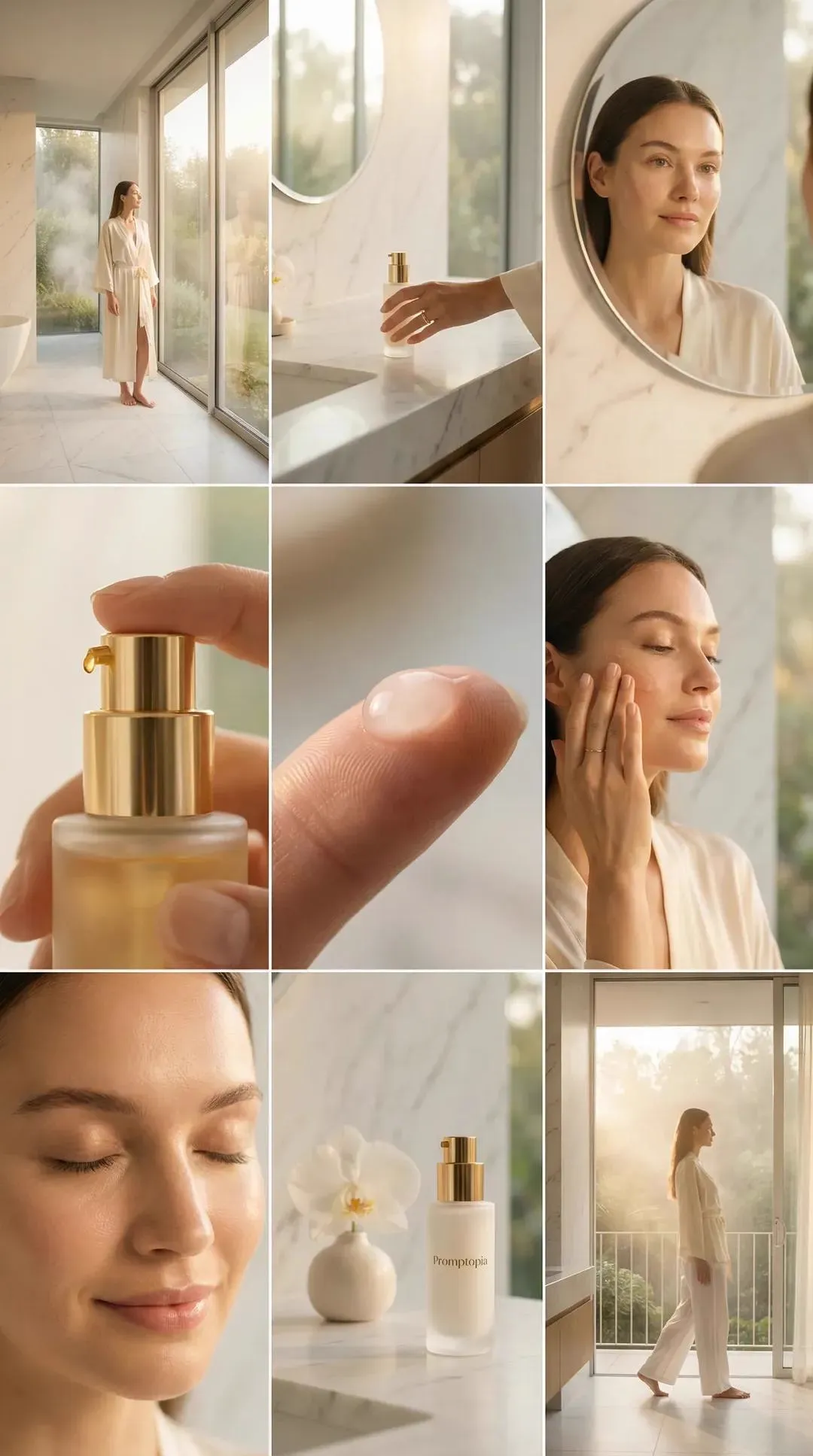
A directed prompt reads like this: early morning kitchen, low warm light from a window on camera left, a woman in her thirties wearing a charcoal t-shirt, eye-level medium shot on a 35mm lens, she pours frozen berries into a blender, presses the button, the blender runs quietly, she glances toward a closed bedroom door and smiles, locked-off camera, no other people, no text.
The second version is not longer for its own sake. It is longer because it contains decisions. Decisions are what make generated footage editable.
A Repeatable Workflow From Brief to Batch
Prompting improves fastest when the work is sequenced. The workflow below assumes a small team, a product, and a target of eight to twelve short clips per cycle.
Phase One: Pre-Production Prompts
Start with a one-page brief: audience, offer, single objection, and the one action you want. Then build a shot list of five to eight beats per concept, each with a framing note and a beat purpose. From that shot list, write base prompts that share wardrobe, location, and lens language. Create three variants per concept by changing one variable only: opening beat, camera move, or final frame. Lock a naming convention before you generate anything, for example concept-beat-version-date, so assets remain findable three weeks later.
Phase Two: Generation and Selection
Generate in small batches and review against three criteria: is the action readable, is the subject consistent, and is the final frame usable. Reject fast. A clip that fails any of the three will cost more to fix than to regenerate. Save the prompts of every keeper alongside the file, because the next cycle will start from those, not from the ones you threw away.
Phase Three: Edit, Captions, and Sound
Assemble to the beat of a specific piece of music rather than a generic bed. Front-load the strongest action frame within the first half second. Add captions that complement rather than duplicate voiceover, and make sure the first caption appears before the viewer could conceivably swipe. Then measure. Retention at three seconds, completion rate, and click-through are the three numbers that tell you which narrative framework is working for this audience.
Choosing Models and Tools for Each Scene Type
No single system is best at everything, and the fastest teams route scenes to engines based on the scene, not on brand loyalty.
Text-to-Video, Image-to-Video, and Hybrid
Text-to-video is best for exploratory beats, abstract transitions, and anything where the exact subject does not matter. Image-to-video is best when identity, product shape, or packaging must stay exact; starting from a real product photo removes an entire class of errors. The hybrid approach, generating a still first and then animating it, is usually the most reliable route for hero product shots because you can approve the composition before spending compute on motion.
Consistency Tricks That Hold Up
Reuse seeds where the tool supports it. Keep a reference image of your on-screen talent and attach it to every prompt in the sequence. Use first-and-last-frame control when you need a precise cut point. Keep lighting language identical across a scene. Most consistency failures are not model failures; they are brief failures, where each clip was described slightly differently by a different person on the team.
Specs That Matter Most
Decide aspect ratio before you write, because vertical and horizontal compositions demand different framing language. Keep individual clips short and cut in the edit rather than requesting long generations. Match frame rate and resolution across a sequence, and export a clean master before adding captions, so you can repurpose the footage later without re-rendering everything.
Creative Testing Without Destroying Brand Consistency
Testing is only useful when you can attribute a result to a change. That requires discipline in what you vary.
Isolate One Variable Per Test
Change the opening frame in one test. Change the final frame in another. Change the proof shot in a third. If you change the hook, the music, and the captions simultaneously, a win tells you nothing you can reuse. Keep a short written hypothesis for each variant: this hook will beat that hook because it shows the problem in the first frame.
Build an Asset Library, Not a Folder Graveyard
Store every approved clip with its prompt, its framework, and its measured performance. Over time, the library becomes your real competitive advantage, because you learn which narrative structures work for your category and which only looked clever in a review meeting. Tag by framework, not by campaign, so patterns surface across quarters.
Keep Guardrails Visible
Write down what your brand will never show: certain gestures, exaggerated reactions, specific claims, particular visual clichés. Give that list to whoever writes prompts. Guardrails reduce review cycles more than any tool feature.
Mistakes That Quietly Kill Performance
Most underperforming AI ads fail for mundane reasons. The opening frame is a logo or a wide establishing shot, so nothing happens before the swipe. The lighting changes between shots, so the sequence feels like a collage. The product appears late. The captions restate the voiceover. The last frame is a blank card instead of a resolved image. The clip is one idea stretched over fifteen seconds when it wanted to be two clips of seven.
Another common failure is over-perfection. Fully synthetic people performing generic happiness produce an uncanny feeling that audiences may not consciously name but do act on. Counter it with specificity and imperfection: real hands, slight asymmetry, a location that looks like a place rather than a set. Where trust matters, mix generated shots with real product footage. The contrast is not a weakness; it is credibility.
Finally, stop judging clips in isolation. A shot that looks weak on its own often works perfectly as the third beat in a sequence. Review in context, on a phone, with sound, at the speed a real viewer will experience it.
Rights, Disclosure, and Platform Realities
Generated video raises questions that traditional production did not. Make sure you have commercial usage rights for the model you use and for any input images. Do not prompt for recognizable people, trademarked characters, or protected packaging. Keep records of which clips are synthetic and which are photographed, because disclosure rules and platform labeling requirements vary and continue to evolve.
Beyond compliance, consider audience trust. Many viewers respond well to transparent, well-made synthetic content and poorly to content that pretends to be something it is not, particularly in categories like beauty, health, and finance. When in doubt, show a real product, use generated footage for the world around it, and keep claims grounded in what the product actually does.
FAQ
How long should a prompt be?
Long enough to contain the six parts: subject, action sequence, camera and lens, lighting, sound and pacing notes, and negative constraints. That usually lands between fifty and one hundred and twenty words. Shorter prompts are not more creative; they are just less directed.
Do I need a different prompt for every platform?
Not a different story, but a different composition. Rewrite the framing language for vertical, square, and horizontal versions, and re-check that the key action still reads in the crop you will actually deliver.
How many clips should I generate per concept?
Plan for roughly three generations per usable clip when you are learning a new model, and closer to one and a half once your prompt templates are dialed in. Track your own ratio; it is the most honest measure of prompt quality you have.
Can I reuse one prompt across multiple products?
Yes, and you should. Build templates with slots for product, wardrobe, location, and stake. Templates keep your visual language consistent and let you produce a new campaign in hours rather than days.
What is the fastest way to improve weak results?
Change the first frame and shorten the clip. Nine times out of ten, a boring ad is a slow opening followed by too much runtime. Fix the opening beat, cut two seconds, and re-evaluate before touching the model settings.
How do I keep a character consistent across a sequence?
Anchor the casting description, attach a reference image, reuse the seed, repeat the wardrobe and lighting phrasing exactly, and avoid mixing tools within a single scene. Consistency is a documentation habit more than a technical trick.
Where to Go From Here
Directing AI video is a learnable craft, and the learning happens in the brief, not in the interface. Start with one product, one objection, and one framework. Write the first frame as a photograph, then build five beats, then write a prompt that carries decisions instead of adjectives. Generate a small batch. Keep only the clips where the action reads, the subject holds, and the final frame earns a pause. Log the prompts of everything you keep, and next cycle, start from there.
Do that three times and you will have something more valuable than a favorite model: a repeatable visual language that audiences recognize, an asset library that compounds, and a workflow your team can hand to anyone. The tools will keep changing. The storytelling does not have to.
