
Why Text-to-Video Became a Serious Production Path
Not long ago, asking an AI model to turn a paragraph into usable footage meant accepting a trade: you got motion, but you lost control. Faces melted, hands multiplied, and a five-second clip could take twenty attempts to become merely acceptable. That trade has largely disappeared. Modern video models understand camera language, respect spatial relationships for the length of a shot, and can hold a consistent look across a sequence when you give them the right anchors.
The practical consequence is that text-to-video is no longer a novelty reserved for experimentation reels. It sits inside real pipelines: agencies building product spots, solo creators producing weekly explainers, learning teams generating training scenarios, and small studios prototyping storyboards before committing to a shoot. The appeal is not that AI replaces a camera crew. It is that one person with a clear script can produce a watchable, on-brand video in an afternoon instead of a month.
What makes this shift interesting is where the bottleneck moved. It used to be generation quality. Now it is direction. The models are capable; the limiting factor is whether the person writing the prompt knows what the shot is supposed to do. That is good news for anyone with a background in writing, editing, or storytelling, because those skills transfer directly.
What "Professional" Actually Means in AI Video
Resolution is the least interesting metric
Beginners chase pixel counts. Professionals chase intent. A 4K clip with a wandering camera and an inconsistent protagonist looks amateur. A 1080p clip with deliberate framing, motivated movement, and clean audio reads as professional on almost any screen. Judge output by whether the viewer understands what they are looking at within the first second, not by whether they can zoom into a texture.
The four pillars
Continuity. The same character, wardrobe, location, and lighting logic across every shot. Audiences forgive soft detail; they do not forgive a jacket that changes color between cuts.
Intent. Every shot answers a question the script raised. If a shot exists only because it looked good in isolation, it is decoration, not storytelling.
Sound. Bad audio destroys good footage faster than bad footage destroys good audio. Dialogue clarity, ambience, and music levels do more heavy lifting than most creators expect.
Edit. Pacing, transitions, and rhythm. This is where raw generated clips become a video.
Where AI video still needs a human
Models are weak at narrative judgment. They cannot decide that a two-second reaction shot is funnier than a four-second one, or that the product should appear after the problem is established. Treat generation as photography and yourself as the director, editor, and sound designer.
The End-to-End Workflow: Script to Final Cut
Step 1 — Write the script as a shot list, not prose
Skip the flowing paragraphs. Write the script directly as a numbered sequence where each line describes one visual unit with a clear subject, action, and purpose. A 60-second explainer usually lands between 12 and 20 shots. A 30-second social spot usually needs 6 to 10.
A useful format: Shot 4 — Close-up of barista's hands tamping grounds, warm side light, slow push in. Purpose: establish craft and care.
Step 2 — Cut into four-to-eight second units
Most models generate short clips. Rather than fighting that limit, design around it. Four to eight seconds is also close to how real editing works: the average shot in a well-cut commercial is under three seconds. If a beat needs more time, split it into two shots with a change in angle rather than one long generation.
Step 3 — Build a reference kit before generating anything
Before spending time on generations, assemble three things:
- A character reference: front-facing portrait, plus one or two alternate angles if the tool supports multi-image input.
- A location or product reference: a clean still of the environment or object.
- A style reference: a frame that defines the color grade, contrast, and texture you want.
This kit is what separates a coherent sequence from a pile of unrelated clips.
Step 4 — Generate in batches and select ruthlessly
Run four variations of the same shot rather than one. Compare them side by side at small size, where structural problems become obvious and textures stop distracting you. Keep a shot if it satisfies three conditions: correct subject, acceptable motion, and a usable start and end frame for editing. Otherwise regenerate with one changed variable at a time so you learn what actually mattered.
Step 5 — Assemble, then finish
Bring every clip into an editor. Cut on motion, not on stillness, so transitions hide inside movement. Lock the picture before you touch music, because music will tempt you into cutting to the beat instead of to the story. Add sound, then color, then titles, then export.
Prompting That Directs Instead of Describes
The five-slot prompt structure
A reliable prompt answers five questions in order:
- Subject — who or what, with two or three identifying details.
- Action — a specific verb describing what changes during the shot.
- Camera — shot size and movement: wide static, medium handheld, close-up slow push.
- Light and atmosphere — time of day, source direction, weather, mood.
- Format and style — aspect ratio, lens feel, film stock or render style.
Example: A middle-aged cyclist in a mustard rain jacket, pedaling through shallow standing water, medium tracking shot from the side, overcast dawn light with wet reflections, cinematic 2.39:1, 35mm lens feel.
Motion verbs matter more than adjectives
Adjectives change appearance; verbs change behavior. Words like turns, lifts, steps, exhales, grips, sweeps, drifts give the model a physical event to animate. If a shot looks like a still photograph with subtle drift, the prompt probably lacked a verb strong enough to drive motion.
How to phrase constraints
Instead of piling on negative words, describe the positive condition you want. Rather than no blur, no distortion, no extra people, write sharp focus on the subject, clean empty background, single figure in frame. Positive description gives the model something to build; pure negation gives it a void.
One variable at a time
When a shot fails, change one thing: the camera move, the lighting, or the action. Changing everything at once produces a new shot, not an improved one, and you lose the information you need for the next attempt.
Keeping Characters and Scenes Consistent
Character sheets
Write a short, fixed description of each recurring character and paste it verbatim into every prompt that features them. Include age range, hair, clothing, and one distinguishing detail. Consistency comes from repetition, not from cleverness.
Scene bibles
Do the same for locations. A kitchen should have the same counter material, window position, and light direction every time it appears. Two or three sentences are enough.
Style anchors
Decide on a single visual signature: color palette, contrast level, grain, and lens character. Apply it to every shot. A sequence with one dominant palette feels intentional even when individual frames differ.
When to switch to image-to-video
If a character must remain identical across many shots, generate a still first, approve it, then animate from that image. Text-to-video is faster for establishing shots and scenery; image-to-video is more reliable for people and products that must not drift.
Sound, Pacing, and the Edit That Sells It
Voiceover
Write for the ear, not the page. Short sentences. Concrete nouns. Read the script aloud and cut anything you stumble over. If you use synthetic narration, generate the full script in one session so tone stays consistent, then adjust pacing per line in the editor rather than regenerating.
Music and ambience
Choose music before sound effects, since it defines the emotional register. Add ambience next: room tone, wind, traffic, crowd. Ambience is the glue that makes separately generated shots feel like one continuous world.
Cut rhythm
Open fast, slow in the middle, accelerate into the close. If your video is 45 seconds, aim for the first three shots to land inside six seconds. Long holds feel luxurious only when the audience already trusts you.
The final mix
Aim for dialogue around -12 to -6 dB with peaks controlled, music sitting 12 to 18 dB below dialogue, and effects tucked between. If you can hear the music more than the words, the words are losing.
Choosing the Right Model for Each Shot
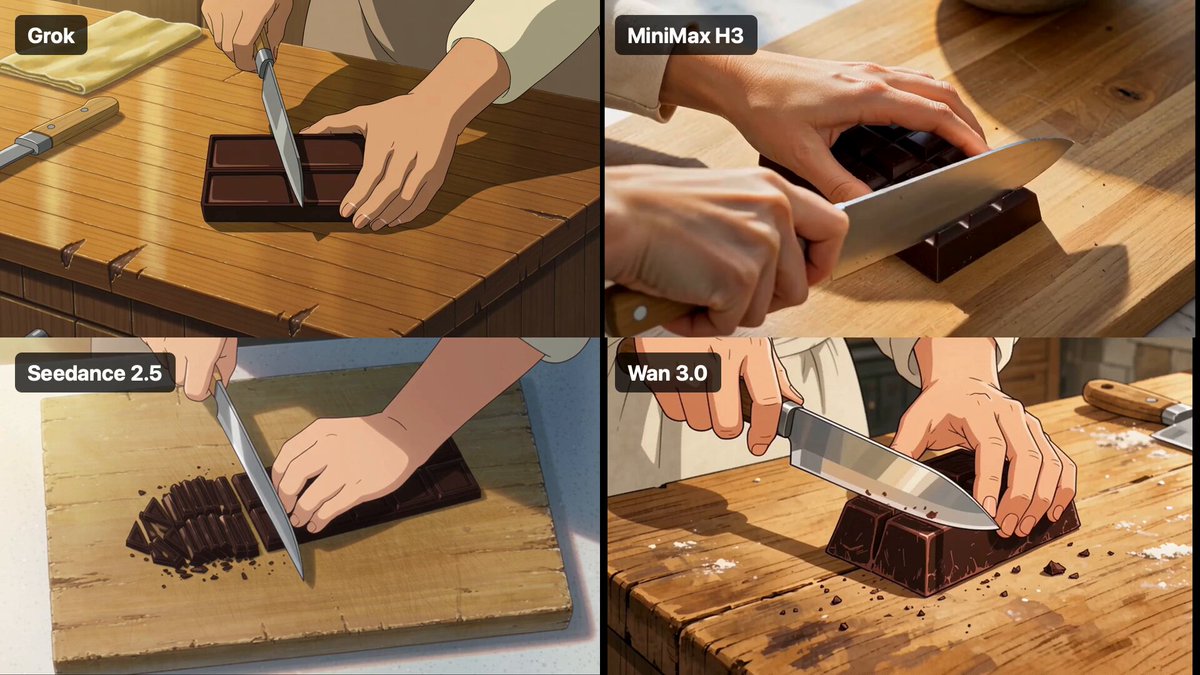
Different shot types reward different model strengths. Build a small mental map rather than defaulting to one tool for everything.
| Shot type | What matters most | Practical guidance |
|---|---|---|
| Establishing / landscape | Coherent depth, natural camera drift | Favour models with strong scene understanding and slow, stable motion |
| Human close-up | Facial stability, micro-expression | Prefer image-to-video from a locked reference frame |
| Product rotation | Geometric accuracy, controlled lighting | Shoot a real still if possible, then animate; avoid pure text prompts |
| Action / movement | Motion coherence, no limb duplication | Keep shots short and generate several variations |
| Abstract / textural | Style fidelity | Text-to-video excels here; experiment freely |
Decision criteria in practice
Ask three questions before generating: Does this shot contain a recurring character? Does it need exact geometry? Is it short enough for one generation? If the answer to the first two is yes, start from a reference image. If the shot is short and disposable, text-to-video is the faster route.
Common Mistakes and How to Fix Them
Over-stuffing prompts. Five competing actions produce mush. One action per shot, always.
Ignoring aspect ratio until export. Generate in the ratio you will publish. Cropping a wide shot to vertical destroys composition and often the subject's head.
Generating before writing. Without a shot list you will produce attractive clips that cannot be edited together.
Chasing perfection on one shot. If a shot has resisted four attempts, change the approach: different angle, different model, or replace it with a simpler frame.
Skipping sound until the end. Silent assemblies always look worse than they are, and you will over-edit the picture to compensate.
Using every clip you liked. A video is defined by what you cut. Ten strong shots beat twenty mixed ones.
A Quality-Control Checklist Before You Publish
Run this pass on the finished cut, ideally after a few hours away from it.
- Watch once with sound, then once muted. The muted pass reveals whether the visuals carry the story.
- Check the first three seconds on a phone at arm's length. If the subject and the promise are unclear, re-cut the opening.
- Scan for continuity breaks: wardrobe, lighting direction, hand positions, background objects.
- Listen on laptop speakers and on earbuds. Different systems expose different problems.
- Verify captions, grammar, and any on-screen numbers.
- Confirm the aspect ratio and duration match the platform you are publishing to.
- Export at a sensible bitrate; a clean 1080p file beats a bloated upscale.
FAQ
How long does a typical AI video take to produce?
A 30 to 60 second piece usually takes two to four hours including writing, generation, selection, and editing, once you have a repeatable workflow. The first project is always slower because you are still learning what your chosen model responds to.
Do I need video editing experience?
No, but you need editing instincts. Learning three things — cutting on motion, keeping dialogue clear, and pacing the opening — will improve results more than any generation setting.
Why do my clips look like slow photographs?
Usually because the prompt describes appearance without describing an event. Add a concrete physical action and a camera instruction, and reduce the shot length so the model is not asked to sustain motion for too long.
Should I use one model or several?
Several, chosen per shot type. Treat models like lenses: you would not shoot a portrait and a landscape with identical settings, and you should not expect one generator to be optimal for every beat.
How do I keep a character from changing between shots?
Lock a reference image, write a fixed character description, and paste it unchanged into every prompt. Consistency is a documentation problem more than a model problem.
What is the fastest way to improve quality?
Cut your average shot length and improve your audio. Both are free, both are immediate, and both move perceived quality more than any upgrade to generation settings.
