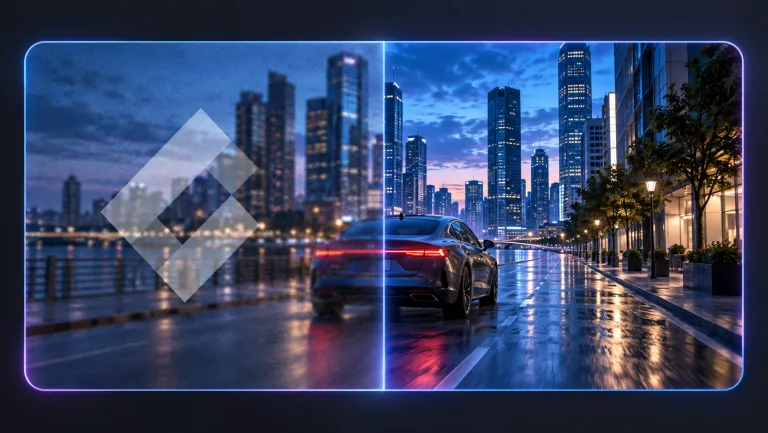
A decohere AI video generator creates video clips with structured motion and spatial relationships from detailed text prompts. Describe object positions, movement paths, and transitions and the tool generates coherent video sequences that follow your scene layout.
Decohere AI Video Generator
Geometric morph
Input
An abstract geometric pattern that morphs through three distinct colour phases: cyan, magenta, and gold, with sharp edges softening between transitions
Expected output
A smooth morphing clip where geometric shapes shift colour and form in sequence with clean transitions
Room rearrangement
Input
A modern architectural interior where the furniture rearranges itself slowly — sofa slides left, table rises, shelves rotate
Expected output
A surreal interior clip showing self-moving furniture with precise spatial changes and no visible characters
Product 3D rotation
Input
A white sneaker rotating slowly on a glass surface with labelled callout text appearing beside each feature
Expected output
A 360-degree product showcase clip with the sneaker rotating and informational labels fading in at each angle
Generate video clips with precise object positions and structured motion sequences from detailed text prompts.
Generate structurally consistent clips
Describe spatial and logical sequences and see them rendered as coherent motion visuals.
Visualise complex arrangements
Translate exact object positions and transitions into video without 3D software.
Design concept previews
Preview architectural, product, or UI concepts in motion through descriptive prompting.
How It Works
1
Describe the scene
Describe the desired scene and motion.
2
Choose settings
Choose the available generation settings.
3
Generate and review
Generate, review, and download a suitable result.
Tips for structured scene prompts
Describe object positions, movement paths, and transition sequences clearly.
Input Constraints
Avoid prompts that require precise physics simulation or exact measurements
Keep the number of moving elements to a manageable few per prompt
Do not claim the tool reproduces specific brand or product visuals exactly
Practical Tips
Describe positions using spatial words: left, right, centre, above, below
Specify movement direction and speed for each element
Use transition words such as morphing, sliding, fading, rotating
Mention the background environment to anchor the scene
Keep the structure simple for better coherence in the output
Privacy
Do not upload personal or sensitive material unless you have permission to use it.
Usage Rights
Confirm that you have the rights needed for the inputs and intended use of the result.
Prompt recipes
Copy a structure, then adjust the subject, lighting, camera, and output details for your own result.
UI animation mockup
A smartphone screen with three app icons arranged in a horizontal row at the centre, icons gently scaling up one by one from left to right, clean white background, subtle shadow under each icon.
Provides clear spatial positioning and sequential motion that mimics UI interaction patterns.
Architectural floor plan walk
A top-down view of a modern apartment floor plan, camera slowly panning from the entrance through the living room to the bedroom, furniture outlined in white on a dark background.
Uses architectural perspective and clear camera movement to visualize spatial layout.
Logo assembly sequence
Five geometric shapes — circle, square, triangle, line, dot — float into frame from different edges and assemble into a logo in the centre, smooth easing, dark gradient background.
Describes each element's entry point and final position, creating a structured assembly animation.
Data visualization flow
A network of connected nodes arranged in a circle, data packets moving along the connecting lines from node to node in a clockwise pattern, blue glow on active nodes.
Specifies layout, motion path, and visual feedback, making the data visualization easy to follow.
Product feature reveal
A laptop on a white surface, camera orbits clockwise around it, at 90 degrees the screen lights up, at 180 degrees a callout label appears, at 270 degrees the keyboard illuminates.
Ties visual changes to specific camera angles, creating a coordinated reveal sequence.
Best use cases
Match the workflow to the input you have and the result you need before opening the generator.
Use case
Best input
Expected result
Tool
Product demo animation
Product with clear camera orbit, rotation angle, and feature callouts at specific intervals
Structured product showcase with synchronized motion and labels
Text to Video
Architectural visualization
Interior or floor plan with camera path and furniture positions clearly described
Spatial walk-through clip showing layout and design
Text to Video
Logo or brand animation
Geometric elements with entry points, assembly order, and final composition
Animated logo sequence with clean transitions
Text to Video
UI interaction preview
Screen layout with element positions, tap targets, and sequential animation
UI mockup clip showing interaction flow
Text to Video
Product demo animation
Input: Product with clear camera orbit, rotation angle, and feature callouts at specific intervals
Result: Structured product showcase with synchronized motion and labels
Tool: Text to Video
Architectural visualization
Input: Interior or floor plan with camera path and furniture positions clearly described
Result: Spatial walk-through clip showing layout and design
Tool: Text to Video
Logo or brand animation
Input: Geometric elements with entry points, assembly order, and final composition
Result: Animated logo sequence with clean transitions
Tool: Text to Video
UI interaction preview
Input: Screen layout with element positions, tap targets, and sequential animation
Result: UI mockup clip showing interaction flow
Tool: Text to Video
Limitations to know before generating
Output accuracy depends on how clearly you describe spatial relationships and motion sequences.
Complex scenes with many moving elements may lose coherence; simpler prompts produce more reliable results.
The tool interprets your prompt but does not support exact measurements or physics simulation.
Generated clips should be reviewed for spatial consistency before use in finished projects.
The tool does not replicate branded product visuals or specific architectural designs exactly.
Creative Suite: AI Video Generator & AI Image Generator Tools
Power up your creative workflow with our AI-driven tools. Generate stunning videos, create images, and apply custom adjustments - our AI Video Generator and AI Image Generator offer a complete solution for all your creative needs.