
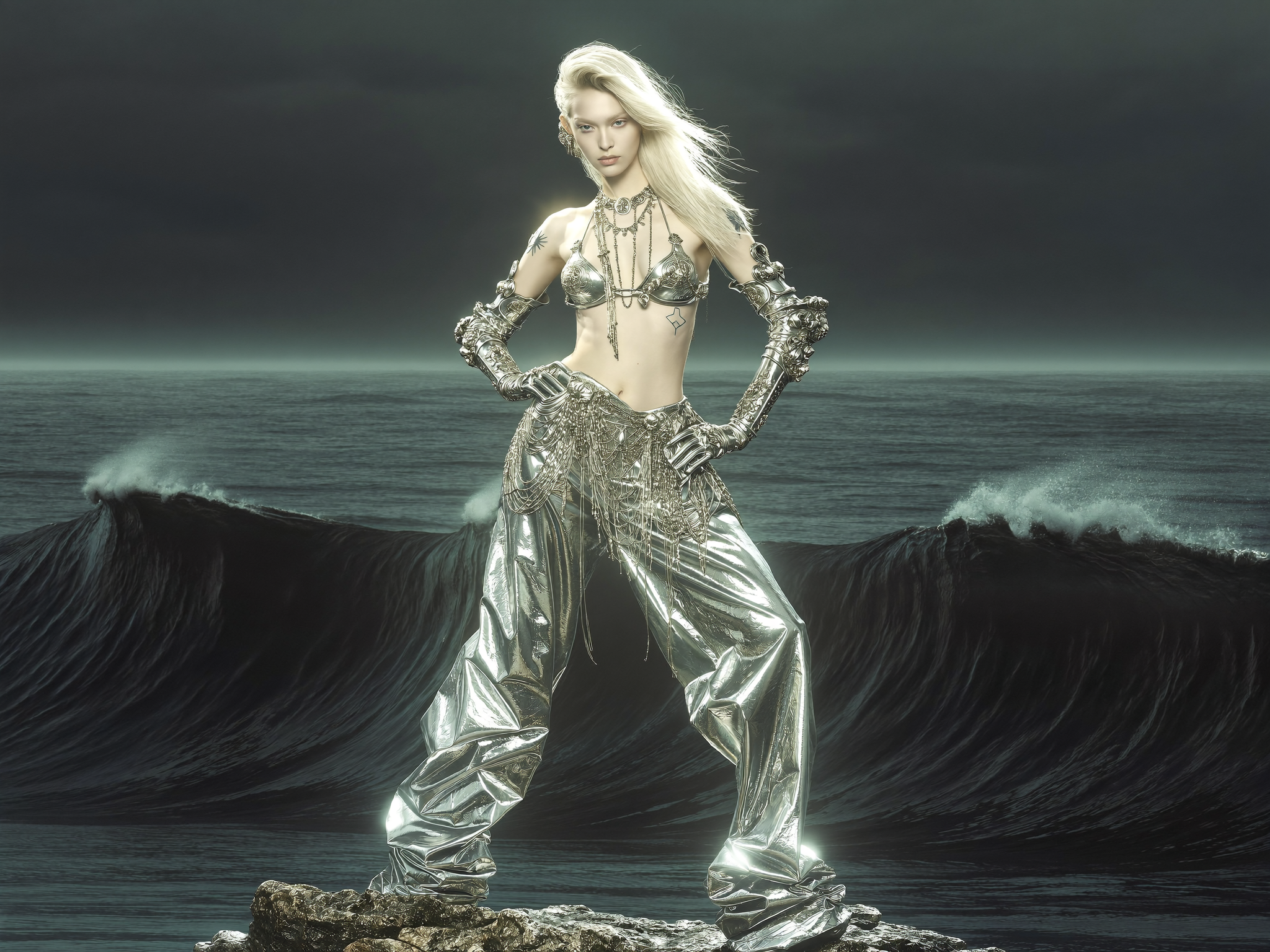
Character consistency is the difference between AI video that looks like a demo reel and AI video that looks like a story. The technology behind it has a name: multi-image fusion, the practice of feeding a generative model several reference images so it reconstructs the same character across scenes, poses, and styles. It is simple in concept and demanding in practice.
This guide covers the advanced side of the technique: how to build a reference database, how to coordinate keyframes across scenes, how to use multi-reference methods to anchor the model, how to handle the instability that remains, and how to turn all of it into a repeatable production workflow.
What Multi-Image Fusion Is and Why It Matters
Text-only prompts describe a character from memory, and memory is lossy. Describe a woman with red hair and a leather jacket, and every generation will produce a different interpretation: different face, different jacket, different energy. Multi-image fusion replaces description with demonstration. The model sees the actual character from several angles and builds a stable identity representation from those images.
Why does this matter so much? Because audiences are unforgiving. A face that changes between cuts breaks the illusion of a coherent world, and once the illusion breaks, the video stops being a story and becomes a technical artifact. Any project with a recurring character, a brand mascot, or a serialized narrative needs fusion as a foundation, not as an afterthought.
The technique also unlocks cross-model workflows: build the character once, then render scenes with different generators, because the identity anchors travel with the project instead of living inside a single prompt.
It also changes the economics of production. Before fusion, a character-driven project meant either endless re-rolls or expensive manual retouching. With a strong identity anchor, the first pass is often usable, and the re-roll budget can go to art direction instead of damage control. That is why the technique belongs at the start of the pipeline, not at the end.
Building a Reference Database for Your Character
Your reference set is the source of truth for everything that follows, and most consistency failures can be traced back to a weak set. A professional reference database has deliberate structure.
Cover the angles: front, three-quarter, profile, and full body. Cover the expressions: neutral, smiling, serious, and one emotionally specific shot that matters for your story. Keep the lighting consistent across the set, because the model will blend lighting families and produce mud if you mix harsh sun with a dark studio. Keep the wardrobe consistent for the hero version of the character, and keep the images clean: no filters, no overlays, no watermarks.
Quality beats quantity after a point, but redundancy matters too. Six to ten well-chosen images outperform two perfect ones, because the model needs to see variation to learn which features are stable identity and which are incidental.
Name your reference files deliberately, with the character name and angle, and keep them in a versioned folder. When you update the character, add the new images as a new version instead of overwriting the old set. Consistency across a project is easier when you can reproduce exactly which references were used for each shot, and versioning gives you that audit trail for free.
Keyframe Coordination Across Scenes
Fusion anchors the character, but the character still has to move through a sequence of scenes, and each scene has its own requirements. Keyframes are the bridge. A keyframe is a frame you want the model to treat as fixed: the opening composition of a scene, a dramatic pose, the last frame of a shot.
Coordinate keyframes the way a film editor coordinates cuts. Before generating, map the critical frames of the whole project: what the audience must see at the start of each scene, what the character is doing, and where the camera is. Generate those keyframes first, then let the model fill the motion between them.
When a character appears in a later scene, re-inject the same reference set and, where possible, a matching keyframe from the earlier scene. This creates a continuity chain: every new shot is anchored to the identity and to the visual history of the project.
Treat the keyframe map as a living document. When a scene changes during production, update the map before you render, and re-anchor any shots that depended on the old version. The map is the contract between your story and your renders, and like any contract, it only works if everyone follows the current version.
Multi-Reference Techniques: Anchoring the Model
Single-reference fusion is a good start; multi-reference fusion is the professional tier. Instead of feeding the model one image, you feed it several that represent different aspects of the character: one for the face, one for the outfit, one for a distinctive prop, one for a specific expression.
The technique works best when each reference has a clear job. A face reference defines identity; a body reference defines proportions; a wardrobe reference defines the look; a prop reference defines the signature object. Describe each element in the prompt with the same wording used to name the references, so the model can connect the image to the text.
Multi-reference also protects against overfitting. If the model relies on a single image, it tends to copy the pose and lighting of that image. Multiple references force it to separate identity from circumstance, which is exactly the generalization you need for new scenes.
Decide the reference priority before rendering. If the face is the most important element, feed the face reference first in the prompt and keep its description closest to the identity block. Most models weight earlier references more heavily, so ordering is a control you should use deliberately rather than discover by accident.
Taming Inherent Jitter in Visual Language Models
Even with strong references, generative models drift. The technical term for the worst symptom is jitter: subtle changes in features, textures, or identity between frames or generations. It is inherent to how these models work, because every generation starts from noise and sampling is probabilistic.
The practical toolkit against jitter has five tools: lock your generation settings, including the seed, so re-rolls start from the same place; shorten the generation segments, because shorter clips drift less than long ones; tighten the keyframe distance, so the model has less room to wander; strengthen the reference set, especially front-facing images; and reduce the number of style adjectives in the prompt, because each one gives the model a reason to reinterpret the character.
Accept that some jitter is unavoidable, and design your pipeline so it is caught and fixed cheaply: review every shot against the reference set before it enters the edit.
Two practical tricks help in stubborn cases. First, generate a small consistency strip: the same character performing five simple actions, reviewed as a set. It exposes drift patterns that single shots hide. Second, when a shot must be perfect, generate several variants of it and pick the best instead of re-rolling repeatedly: the model's distribution matters more than the luck of one draw.
Consistency Across Environments and Styles
Characters do not exist in a vacuum, and consistency has to survive changes in environment and style. A character who looks right in a bright kitchen should still be recognizable in a dark alley, and a character rendered realistically should still read as the same person in a stylized dream sequence.
The trick is to separate identity from environment in your prompts. Keep the identity block completely fixed: same traits, same outfit, same wording. Change only the environment block: location, lighting, mood. This division of labor tells the model what must not change and what may change.
When a scene needs a major style shift, generate a bridging shot: a transition that takes the character from the old style to the new one gradually. A hard cut between two visual worlds reads as a mistake; a graded transition reads as intention.
Surviving Fast Cuts and Interactive Sequences
Fast cuts are where consistency failures become visible, because the audience compares adjacent frames directly. Two shots of the same character cut together expose any difference in face, outfit, or lighting immediately.
The rule for fast cuts is stricter anchoring: use more references, tighter keyframes, and identical lighting descriptions for every shot in the sequence. Generate the shots of a fast-cut sequence in the same session with the same settings, because models are more consistent within a session than across sessions.
Interactive sequences, where the character reacts to something in the scene, add a second problem: the reaction has to feel motivated. Plan the interaction in keyframes: the setup, the moment of reaction, the result. Generate the setup and the result as anchors, then let the model fill the reaction between them.
A Practical Workflow from Character Sheet to Final Render
The advanced techniques only pay off inside a disciplined workflow. Here is one that works for production projects.
- Write the character sheet: name, fixed trait block, outfit, prop, personality notes, and the negative prompt.
- Build and review the reference database, checking that all images read as the same person.
- Generate test shots in every model you plan to use, and lock the prompt variants that pass.
- Map the keyframes of the whole project before rendering anything.
- Generate scene by scene, injecting references and keyframes every time.
- Assemble a rough cut and review continuity in sequence, not shot by shot.
- Fix failures at the source, re-rolling with stronger references or tighter settings.
The workflow is linear on purpose: identity before scenes, references before renders, continuity review before finishing. Every step catches problems while they are still cheap.
Quality Control and Iteration
Quality control for consistency is a comparison, not a feeling. Build a simple checklist and run it on every shot: does the face match the reference set, is the outfit correct, does the lighting match the scene brief, does the keyframe composition match the storyboard, and does the motion look natural at speed.
When a shot fails, diagnose before you re-roll. Ask what changed: identity, environment, or motion. Identity failures mean references or prompts; environment failures mean the environment block; motion failures mean segment length or keyframe distance. Fix the cause, not the symptom, and re-run the whole shot, not just the broken part.
Keep a log of what failed and why. After a few projects, the log becomes your personal failure taxonomy, and it will tell you exactly where your pipeline needs reinforcement.
Automate the easy checks. If your pipeline allows it, compare each generated frame against the reference face with a simple similarity score, and flag shots below a threshold for human review. The human still makes the final call, but the machine catches the failures that eyes miss after the tenth hour of review.
FAQ
How many reference images does a production character need? Six to ten, covering angles, expressions, and one consistent wardrobe. More images help only if they add new information.
Why does my character still drift with references? Usually one of three causes: weak references, prompts that contradict the references, or generations that are too long. Fix all three before changing models.
Can multi-image fusion be used for environments and props? Yes. The same technique applies to any recurring visual element: locations, vehicles, products, and signature props all benefit from reference anchoring.
Is multi-reference fusion slower? Somewhat, because the model processes additional images. The extra seconds are cheaper than re-rolling a full scene because the character changed between shots.
Do I need a reference database for every character in a scene? Only for characters that appear in more than one shot or that the audience must recognize. Background characters can be described in words; heroes and recurring side characters deserve references.
How do I handle characters who change outfits mid-story? Keep a separate wardrobe variant set that shares the same face and body references. Change only the clothing images and the outfit description; the identity stays anchored to the shared face and body images.
