

Storytelling that works: directing cinematic shots with AI
Film is the discipline of turning a story into images, shot by shot. A script has meaning on the page, but it becomes emotion on the screen only through deliberate choices of framing, camera movement, light, and tone. In the past, this craft belonged almost exclusively to experienced directors and cinematographers. Today, generative AI is putting much of that art into the hands of any creator with a clear vision.
This guide explores how storytelling authority intersects with AI-assisted direction. It explains how a strong shot design can be planned, how an AI director interprets a script into concrete camera decisions, and how editing, lighting, and continuity turn a set of images into a coherent, emotional narrative.
Why shot design defines the emotional story
Good storytelling is not only about what happens, it is about how the viewer feels at every moment. The choice between a wide establishing shot and a tight close-up changes the emotional texture of a scene entirely. A slow, calm camera suggests reflection; a fast, unstable movement creates tension. Directors manipulate these elements to guide the audience's attention and feeling.
In AI-assisted production, the same principles apply. The difference is that the creator can now direct this vocabulary explicitly through prompts and parameters, and let the machine render the result. Learning the language of shots is therefore the single highest-leverage skill for AI storytellers.
Composition tells the viewer where to look
Composition arranges the elements inside the frame to guide the eye. The rule of thirds, leading lines, symmetry, and negative space all influence where attention lands and what mood the image conveys. In AI prompting, describing the composition, such as a subject placed off-center with leading lines converging on it, gives the engine a clear target and produces stronger, more intentional frames.
Camera angles shape the emotional charge
The angle from which a scene is filmed carries emotional meaning. A low angle makes a subject feel powerful; a high angle makes it seem smaller or more vulnerable; an over-the-shoulder shot connects two characters. Directing these angles deliberately, instead of leaving them to chance, is what turns a sequence of pretty images into a narrative with direction.
Blocking directs the motion inside the frame
Blocking is how characters and objects move and interact within the shot. Telling the model that a figure walks slowly from the background toward the camera, or that two people circle each other while talking, gives the scene intention. Motion that serves the story is far more engaging than motion for its own sake.
How an AI director translates a script into shots
The most advanced tools in generative video now include a "director" mode: an agent that reads a written script and returns a shot plan. Instead of generating one floating image, the agent breaks the script into narrative beats and assigns each beat a shot type, angle, and camera movement suited to its emotional role.
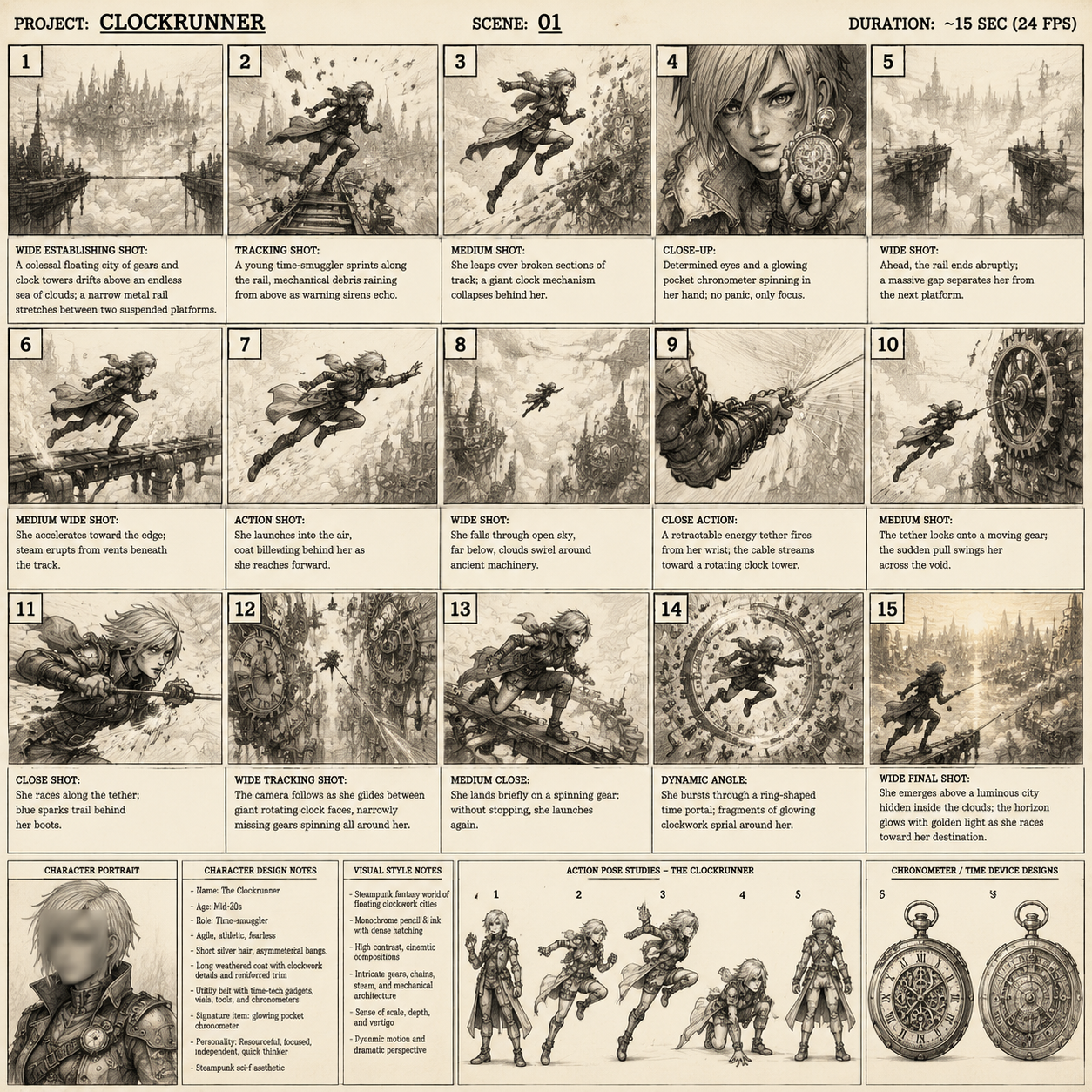
This is a genuine change in how stories get made. The creator provides intent, tone, and dialogue; the agent proposes the visual grammar. An introduction may be assigned a wide establishing shot to set location, a moment of confrontation a tight two-shot, a revelation a slow push-in. The creator reviews, adjusts, and approves, keeping full creative control while delegating the mechanical layout.
The role of advanced video models in realizing vision
Reading a story and translating it into shots is only part of the work; the engine must actually render that description with believable motion and visual quality. Advanced video models add layers of realism: fluid motion, consistent lighting, coherent physics of objects, and camera behavior that follows the director's instructions.
As these models improve, the gap between what a director imagines and what a machine renders narrows. Text-to-video models turn words directly into moving shots, while image-to-video models animate a chosen still, which is especially useful for keeping a specific look. Using both in the same project lets a director combine the freedom of text with the precision of a curated image.
Using AI tools to keep visual consistency across scenes
A story told across several scenes succeeds only if the visuals feel like one world. Consistency problems, a character whose face changes, a room whose layout shifts between cuts, break the illusion instantly. AI tools address this in a few ways.
Anchoring on reference material
Start with a reference image that establishes the world and the hero, then drive subsequent shots from that base. Keeping the same visual anchor scene to scene preserves identity and setting. This technique is especially important for multi-scene narratives and branded storytelling.
Reusing a coherent prompt language
Consistency also comes from the prompt. Describe lighting, palette, and setting with the same vocabulary across shots. If the world is defined once and referenced consistently, the renders are far more likely to share a coherent look. Treat your prompt library as the production bible.
Planning transitions in advance
Transitions are where inconsistency shows most. Direct the story through clear beats and controlled cuts between them, keeping lighting and palette stable and using establishing shots to re-anchor location. Careful continuity planning makes the final edit feel seamless rather than stitched together.
Mastery through lighting and atmosphere
Lighting is arguably the most powerful tool for mood. A single source of warm key light suggests intimacy and comfort; a cold, high-contrast setup creates unease; silhouette lighting suggests mystery. Directing lighting is one of the quickest ways to raise the emotional quality of any scene.
Creating emotion with light and color
Describe light precisely in your prompts: the direction, the temperature, the hardness or softness of shadows, and the presence of practical lights or reflections. Color grading on top reinforces the emotion, whether pushing toward warm nostalgia or cold tension. Together, light and color give a scene its psychological temperature.
Building atmosphere across a sequence
Atmosphere is cumulative. If each shot maintains the same lighting logic and mood, the whole sequence feels designed rather than accidental. Plan the atmosphere at the scene level, then ensure each shot inside it obeys the same logic. This consistency is what separates content that feels cinematic from content that merely cycles between images.
A creative workflow for AI-assisted storytelling
A reliable process keeps the craft intact while enjoying the speed of AI. Begin by writing the emotional arc of the story and the mood you want at each beat. Second, break the script into shots and assign each one a shot type, angle, movement, and lighting intention. Third, use a director agent to draft the shot plan, then review and adjust it against your vision. Fourth, render with the appropriate model and iterate on the prompts until the frames match the intention. Finally, assemble and post-process, keeping light, palette, and continuity consistent across the edit.
Throughout, keep your own taste as the final judge. The machine proposes; the creator disposes. This balance, delegation of mechanics plus retention of creative authority, is the essence of directing with AI.
Common pitfalls in AI shot design
The most frequent mistake is leaving shot decisions to chance. If you do not specify the angle, movement, and lighting, the engine will default to whatever is easiest, and the emotional intent is lost. A second mistake is ignoring continuity, producing beautiful but unrelated images that cannot be assembled into a coherent story. A third is over-relying on the agent without review, letting an automatic plan override a deliberate creative choice.
Avoid also describing without directing. Vague descriptions like "a dramatic scene" do not give the model a shot to realize. Translate every intention into concrete camera and light language. Finally, be patient: the distance between a first render and a final, coherent sequence is usually a few deliberate revisions.
A practical lexicon of shots to use in prompts
Learning a small vocabulary of shot types pays off immediately, because the AI understands these terms literally. An establishing shot sets location and stakes; a wide shot frames a character in context; a medium shot balances body and expression; a close-up isolates emotion; an extreme close-up amplifies detail and tension. Camera movement adds more options: a dolly in builds intimacy, a push past the subject creates momentum, and a handheld feel introduces unease.
In practice, write the shot type at the start of your prompt, then layer in angle, movement, and lighting. A prompt such as "extreme close-up, slow push-in on the character's eyes, warm key light from the side" gives the engine an unambiguous directive. Over weeks of work this vocabulary becomes instinctive and dramatically narrows the distance between the image in your head and the frame the machine returns.
Building dramatic structure across a sequence
Storytelling is not only about individual shots but about how rhythm and contrast shape emotion across a whole sequence. Alternating slow and fast pacing, wide and tight framing, or long and short durations keeps the viewer engaged and punctuates each narrative beat. A scene that is entirely uniform, however beautiful, drains energy and loses meaning.
Plan the emotional curve before rendering: build tension, release it at a key moment, then settle. Use contrast deliberately, a fast montage followed by a lingering slow shot, to mark shifts in the story. This structural level of thinking lifts a project from a set of attractive images into a designed piece of storytelling that audiences actually feel.
Directing with sound and rhythm in mind
Visual storytelling is incomplete without an awareness of rhythm and, when present, sound. Even a silent sequence is read in time; the duration you give a shot, and the pauses between them, set the emotional tempo as much as any visual. As you direct shots, note on the storyboard how long each moment should breathe and where a cut should land.
When a project includes sound, plan the soundtrack and the pace of the edit together. A rising score changes what a slow push-in means. Storyboarding time and mood in parallel with the visuals helps the final edit feel designed rather than happenstance, and it is one of the fastest ways to make generated content read as deliberate cinema. Even when a piece will ship silent, treating the rhythm as part of the direction keeps the whole sequence intentional end to end.
Frequently asked questions
Do I need to study film theory to direct with AI?
Not formally, but a working knowledge of composition, camera angles, and lighting hugely improves results. These are the levers the AI understands.
Can AI fully replace a human director?
No. AI executes mechanical shot layout quickly, but it does not replace creative judgment, taste, or the ability to serve a story's meaning. The best work pairs machine speed with human direction.
How do I keep a scene consistent across shots?
Anchor on reference images, reuse a coherent prompt vocabulary for light and palette, and plan transitions in advance. Consistency is a planning discipline, not a post-production fix.
What is the quickest way to raise emotional quality?
Redirect the lighting and camera language with intention. Small changes to how the shot is described, warm versus cold light, static versus moving camera, change the mood far more than most creators expect.
Conclusion
Storytelling in video has always been the craft of turning words into images with purpose. Generative AI lowers the barrier to that craft by rendering cinematic shots from clear direction. By mastering composition, camera language, blocking, and light, and by using AI agents to handle mechanical layout while retaining creative control, any creator can now tell emotionally coherent stories at a fraction of traditional cost and time.
Begin with a single scene. Write its emotional beat, direct one shot with precise camera and lighting language, and iterate until the frame matches your intent. Then expand to a sequence, guarding continuity at every cut. The skill of directing with AI compounds quickly, and it rewards creators who treat the machine as an instrument of their vision rather than a replacement for it.
