


Why Memorable Short Clips Matter More Than Ever
Short-form video is no longer a side channel. It is where most audiences first meet a brand, an artist, or a creator, and it is where the decision to keep watching or keep scrolling gets made in under two seconds. The feed is crowded, the swipe is instant, and attention is the scarcest resource in the entire digital economy. In this environment, producing clips that people remember after they have already scrolled past is not a nice-to-have; it is the difference between a channel that compounds and a channel that disappears into the noise.
The interesting shift in the last couple of years is that the barrier to entry for video production collapsed. Anyone can generate moving images from a text prompt now. But that collapse created a new problem: when everyone can produce video, the value moves from production capacity to storytelling judgment. A clip can have perfect pixels and still be forgettable, while a clip with rough edges but a clear emotional arc can travel around the world. This is why the conversation has moved from "which generator is the most realistic" to "how do I direct an AI so the result actually holds attention."
That is exactly where AI director agents come in. Instead of asking you to master every prompt trick, camera term, and editing rule yourself, a director layer helps you think in scenes, beats, and hooks. It turns a vague idea into a structured shot list, keeps characters and settings stable across cuts, and applies cinematic language automatically. The result is not just faster production but better storytelling, and that combination is what makes short clips memorable rather than merely watchable.
What an AI Director Agent Actually Does
A raw video generator takes a prompt and returns a clip. An AI director agent does something more interesting: it treats your request like a production brief and plans the work before the generator ever runs.
In practice, a director agent typically breaks a project into a series of decisions. First, it analyzes the core idea and identifies the emotional beat you are going for, whether that is surprise, nostalgia, tension, or humor. Second, it proposes a story structure for the clip, often a compressed version of the classic setup, conflict, and payoff, adapted to the few seconds a short video allows. Third, it decomposes the clip into individual shots, each with its own subject, framing, camera movement, and duration. Fourth, it selects or suggests the right generation model for each shot, because a fast stylized model and a slow photorealistic model are not interchangeable. Finally, it keeps track of consistency tokens, the character descriptions, color palettes, and location details that must stay stable across every generated shot.
This division of labor matters because the hardest parts of AI video are not about raw quality. They are about continuity and intent. A single generated clip can look stunning and still feel random. A director agent imposes order on that randomness: it decides what the viewer should look at, in what order, and with what emotional rhythm. You remain the creative lead, but the agent handles the production management that used to require a small team.
Think of it as the difference between asking an illustrator to draw a picture and working with an art director who storyboards the concept, briefs the illustrator, and checks that every panel matches the others. The illustrator is essential, but the art director is what turns individual drawings into a coherent piece of work.
Building Story Consistency Across Scenes
The most common complaint about AI video is that characters change appearance between shots. A protagonist walks into a room wearing a red jacket and walks out wearing a blue one. A location shifts from day to night for no reason. This is not a minor flaw; it breaks the viewer's trust in the story and makes the clip feel cheap, no matter how good individual frames look.
Consistency starts before generation. You need a written reference for every recurring element: the character's face, clothing, hair, age, and mannerisms; the setting's architecture, lighting, and color palette; the props that matter to the plot. Treat this like a mini story bible. The more specific the description, the more stable the output will be.
Modern tools support this in several ways. Some let you provide reference images that the model uses to lock a character's identity across shots. Some offer style transfer or image fusion features that combine a character reference with a new scene description, so the model knows both who is in the frame and what is happening around them. Even without those features, you can stabilize output by keeping the descriptive language identical across prompts. If the character is "a young woman with short copper hair, a denim jacket, and a silver pendant," use that exact phrase in every shot prompt, and resist the urge to reword it for variety. The model treats wording changes as content changes.
It also helps to generate the most important shot first and then use it as the anchor for the rest. Establish the character's look in a clean, well-lit scene, review it, and then carry that result forward. When you review your first drafts, check for continuity before you check for beauty. A slightly less dramatic frame that matches the rest of the clip is worth more than a gorgeous frame that belongs to a different movie.
Directing Camera Movement and Composition
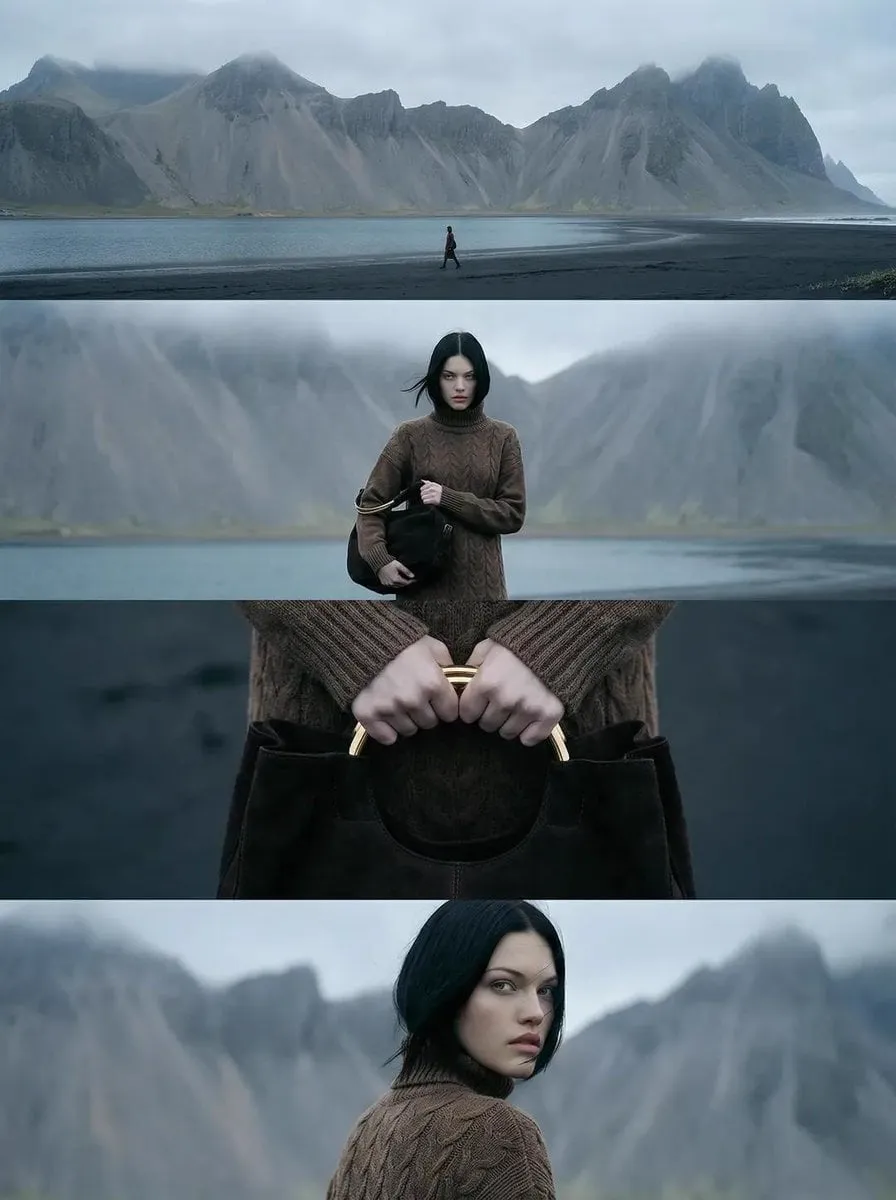
Cinematic feel does not come from resolution. It comes from camera language: where the camera sits, how it moves, and what it frames. Audiences may not know the technical names, but they feel the difference between a static locked-off shot and a slow push-in that builds tension.
The most useful camera moves for short clips are simple to describe and highly effective. A slow push-in draws the viewer toward a character's face and raises emotional intensity. A pull-back reveals context and can land a joke or a twist. A lateral tracking shot adds energy and is great for movement or dance content. A dolly zoom, where the subject stays the same size while the background stretches, creates an instant feeling of unease and is perfect for reveals. Even a subtle handheld wobble can make a clip feel documentary and real, while a perfectly smooth gimbal shot feels commercial and polished. Choose the feeling you want first, then choose the move that produces it.
Composition rules still apply. The rule of thirds, leading lines, and negative space all guide the eye, and you can encode them directly in your prompt: "subject framed on the right third, empty street stretching behind her" gives the model clear composition instructions. Lighting direction matters just as much: backlight creates silhouette and mystery, soft front light flatters, and hard side light adds drama. If your tool supports camera parameters like focal length, aperture, and lens type, use them deliberately. A shallow depth of field isolates the subject and instantly reads as cinematic; a wide lens exaggerates space and suits action.
The key is to direct with intention. Do not write "dynamic camera movement" and hope for the best. Decide the purpose of the shot in the story, and then write the camera instruction that serves it.
Choosing the Right Model for Each Scene
Not all generation models are the same, and treating them as interchangeable is the fastest way to waste time and budget. The current landscape splits into a few broad families, and each one has a sweet spot.
At the top end are flagship models designed for photorealism and complex motion. These are the models you reach for when the shot is hero content: a product hero, a cinematic opening, a scene where the audience will scrutinize the details. They are typically slower and more expensive per generation, but the quality difference shows on screen.
In the middle are general-purpose models that balance speed, cost, and quality. For most social clips, talking-head content, and short narrative scenes, these are the workhorses. They generate quickly enough to iterate, and their failure rate is low enough that you can run several variations without burning through your allowance.
Then there are specialized and stylized models: anime looks, watercolor looks, claymation, retro film grain, and other distinctive aesthetics. If your brand has a recognizable visual style, a specialized model will often deliver it more reliably than prompting a generic model to imitate it.
Finally, open-source models and lightweight local options matter for budget-conscious creators and for projects with strict privacy requirements. They may trail the flagship models on raw quality, but they give you unlimited iteration, full control, and no per-generation cost, which makes them ideal for prototyping and for volume work where consistency matters more than peak fidelity.
The practical rule is simple: match the model to the job. Spend the premium model on the shots the audience will remember, and use efficient models for filler, backgrounds, and exploratory drafts. If your platform lets you switch models per shot, plan which shots need which model before you start generating.
Sound, Music, and Rhythm in Retention
Video is an audiovisual medium, but many AI workflows treat audio as an afterthought. That is a mistake. Sound is one of the strongest retention levers you have, and it is often the difference between a clip that feels finished and one that feels like a draft.
Start with the voice. If your clip includes narration or dialogue, generate it first and build the visuals around it, because the timing of the voice defines the rhythm of the edit. A well-paced voiceover with natural pauses gives the editor natural cut points. If the tool offers AI voice generation, choose a voice that matches the tone of the piece, and listen to it before you commit to visuals.
Music is the second layer. The emotional meaning of a scene changes completely with the soundtrack. A tense scene scored with a light ukulele becomes comedy; the same scene scored with a drone becomes dread. When your tool supports music generation or sync features, use them to reinforce the intended emotion rather than just filling silence. Watch for beat alignment: cuts that land on musical downbeats feel intentional, and viewers notice the difference even when they cannot articulate it.
Pacing is the third layer, and it ties everything together. Short clips fail most often because they are either too slow at the start or too dense throughout. The first second must communicate what the video is about, the middle should alternate between information and emotional payoff, and the final second should leave something to remember. Captions and on-screen text also shape rhythm: they give viewers a reason to keep watching on mute, which is how most short-form content is consumed.
A Practical Workflow: From Idea to Finished Clip
Here is a repeatable workflow that puts all of the above together.
First, write the idea as one sentence. If you cannot say what the clip is about in a single sentence, the idea is not ready. Second, define the hook: the first visual or line that stops the scroll. Third, outline the arc in three beats, a setup that orients, a development that adds tension or information, and a payoff that delivers the emotion. Fourth, build the shot list: for each beat, decide the subject, framing, camera move, and duration. Five to eight shots is enough for most short clips.
Fifth, write the story bible for recurring elements. If a character or location appears more than once, describe it precisely and reuse the exact wording. Sixth, generate the anchor shot first, review it for quality and consistency, and then generate the rest with the anchor as a reference. Seventh, assemble the draft and review for continuity, pacing, and audio. Check that the character looks the same, the light makes sense, and the cuts follow the rhythm of the music or voice. Eighth, iterate on the weakest shot only. Resist the temptation to regenerate everything; targeted fixes are faster and keep the clip consistent.
Finally, export at the right aspect ratio for your platform, add captions if they are not baked in, and publish with a title and description that match the clip's actual content. Consistency between the video and its metadata is part of the package, especially when you plan to reuse the clip across projects.
Common Mistakes That Kill Short Clips
Several mistakes appear over and over in AI-generated short-form content, and they are all avoidable.
The first is prompt overload. A prompt that lists ten objects, three lighting schemes, and two camera moves confuses the model, and the result is a mush where nothing is right. Narrow the scope: one subject, one action, one mood, one camera instruction.
The second is inconsistency, which we covered above but which deserves emphasis because it is the most common quality killer. If your characters drift between shots, your story dies.
The third is a missing hook. Many creators put the most interesting moment at the end, but short-form audiences rarely get there. Front-load the curiosity.
The fourth is flat pacing. If every shot has the same length and energy, the clip feels like a slideshow with motion. Vary shot duration, camera energy, and sound density to create a rhythm.
The fifth is ignoring sound. A clip with no music, no ambience, and no voice sounds dead even when the visuals are excellent.
The sixth is treating the tool as a black box. The creators who get the best results are the ones who understand why a prompt produced what it did, and who adjust their language based on the model's behavior. That feedback loop, prompt, review, adjust, is the actual skill.
Frequently Asked Questions
Do I need to be a filmmaker to use an AI director agent? No. The value of the director layer is precisely that it encodes filmmaking knowledge so you can make better decisions without a film degree. You still need taste, but the agent handles much of the technical vocabulary.
How long should a memorable short clip be? It depends on the platform and the story, but for most social feeds, fifteen to forty-five seconds is the practical range. Longer works when the story justifies it, but assume attention is scarce.
How do I keep the same character across many clips? Build a reusable character reference, use the same description in every prompt, anchor on a strong first generation, and use reference-image features when your tool supports them.
What is the fastest way to improve my AI clips? Improve the hook and the pacing first. Those two changes have the largest impact on retention, and they are cheaper to fix than visual quality.
Can I reuse these clips across different projects? Yes, and that is one of the strengths of this workflow. By avoiding brand-specific wording and site-specific links, the clips and the process behind them stay portable, so the same story can serve different channels and campaigns.
