
Professional video storytelling used to be a craft reserved for studios with big budgets and experienced directors. That has changed. With generative AI, a single creator can produce cinematic content, but only if they bring structure, composition, and narrative discipline to the process. Raw generation power is no longer the bottleneck; direction is.
This guide explains how an AI director agent fits into a professional video workflow, what it can actually do for scene composition, narrative structure, lighting, camera movement, and character animation, and how to build a repeatable production pipeline around it.
Why professional storytelling is now a production requirement
In a crowded digital environment, viewers decide within seconds whether to keep watching. Short-form video dominates social platforms, and the bar for quality keeps rising. Content that feels random or technically sloppy gets swiped away, regardless of how impressive the individual shots are.
Professional storytelling is not about expensive equipment. It is about intentionality: every frame should serve a purpose, every cut should advance the story, and every scene should feel like it belongs to the same piece. When you produce with AI, this intentionality becomes harder to maintain, because the tool generates images and motion that can easily drift away from your original vision. That is why creators increasingly rely on an AI director layer: something that interprets your creative intent and translates it into concrete production decisions.
What an AI director actually does
An AI director agent is not a filter or a fancy preset. It is an orchestration layer that sits between your idea and the raw generation models. It performs a set of tasks that a human director would normally handle:
- breaking a narrative into scenes and shots;
- deciding which model fits each shot's requirements;
- turning creative descriptions into precise, cinematic prompts;
- keeping characters, locations, and emotional tone consistent;
- reviewing output and suggesting targeted revisions.
Think of it as a first assistant director that never sleeps. You still make the creative calls, but the mechanical work of translating intent into production choices becomes faster and far more consistent.
Scene composition: framing that looks intentional
One of the most visible differences between amateur AI video and professional work is composition. A good director does not just describe what happens in a scene; they decide how the camera sees it.
An AI director understands fundamental cinematography principles. When you ask for a scene, it can consider camera angle, the rule of thirds, depth of field, and the visual weight of the subject. Instead of a prompt like "a person walks into a room," you get framing decisions built in: a low angle to convey power, a shallow depth of field to isolate the character, a wide shot to establish the space before cutting to a close-up.
In practice, this means you should describe scenes in terms of intent, not just action. Tell the director what the audience should feel, and let it translate that into camera and staging choices. The result is footage that looks deliberate, which is exactly what separates professional storytelling from random generation.
Narrative structure and keeping the story on track
A story is more than a sequence of impressive shots. It needs an arc: a beginning that establishes stakes, a middle that develops conflict, and an end that pays it off. When you generate scenes one by one, it is easy to lose sight of the whole.
An AI director acts as a narrative supervisor. It keeps track of the story arc and ensures that every visual element serves the core message. Before you generate a shot, it can check: does this shot advance the plot? Does the emotional tone match where the story is at this point? Is the character acting consistently with their established personality?
A useful workflow is to write a one-paragraph story brief first: protagonist, goal, obstacle, and resolution. Then generate each scene against that brief. When a scene feels off, the problem is usually not the model, it is the scene's relationship to the story. Fixing the brief first saves far more time than regenerating pixels.
Lighting, camera movement, and character animation in practice
Cinematic quality comes from the details. Here is how an AI director helps with the three elements that most affect perceived quality.
Lighting and shadow: Instead of generic lighting descriptions, you can specify mood through light: warm rim light for a heroic moment, hard shadows for tension, soft diffused light for intimacy. An AI director can translate these abstract ideas into consistent lighting conditions across multiple shots, so the same scene does not jump between different light sources between cuts.
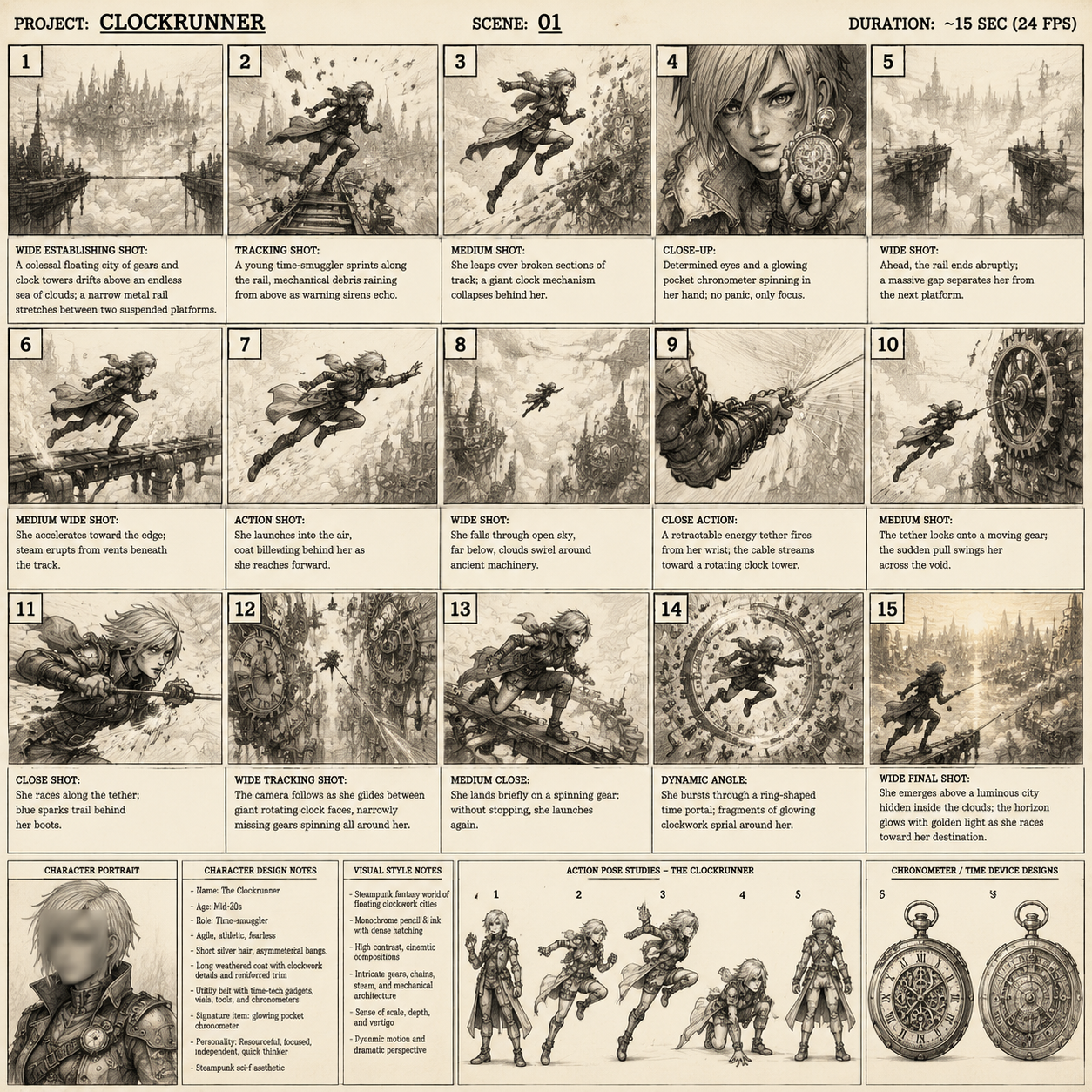
Camera movement: Dynamic camera work adds energy, but uncontrolled motion looks amateur. You can plan camera moves the way a storyboard artist would: a slow push-in to build tension, a tracking shot to follow a character, an orbit around a subject for drama. Generating with a defined camera move per shot makes the edit feel intentional and gives you real options in the cutting room.
Character animation: The hardest part of AI video is keeping a character consistent while they move and express emotion. The reliable approach is to separate identity from action. Lock the character's appearance with reference images first, then direct the action through described movement and expression. For recurring actions, reuse the same motion template so a "standard wave" looks the same in every scene.
Building a repeatable production workflow
A professional pipeline does not depend on inspiration; it depends on process. Here is a workflow that works for solo creators and small teams:
- Write the story brief. One paragraph that defines the protagonist, goal, obstacle, and resolution.
- Create the visual bible. Reference images for characters, key locations, and the overall style. This is the source of truth for every scene.
- Build the shot list. Break the story into shots, each with a clear purpose, camera move, and emotional tone.
- Generate in batches. Produce drafts for all shots before polishing any single one. This lets you see the whole piece early and catch structural problems.
- Review against the brief. Check each shot for story fit, character consistency, and technical quality.
- Regenerate targeted shots. Fix what failed, using the references and style locks, instead of starting over.
- Assemble and polish. Edit, color-correct, add sound design and captions, then release.
The point of the workflow is that most of your effort goes into decisions, not into fighting the tool. The director layer handles the translation; you handle the taste.
Using AI direction to iterate faster
The biggest advantage of an AI director is speed of iteration. In traditional production, a reshoot costs time and money. With generative video, the cost of a new draft is measured in minutes, but only if you know what to change.
Treat each generation round as a hypothesis test. If the lighting is wrong, change the lighting instruction, not the whole scene. If the character drifted, strengthen the reference set, not the prompt wording. If the pacing feels slow, adjust the shot list, not the individual shots. An AI director can analyze the previous output and suggest exactly which variable to adjust, turning trial and error into a deliberate refinement loop.
A worked example: taking a scene from brief to shot
Let us make this concrete. Suppose your story needs a scene where a tired courier arrives home at night. A beginner prompt might read: "a person arrives home, tired." The result will be generic, and the character will probably not match anything else in your project.
A directed version works differently. First, you set the emotional target: the audience should feel relief mixed with exhaustion, and the scene should make them notice how alone this character is. Then you translate that into production choices:
- Camera: a slow push-in from a wide establishing shot of the empty street to a medium shot of the character at the door.
- Lighting: cool blue streetlight on the background, warm light spilling from the doorway to suggest safety.
- Action: the character pauses before unlocking the door, a small beat that sells the exhaustion.
- Consistency: the character's reference images are attached, so the face, jacket, and bag match every other scene.
Each of these choices is something an AI director can derive from your brief. You do not need to know the technical terms; you need to know what you want the audience to feel. That division of labor is the whole point.
Sound, pacing, and the final edit
Most AI production guides stop at the visuals, but a video is not finished until it breathes. Sound design and pacing do half the storytelling work, and they are also where you can hide the seams of generated footage.
Start with sound: a clear voiceover or dialogue track, room tone, and one or two deliberate sound effects. Silence is a tool too; a beat of quiet before a reveal costs nothing and adds a lot. Background music should serve the emotional arc rather than play over everything at equal volume.
Pacing comes from the edit, not the generation. Cut for rhythm: shorter shots raise energy, longer shots build tension. The same generated footage can feel amateur or professional depending on where the cuts fall. When in doubt, cut on action or on a music beat, and always cut for story, not for visual novelty.
Finally, treat the rough cut as a draft. Watch it twice: once for story, once for craft. Fix the story problems first, then the technical glitches, then the polish. This review order is what separates produced content from generated content.
Measuring success and improving your process
A workflow is only worth keeping if it improves over time. After each project, spend ten minutes reviewing what happened: which shots needed the most regeneration, which prompts produced the best results, which model choices saved time. Keep a short production log. Over a few projects, patterns appear, and you can adjust your brief template, your reference library, and your model assignments accordingly.
The goal is to move effort away from fixing and toward deciding. Every time you reuse a working prompt, a verified reference set, or a proven shot list, the next project gets faster. That compounding effect is what makes professional AI production sustainable rather than a series of one-off experiments.
Common pitfalls and how to avoid them
- Describing action without intent. Prompts that only list what happens produce footage that looks random. Always add the emotional or narrative purpose of the shot.
- Changing references mid-project. If you swap character references halfway, every scene after the swap will look different. Lock the visual bible early.
- Generating scene by scene without a plan. You will end up with beautiful shots that do not fit together. Build the shot list before generating.
- Overloading one prompt. A single prompt cannot reliably handle complex action, tricky lighting, and character consistency at once. Split the shot into simpler pieces.
- Skipping the review pass. The fastest way to look amateur is to publish the first draft. A disciplined review step is what separates produced content from generated content.
FAQ
Do I need to know cinematography to use an AI director?
No, but it helps. The director handles the technical translation, while you provide taste and intent. Over time, watching the choices it makes is a fast way to learn composition and camera language yourself.
Can an AI director replace a human director?
Not for creative decisions. It removes mechanical friction and enforces consistency, but the story, the taste, and the final call remain human responsibilities.
How long does a typical short video take with this workflow?
Once your visual bible and shot list are ready, a 30-second piece can go from script to near-final drafts in a single working session, depending on model speed and how many iterations the shots need.
Does this workflow work for teams?
Yes. The story brief and visual bible become shared documents. Everyone involved generates against the same constraints, which keeps the output coherent even when different people handle different scenes.
