
What a Prompt Really Is
A prompt is the only interface most people will ever have with generative AI, and almost everyone treats it as a wish. They type a vague desire, get a disappointing result, and blame the technology. The truth is the opposite: the technology is a literal-minded translator, and the prompt is the source document. Bad source, bad translation, every time.
Understanding prompts as a language, with vocabulary, grammar, and context, is the difference between random luck and repeatable results. This guide covers the complete journey, from the first prompt a beginner writes to the structured, professional techniques that production teams use, with the video generation focus that makes prompt engineering most valuable today.
The Core Elements of a Successful Prompt
Every effective prompt, for images or video, contains the same building blocks. Learn to see them and you can diagnose any bad output by asking which block is missing or confused.
Subject is the who or what. It must be specific enough for the model to know what it is looking at: "a woman in a red raincoat" beats "a person." For consistency across generations, the subject should be locked to a reference: "the character from the reference image."
Action is the what happens. In video this is the most important element, because the whole point of video is movement. "She turns her head toward the camera and smiles" is a concrete physical event; "she reacts" is a prayer.
Scene and environment is the where. "in a neon-lit Tokyo alley at night, rain on the pavement" places the subject in a world. Without it, the model invents a background, usually a boring one.
Camera and framing is the how we watch. "close-up," "wide shot," "push-in," "dolly left," "shallow depth of field" are all instructions the model understands from film training. This is the element beginners skip and professionals never do.
Lighting and atmosphere is the mood. "golden hour," "soft overcast," "hard rim light," "mist," "smoke" change the emotional read of a shot more than any other element.
Style is the final polish: "35mm film grain," "anime key visual," "product photography on seamless white," "watercolor." One clear style cue is enough; stacking five styles averages them into mush.
Negative space, what you do not want, matters too. "no text," "no watermark," "no extra people in the background" prevents the most common artifacts. Use negative instructions early and save the rerolls.
Writing Your First Prompts
Beginners overcomplicate prompt writing because they think the model rewards elaborate language. It does not. The model rewards clarity, and clarity is easiest to reach with short, concrete sentences.
Start with a template that works: subject, action, scene, camera, light. "A fox in a red scarf, walking through falling snow in a forest clearing, medium shot, soft winter light." That is five elements, one sentence, and it produces a usable result from almost any modern model.
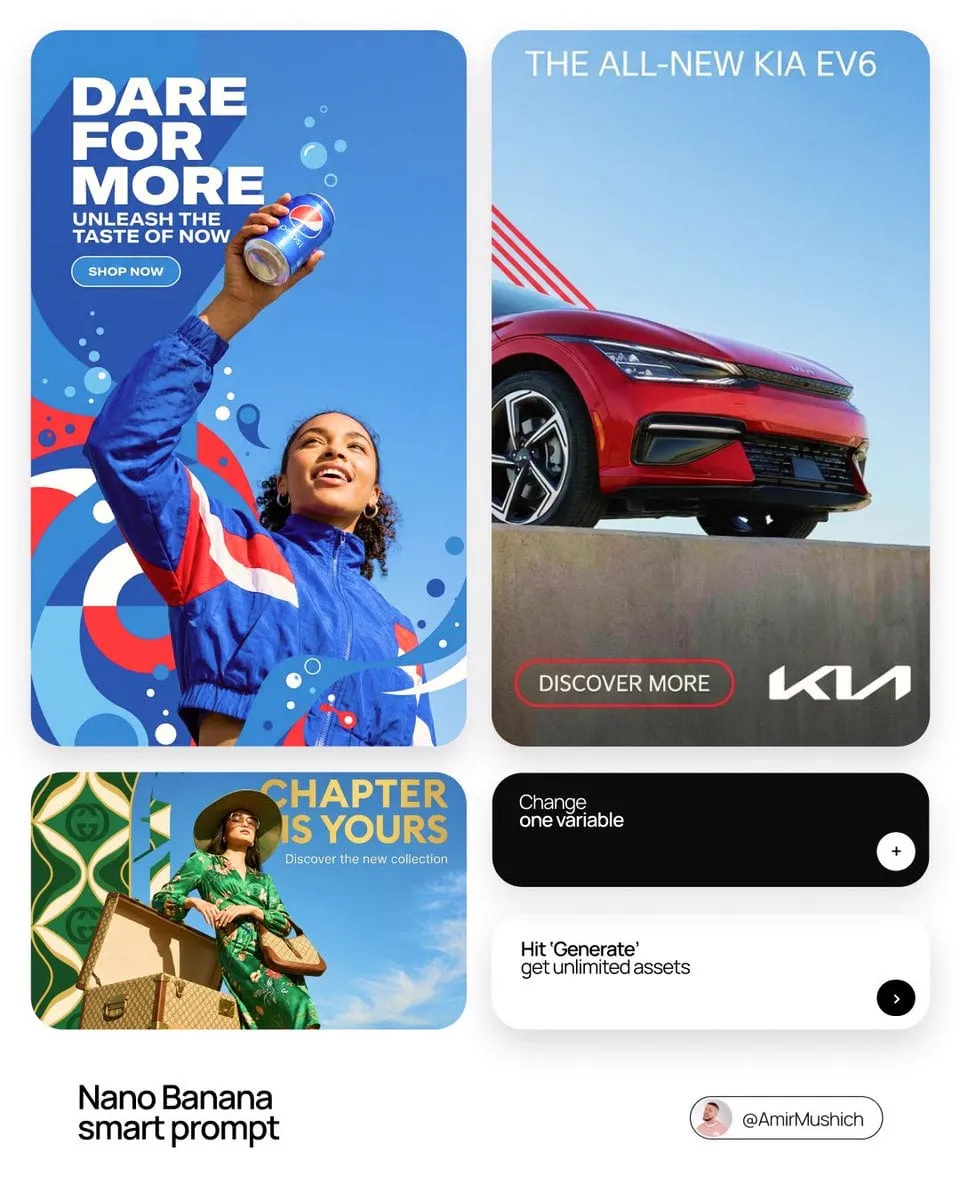
Test one variable at a time. Change the action, keep everything else, and see what happens. This is how you learn what the model responds to, and it is also how you build intuition about its vocabulary. After a few rounds of single-variable testing, you will know whether your model handles camera instructions or ignores them, which changes how you write for it.
Keep a prompt journal. Save the prompt, the model, and the result for every meaningful test. It is the fastest way to improve, because it turns your experiments into a reference library instead of scattered memory.
Moving from Beginner to Professional
Professional prompting is not fancier language; it is structure, control, and reproducibility. The techniques that separate pros from hobbyists are learnable in an afternoon.
Structural prompting splits the prompt into labeled sections instead of one long sentence. A structured prompt looks like this:
- Subject: the character from the reference image, red jacket, scar on left cheek
- Action: walks toward camera, turns head, slight smile
- Scene: empty subway platform, fluorescent lighting, steam from vents
- Camera: dolly push-in, eye level, 35mm lens
- Mood: tense, quiet, late night
The model parses sections far more reliably than prose, and the format makes iteration trivial: change the action line, keep the rest, regenerate.
Iteration by editing, not rewriting, is the second professional habit. Change one line at a time and observe the delta. Rewriting the whole prompt for every attempt destroys your ability to learn which words mattered.
Seed and variation control matter for reproducibility. When a tool exposes a seed or variation setting, use it: fix the seed to reproduce a result, vary it to explore a family of outcomes. This is how you generate ten coherent alternatives instead of ten unrelated gambles.
Finally, professionals write prompts for the specific model. The model's documentation and community examples teach its vocabulary, and the same shot described two ways can behave completely differently in one model. Learn your tool's dialect.
Matching Prompts to Models
Prompt quality is meaningless without model fit. A perfect cinematic prompt is wasted on a model that cannot render cinematic language, and a simple product prompt is overkill for a model that excels at exactly that.
For text-to-video, choose the model by the type of shot, then write the prompt in that model's strongest register. Photorealism-focused models reward film vocabulary: lens, depth of field, lighting, grain. Instruction-following models reward explicit physical actions and simple scene descriptions. Fast tiers reward brevity; they do not need your life story, just the action and the subject.
For image-to-video, the prompt is shorter because the source image carries the subject and scene. Focus the prompt on motion: what moves, how it moves, and what the camera does. "The subject turns to the camera as the wind lifts the curtain behind them, slow push-in" is the whole job.
For character consistency, the prompt alone is never enough; it must be paired with reference images. The prompt describes the action and scene, and the reference describes the identity. Trying to describe a face in words when you have a picture of it is fighting the tool.
Keeping Characters and Style Consistent
Consistency is the hardest prompt problem, because it requires controlling something the model invents fresh every generation: identity. The reliable solution is to remove the invention entirely.
Lock identity with references, not adjectives. One strong anchor image of the character, attached to every generation, beats the most detailed face description you can write. For style, one style reference image beats every style adjective in the dictionary.
Describe the scene in facts, not judgments. "The character from the reference, wearing the black coat, standing in the rain" keeps the identity in the reference and the situation in the prompt. When the output drifts, change the reference or the facts, never the mood words.
For multi-scene projects, reuse the exact same subject and style lines in every prompt. Copy them, do not retype them. Small wording changes cause small identity changes, and small identity changes accumulate into characters who visibly morph across a film.
Sequencing Scenes and Transitions
Once a single shot works, the next skill is making shots feel like one continuous video. Sequence control is the prompt problem of linking.
Plan transitions at the prompt level. If scene one ends with the character walking right, scene two should start with them entering from the left, so the edit feels continuous. Describe the entry and exit in the prompts, not in the edit, and the footage will be far easier to cut.
Use consistent spatial anchors. Establish the environment once, in a wide shot, then reference its landmarks in closer shots. "the same cafe from the wide shot, now a close-up of the coffee cup" tells the model the world is one place.
Vary the camera, not the world. The audience reads continuity from the environment and character, so keep those constant and let the camera move. Changing the style or the character between shots is what breaks the illusion, not changing the angle.
Controlling Technical Image Elements
Beyond narrative, professional video prompting controls the technical look of every frame: resolution feel, motion blur, focal length, and artifact avoidance.
Motion language controls feel: "smooth slow motion," "handheld shake," "fast whip pan," "locked-off tripod" each produce a recognizable motion signature. Choose the signature that serves the scene and stick to it across related shots.
Avoidance language prevents common failures: "no warping," "no extra limbs," "no text or watermarks," "stable face." Put the critical negatives in every prompt for shots where those failures have bitten before.
Keep the frame clean by limiting simultaneous motion. One strong motion per shot, with camera and atmosphere as support, produces footage that holds together. Multiple competing motions produce mush, and no technical prompt can save it.
Integrating Prompts into a Full Workflow
Prompting is not the whole pipeline; it is the instruction layer of one. The professionals treat prompts as assets that feed an assembly line: brief, prompt, generate, review, edit, deliver.
Write the brief first, always. The brief defines the shot, the audience, and the purpose. The prompt is the translation of that brief into model language, and the generation is the test of that translation. When a generation fails, the question is whether the brief was wrong, the prompt mistranslated it, or the model could not do it, and those three failures have three different fixes.
Document every working prompt in a library organized by shot type: hero shots, transitions, product close-ups, character entrances. The library is the compounding asset; every good prompt you write makes the next project faster and the quality higher.
Prompt Patterns for Common Content Types
The same core elements flex into recognizable patterns for the content people actually make. Learning the pattern for your type shortcuts the whole design process.
For product and commercial content, the pattern is clean subject, single hero action, premium environment, and brand-safe lighting. The prompt centers the product, gives it one satisfying motion such as a slow rotation or a pour, and keeps the background simple enough that the product reads instantly. Negative space for text and watermarks is mandatory, because product footage always ends up under captions.
For character and story content, the pattern is reference-locked identity plus factual action plus consistent environment. The character's look lives in the reference, the action describes one physical event, and the scene landmarks repeat across shots so the world stays one place. Mood words come last and stay stable from shot to shot.
For social and short-form content, the pattern is hook-first: a strong opening visual, one fast motion, and a clear payoff in the final second. The prompt should make the first frame arresting on its own, because most viewers decide in the first two seconds and the thumbnail often is the first frame.
For atmospheric and ambient content, the pattern is environment-led: the scene, the light, and the particles carry the piece, and the subject is small or absent. These prompts succeed on sensory language, mist, rain, slow drift, and fail when they add a subject the model does not know what to do with.
Every pattern still obeys the same rules: one action, structured sections, negatives for known artifacts. The pattern only changes which elements lead.
FAQ
How long should a prompt be? As long as it needs to be and no longer. A short prompt with the five core elements beats a long prompt with two elements buried in adjectives.
Do I need to learn coding to write good prompts? No. The skills are observation, precise description, and disciplined testing, none of which require code.
Why does the same prompt give different results every time? Generation is sampling-based, so variation is normal. Use seeds or variation controls when you need reproducibility, and embrace the variation when you are exploring.
Are negative prompts necessary? Not always, but they are the cheapest insurance against known artifact patterns. Use them for shots where specific failures have occurred before.
How do I know if my prompt or my model is the problem? Test the same prompt on a different model, and test a known-good prompt on your model. The results separate prompt problems from model problems quickly.
Key Takeaways
Prompting is a learnable language built from subject, action, scene, camera, lighting, and style, with structure and negative space as the professional layer. Beginners improve fastest through short concrete prompts and single-variable testing; professionals win through structured sections, iteration by editing, model-specific vocabulary, and reference-locked identity. Treat prompts as reusable assets, keep a library, and let the brief drive the prompt. Do that, and the results stop being luck and start being a craft.
