
Marketing videos fail for a surprising reason: not bad footage, but bad thinking before the footage exists. Teams jump straight into generation — prompting scene after scene — and end up with beautiful clips that tell no story, target no audience, and answer no business question. The fix is pre-production, and AI has made it dramatically easier to do well. Scriptwriting assistants turn a rough brief into a structured narrative, shot-list generators break that narrative into camera-ready frames, and image-to-video workflows lock characters and scenes before a single second is generated. This guide walks through the full process: turning a business goal into a script, designing shots that survive AI generation, and managing the workflow so the final video actually sells something.
Start With the Business Goal, Not the Scene
Every marketing video exists to change something: awareness, sign-ups, purchases, trust. If you cannot state that goal in one sentence, no amount of cinematic quality will save the video. The pre-production process starts by writing the goal down, along with the audience and the single message the video must deliver.
A useful format is the one-line brief: "For [audience], who [problem], our video shows [message], so they [desired action]." This sentence does the work of a dozen meetings. Every scene, every prompt, every shot in the list is then evaluated against it: does this help the audience understand the message and take the action? If not, cut it. The brief also defines the constraints — duration, platforms, tone, brand voice — that keep the creative work on rails.
Build the Narrative Arc Before the First Prompt
A marketing video is a story even when it is only fifteen seconds long. The most effective short-form structure is still a three-beat arc: establish the problem, reveal the solution, prompt the action. In fifteen seconds, that means roughly five seconds per beat; in sixty seconds, the beats expand with room for context, proof, and emotion.
Do not confuse story with plot. For marketing, the narrative is about the audience, not the brand: the protagonist is the customer, the conflict is their problem, and the resolution is the product or service. Write the arc as three or four sentences before touching any AI tool. Then expand each beat into a few lines of script — what the viewer sees, what they hear, what they should feel. This skeleton is what you hand to the script assistant and, later, to the generation model. If the skeleton is weak, the AI will faithfully produce a weak video with excellent visuals.
Define a Consistent Lead Character
Viewers bond with a face, not a feature list. Marketing videos work best when a consistent lead character — a presenter, a mascot, a product, or a stylized avatar — carries the story from scene to scene. The hardest technical problem in AI video is keeping that character identical across shots, and the solution starts before generation: define the character once, in detail, with reference images.
Create a character sheet with the visual traits (appearance, clothing, setting), the personality traits (tone, energy, catchphrases), and two or three approved reference frames. Use those references in every scene that features the character. If the model drifts, fix the reference rather than re-describing the character in words. Consistency is what separates a campaign from a collection of unrelated clips, and it is the quality that clients and audiences notice first.
Write Dialogue That Survives AI Voices
Modern AI voiceover is good, but it is not forgiving. Long sentences become monotonous, acronyms get mispronounced, and complex clauses lose their emphasis. Script for the voice: short sentences, active verbs, and natural speech rhythms. Read every line aloud; if it sounds awkward spoken, rewrite it before recording or generation.
Structure the audio track the same way you structure the visuals. Mark the beats: where the voice should pause, where emphasis lands, where the music swells. If the video will be watched muted — and most social video is — the dialogue must be redundant with the on-screen text. Write captions as part of the script, not as an afterthought, and keep them short enough to read in two seconds. The voice and the captions are two deliveries of the same message; plan them together.
From Script to Shot List
The shot list is the bridge between the story and the generator. For each beat of the script, define the shots: subject, action, framing, camera movement, and duration. A fifteen-second video might have five to eight shots; a sixty-second video, fifteen to twenty-five. Each line of the shot list should be specific enough to become a prompt without additional thought.
The shot list is also the quality gate. Before generating anything, review the list against the brief: does every shot serve the message? Are the shots varied enough to hold attention — close-ups, wide shots, inserts — without feeling random? Does the sequence build toward the call to action? Fix the list first; generation then becomes an execution problem instead of a discovery problem.
Camera Language: Angles, Lenses, and Movement
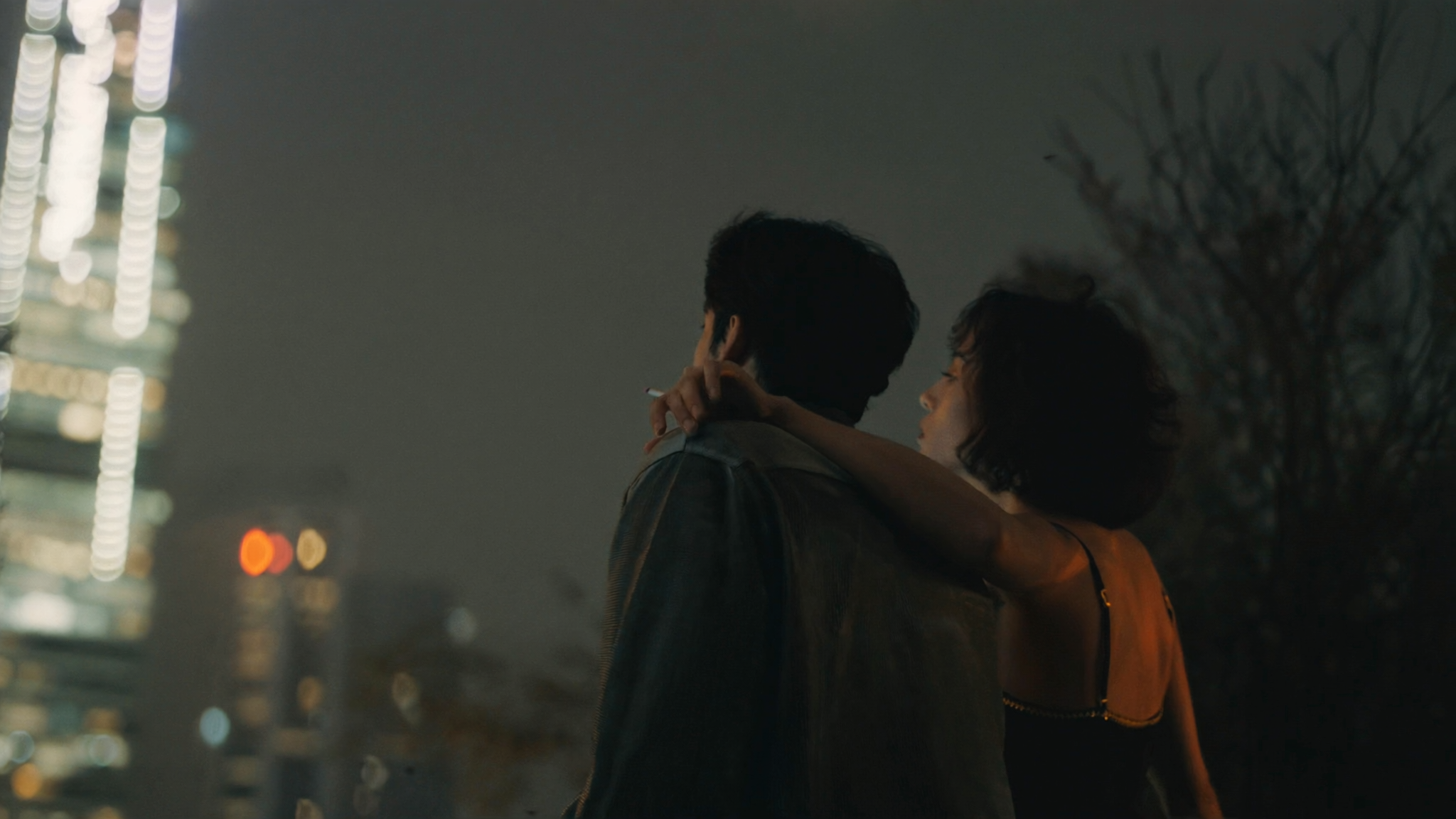
Cinematic language is a set of conventions that communicate emotion without words. Low angles make subjects feel powerful; close-ups create intimacy; wide shots establish scale; slow pushes build tension; whip pans signal energy. You do not need film school to use these tools — you need to choose them deliberately and describe them in the prompts.
Write camera instructions into the shot list explicitly: angle (eye-level, low, high), framing (close-up, medium, wide), and movement (static, pan, tilt, push-in, pull-back, handheld). AI models now respond well to this language, especially when the terms are consistent. Keep a small vocabulary of camera terms and reuse it; inconsistent terminology produces inconsistent results. The camera plan is also where the video develops its rhythm: alternate static and moving shots, vary shot length, and reserve the most dynamic camera work for the emotional peak.
Prompting for Cinematic Frames
With the shot list complete, write the generation prompts. Each prompt combines the shot's content (subject, action, setting) with its camera language (angle, framing, movement) and the project's style (lighting, color, mood). A good prompt is a sentence, not a paragraph: "Low-angle medium shot of a confident presenter walking toward the camera in a bright modern office, slow push-in, natural lighting, warm color grade."
Keep the style block identical across all prompts so the video feels unified, and keep a prompt library per project — the same style reused across dozens of shots is what makes a campaign look like a campaign. When a shot fails, change one variable at a time: adjust the camera term, then the lighting, then the action. Blindly re-rolling the same prompt is how budgets disappear.
Two more prompt habits are worth building. First, save every prompt that works, tagged by scene type — a library of fifty proven prompts covers most marketing needs and makes the next campaign dramatically faster. Second, write prompts that the team can read: a prompt that says "hero product shot, clean studio, push-in" is self-documenting, while a paragraph of random adjectives is a mystery by next week. Treat the prompt library as living documentation of the brand's visual language, and review it every few months as the models improve.
Managing Transitions and Scene Flow
Generation produces shots; editing produces flow. Plan transitions at the shot-list stage: hard cuts for energy, dissolves for time passing, whip pans or match cuts for continuity. AI-generated footage rarely has the exact motion to justify a match cut, so keep transitions simple and let the music carry the pacing.
Assemble the shots against the voiceover timeline, not the other way around. Cut on the voice's natural beats, add the music bed, and only then refine the transitions. A common rookie error is editing the visuals first and forcing the audio to fit. The result is always awkward. When the voice leads, the edit feels intentional, and the viewer's attention follows the story instead of the effects.
Planning Resources, Iterations, and Deliverables
Pre-production also means planning the production itself: how many generations per shot, which models for which scenes, what budget per scene, and what happens when a shot fails. Set a maximum iteration count per shot before you start; when it is reached, change the prompt or the approach instead of rolling again. Track cost per finished minute across the project — not per generation — to see which scenes are genuinely expensive.
Deliverables need the same discipline. Decide the aspect ratios and resolutions for every destination (vertical, square, wide) and export presets once. Name files project-scene-take so versions stay findable, and keep a project folder with the brief, the script, the shot list, and the prompts. That folder is the reproducibility engine: six months later, you can recreate the campaign's look, or hand it to a colleague who can.
Cross-Platform Repurposing
One marketing video should become many. A sixty-second hero video can produce a fifteen-second cutdown for vertical feeds, a silent-loop teaser for social, a square version for embeds, and a still-frame sequence for carousel posts. The shot list makes this trivial: the same scenes, reordered and re-timed, with captions adjusted per platform.
Design for repurposing from the start: keep the most important visual in the center of the frame (it survives crops), shoot the message early (so cutdowns keep the core), and avoid platform-specific references in the voiceover. The video that generates five assets from one production is worth five times the one that ships in a single format. Repurposing is not an afterthought; it is part of the brief.
FAQ
How long should a marketing video script be? As long as the message needs and no longer. Fifteen to sixty seconds covers most paid and organic formats; the script should be tight enough to fit the shortest cutdown of the campaign.
Do I need a real scriptwriter if AI can write scripts? AI scripts are a strong starting draft, but they still need human judgment on strategy, tone, and brand voice. Treat the AI as a fast first-draft partner, not the final decision-maker.
How do I keep the same character across many shots? Lock the character with reference images and reuse them in every scene. Fix drift by improving the reference, not by re-typing descriptions.
What is the most common pre-production mistake? Skipping the brief. Teams that start generating before writing the goal, audience, and message almost always produce beautiful footage that sells nothing.
How many iterations should I allow per shot? Set a limit before production — five is a reasonable default. When you hit it, change the prompt or the model, not the luck.
Should the voiceover be recorded before or after editing? Before. The voiceover timeline is the spine of the edit; visuals are cut to it, and music is layered around it.
How do I know if my shot list is good enough? Try the ten-second test: read each shot line and imagine the frame. If you can picture it clearly, the line is ready; if you hesitate, add the missing detail. A shot list that generates without friction — no reinterpretation, no guesswork — is a good shot list.
What if the AI keeps ignoring my camera instructions? Simplify the camera language and move it to the front of the prompt. Models respond better to short, standard terms like "low angle" or "slow push-in" than to elaborate descriptions. If it still fails, switch models for that shot rather than fighting the one you have.
Final Thoughts
The quality of an AI marketing video is decided before a single frame is generated. The brief defines the goal, the narrative arc shapes the story, the character sheet locks the consistency, and the shot list turns the script into camera-ready prompts. Pre-production is where creativity and discipline meet, and it is the part of the process that AI tools amplify rather than replace. Start your next campaign by writing the one-line brief, building the three-beat arc, and completing the shot list before opening a generator. The footage will be better, the iterations fewer, and the finished video will do what marketing videos are supposed to do: move the audience toward action.
