
AI video tools can generate beautiful images and smooth motion, but beauty and motion are not stories. A story has a character who wants something, a conflict that gets in the way, and a change by the end. Most AI-generated content fails at exactly this level: it produces ten impressive clips and calls the sequence a video, when what it really has is a slideshow of effects.
The gap between generating clips and telling stories is where the craft now lives. This guide is a practical workflow for creators who want to move from random AI output to intentional narrative work. It covers planning scenes, using AI director agents, locking character identity, choosing engines per scene, handling sound, and finishing the edit — the full path from idea to a story that holds together.
Why storytelling is the differentiator
Generative quality has become a commodity. Every few months, new models push realism further, and audiences have learned to expect good-looking AI footage. What they still notice, immediately, is whether the piece means something. A video with a clear point of view, a character arc, and a deliberate rhythm will outperform a technically perfect video with no direction, every time.
Storytelling also changes how you work. When you start from a story, every technical decision has a reason: this shot exists because the audience needs to see the character's reaction; this style exists because it matches the emotional tone; this cut exists because the rhythm demands it. Without a story, decisions are arbitrary, and arbitrary decisions produce forgettable content.
The good news is that AI tools are finally getting good at supporting narrative work instead of fighting it. The same features that help with consistency — reference images, keyframes, multi-image fusion — are fundamentally storytelling features. They let you hold an identity across scenes, which is the minimum requirement for any story.
The AI director agent: your first assistant director
One of the most useful developments in AI video is the director agent: an assistant that applies filmmaking principles to the generation process. It is not a replacement for the creator's vision, but it removes a huge amount of technical friction.
Scene composition without film school
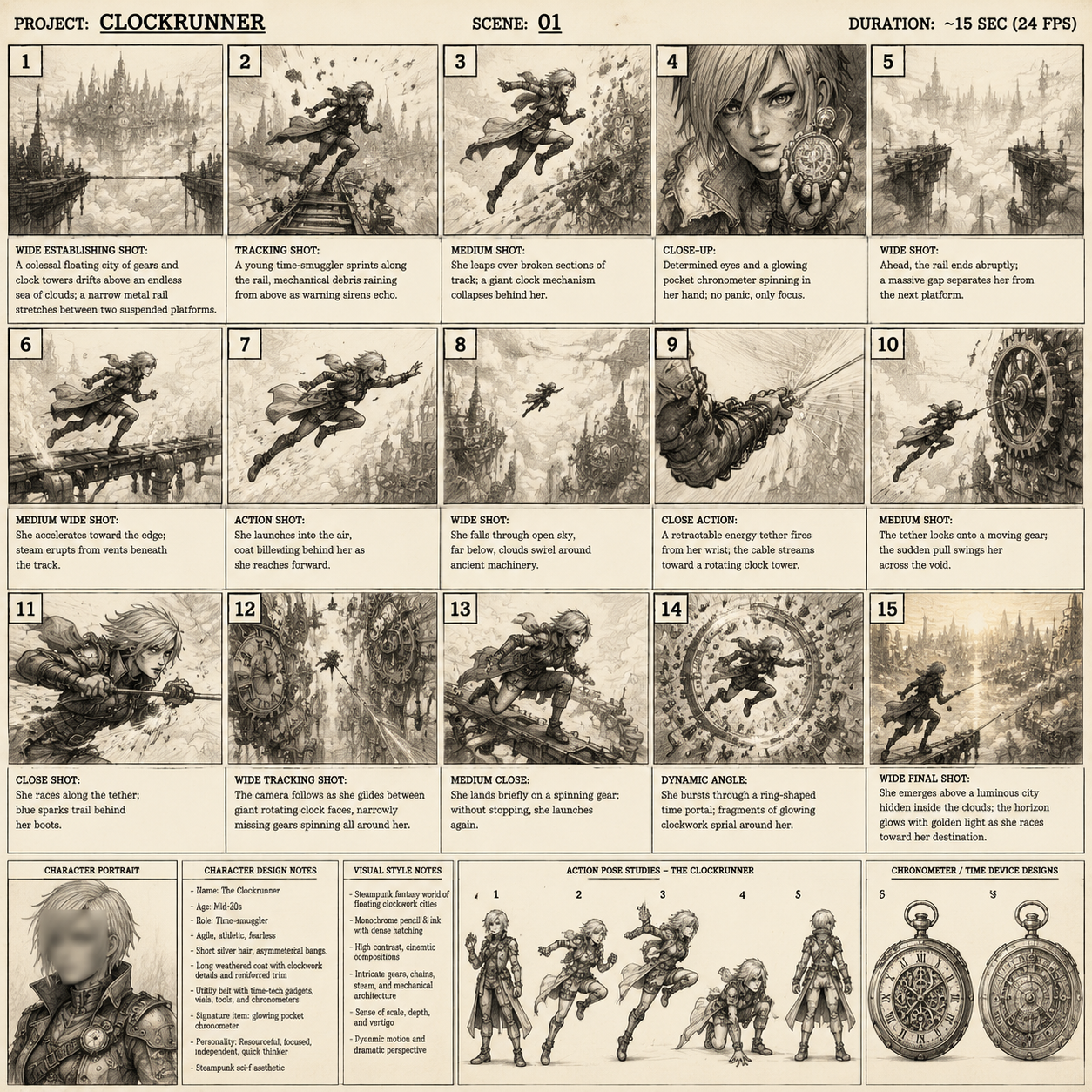
A director agent analyzes a scene description and suggests framing, camera angles, and movement that fit the narrative intent. Instead of guessing at prompts, you start from "what kind of shot does this moment need?" — a close-up for emotion, a wide shot for context, a tracking shot for energy. The agent translates those choices into generation parameters. This makes filmmaking knowledge accessible to creators who never had the chance to learn it on set.
Narrative structure as a starting point
The agent also helps you think of the piece as a whole. How many scenes does the story need? Where should the turning point land? Where does a slow moment serve the story, and where does it kill the pace? It works like a script supervisor who returns an editable structure instead of a blank page. For brand films, educational content, and teasers, this guidance dramatically reduces wasted iterations.
Consistency as a creative tool
The most valuable function of a director agent is maintaining coherence across shots: fixing keyframes, defining character identity through reference images, and keeping the style stable when you switch engines. This is the difference between a collection of clips and a sequence. It is also the difference between being able to tell a story at all and merely generating content.
Build the story before you build the shots
The discipline that separates professionals from hobbyists is planning. Before opening any generation tool, write the story down. It does not need to be long — a few paragraphs will do — but it needs to exist.
Start with the essential structure:
- The character. Who is the protagonist? What do they want? What do they fear?
- The conflict. What stands between the character and what they want? This can be another person, an environment, or an internal doubt.
- The change. How is the character different at the end? Even a 30-second ad can show a change: before and after, problem and solution, hesitation and confidence.
- The tone. How should the audience feel? Excited, nostalgic, inspired, uneasy? Write three adjectives and keep them visible during every decision.
Then break the story into scenes. For each scene, note four things: what happens, who appears, what the audience should feel, and what kind of shot serves that feeling. This scene list becomes your production bible. Every generation, every model choice, every edit decision flows from it.
Choosing engines for each scene type
With the scene list in hand, you can assign the right tool to each scene instead of using one engine for everything. This is where the variety of available models becomes a creative advantage.
- Realistic scenes — product shots, people, environments that should look filmed — benefit from engines known for photorealistic output, such as the Flux family, Runway, or the Sora series. Use them for the scenes where viewers will look closely and believe what they see.
- Stylized scenes — animation, illustration, comic aesthetics, brand-specific looks — benefit from engines with strong style adherence, such as Kling AI, PixVerse, or Vidu. They hold a defined art direction across multiple shots.
- Motion-heavy scenes — action, dance, particles, camera moves — benefit from engines with strong physical motion, such as Luma, Pika, or the Hailuo series. Fluidity matters more than still-frame quality in these moments.
A typical short film might use two engines: one for the realistic establishing shots, another for the stylized dream sequence. The scene list tells you which scenes need which engine, and the consistency layer keeps them feeling like one project.
Keeping characters consistent across shots
Storytelling collapses if the audience cannot recognize the characters. The face must be the same face in scene two as in scene five; the costume must stay consistent; the emotional register must survive the change of engine.
The practical method is reference locking:
- Create the canonical identity. Generate or collect reference images of each character from multiple angles and lighting conditions. Iterate on a still image until it is right — this is the cheapest place to fix problems.
- Feed multiple references. Where the tool supports multi-image fusion, provide several images of the same character. This teaches the model which traits are fixed and which can vary.
- Lock keyframes. For important scenes, fix the starting and ending poses. The model fills the motion between them without betraying the identity.
- Keep a style guide. Write down the palette, the lighting direction, and the texture choices, and reuse them in every prompt.
This work feels slow, but it is the highest-leverage activity in the entire project. Every scene generated after identity is locked has a much higher chance of being usable. Skipping it guarantees a story that looks broken to anyone who watches more than one scene.
Sound: the forgotten half of storytelling
A surprising number of AI video projects end with no sound at all, or with a single royalty-free track slapped on top. That is a mistake. Sound is half of the emotional experience, and in short-form video it is often the deciding factor between a piece that feels professional and one that feels like a test render.
Build the sound in layers:
- Music that follows the story. The track should change with the emotional arc — quieter in the setup, fuller at the climax. Editing music to the story is more important than choosing a "good" track.
- Ambience. Room tone, city noise, wind, footsteps. Even subtle ambience makes scenes feel real.
- Foley and effects. Doors, clicks, whooshes on transitions. Small sounds add physicality that visuals alone cannot provide.
- Voice. If the story has narration or dialogue, record it properly or use a high-quality voice tool. Voice carries the story more directly than any other element.
Do the sound pass after the picture is locked. Then watch the video again with fresh eyes — the difference will convince you better than any argument here.
From rough cut to final delivery
The generated scenes are raw material. The final pass is still editing, and it is where the story actually gets made:
- Assemble the approved scenes in order. Watch the whole thing without judgment on individual shots — the flow matters more than any single frame.
- Cut for rhythm. Remove the dead seconds before and after the action. Tighten pauses. Let the best moments breathe just long enough.
- Grade for unity. Apply a consistent color grade so different engines and lighting conditions feel like one project.
- Add the sound layers described above.
- Check the opening. The first two seconds decide whether anyone watches. The opening must establish the tone and the hook immediately.
- Export for the platform. Vertical for Reels and TikTok, 16:9 for YouTube, with correct resolution and bitrate.
The edit is also where you can fix story problems cheaply. A scene that does not work can sometimes be rescued by cutting it shorter, moving it later, or changing the music under it. Never accept a story problem as permanent until you have tried the edit.
Mistakes that kill AI stories
- Generating before writing. The most expensive mistake. Without a story and a scene list, the generated material will not assemble into anything.
- Inconsistent characters. A character whose face changes between scenes destroys the story regardless of individual shot quality.
- Style drift. Changing palettes and treatments mid-project makes the piece feel like a compilation, not a film.
- Ignoring sound. A silent video is a draft. Sound is not decoration; it is storytelling.
- Falling in love with one shot. A beautiful shot that does not serve the story is a distraction. Cut it.
- Ending without change. If the character is exactly the same at the end as at the start, there was no story. Even a 20-second piece needs a turn.
Frequently asked questions
How long does an AI short film take? A 30–60 second piece with planning, generation, and editing is typically a day of work. With a well-worn workflow and parallel generation, a few hours are realistic.
Do I need a script? A full screenplay is not necessary, but a written plan — character, conflict, change, scene list — is essential. The more concrete the plan, the less you waste on generation.
Can AI director agents replace human directors? No. They are powerful assistants that remove technical friction and suggest cinematic choices, but the vision, taste, and judgment remain human. The best results come from creators who direct the agent.
What if my project is just a product demo? The same structure applies at a smaller scale. The "character" can be the product, the conflict can be the problem it solves, and the change is the customer's transformation. Even a demo is a story.
How do I keep quality high without breaking the budget? Plan before generating, iterate on cheap models, validate on keyframes, and reserve premium engines for the scenes that matter most. The story plan is also a cost-control tool: it tells you exactly how many scenes you need and which ones deserve the expensive treatment.
What if my audience only watches short clips? Short formats need the same narrative discipline, compressed. A 15-second piece can still have a character, a want, a turn, and a payoff. The scene list gets shorter, but the structure does not disappear. Think of it as telling the story with fewer, sharper beats rather than abandoning the story.
Should I publish everything I generate? No. The edit is the story, and selection is part of the edit. Generate more material than you need, then choose the shots that serve the narrative and cut the rest. Publishing every generated clip trains your audience to expect unfocused content. Publishing only what serves the story builds a reputation for quality — and quality compounds over time.
The craft of AI storytelling
The tools will keep improving, but the craft is not in the tools. It is in the decisions: what the story is, what the audience should feel, which shots serve the narrative, and how the pieces fit together. AI removes the friction of production so those decisions can happen faster and more often.
Start small. Write a one-minute story with a clear character, conflict, and change. Plan it, generate it, edit it, sound it. Watch what works and what breaks. The second story will be better, and the tenth will be something you can show with pride. That is the path from generating clips to telling stories — and it is open to anyone willing to plan before they prompt.
