



From single clips to model-agnostic pipelines
For most of the short history of AI video, the workflow looked the same: write a prompt, wait for a few seconds of footage, watch it once, and repeat. Each clip was a standalone experiment. Rendering times were long, hardware costs were high, and the results were hard to stitch into anything longer than a teaser. The creative industry treated AI video as a novelty because, in practice, that is what it was.
That phase is over. The shift that matters in 2025 is not a single model release — it is the move from single-clip generation to model-agnostic production pipelines. Instead of betting everything on one generator, studios and creators now assemble pipelines that route each shot to the right model, keep characters and styles consistent across shots, and turn a pile of clips into a finished piece of content.
The practical consequence is that the bottleneck is no longer raw capability. The models can produce photorealistic, coherent, stylistically consistent footage. The bottleneck is now workflow design: knowing which model to use when, how to keep the output consistent, and how to manage the compute and the iteration loops. Teams that solve the workflow problem get a compounding advantage, because every new model that appears can be dropped into the pipeline without redesigning everything.
Why model diversity matters
There is a temptation to find one model and stick with it. It simplifies decisions and reduces cognitive load. But it is also a strategic mistake, for three reasons.
First, no single model dominates every dimension. Some models produce the most physically accurate motion; others are best at following complex narrative instructions; others are fastest or cheapest per second of footage; others excel at stylized or animated looks. A pipeline locked to one model forfeits the strengths of everything else.
Second, the ranking changes constantly. The model that leads today is often surpassed within months. A pipeline that depends on one specific model inherits its obsolescence. A model-agnostic pipeline treats each generator as a replaceable component behind a common interface.
Third, variety is a hedge. Model providers change their APIs, pricing and availability. Teams that can switch models quickly are protected from vendor risk, and they can always negotiate from a position of choice.
The practical way to manage diversity is a catalog with metadata: each model gets a profile describing its strengths, its target use cases, its cost profile and its failure modes. The pipeline consults the catalog when routing a job. This turns a chaotic pile of options into a manageable system.
Consistency: fusion, keyframes and character locks
The most painful problem in early AI video was character consistency. The same character would change face, hair, clothing or proportions between shots, making longer narratives impossible. The introduction of multi-image fusion as a standard capability changed that.
Multi-image fusion works by taking several reference images of a subject — face, full body, costume details — and using them to lock the subject's visual identity before generation starts. The model does not invent the character from the prompt; it extracts the identity from the references and then animates it. This is the difference between a generic "woman in a red coat" and a specific character who stays recognizable across every shot.
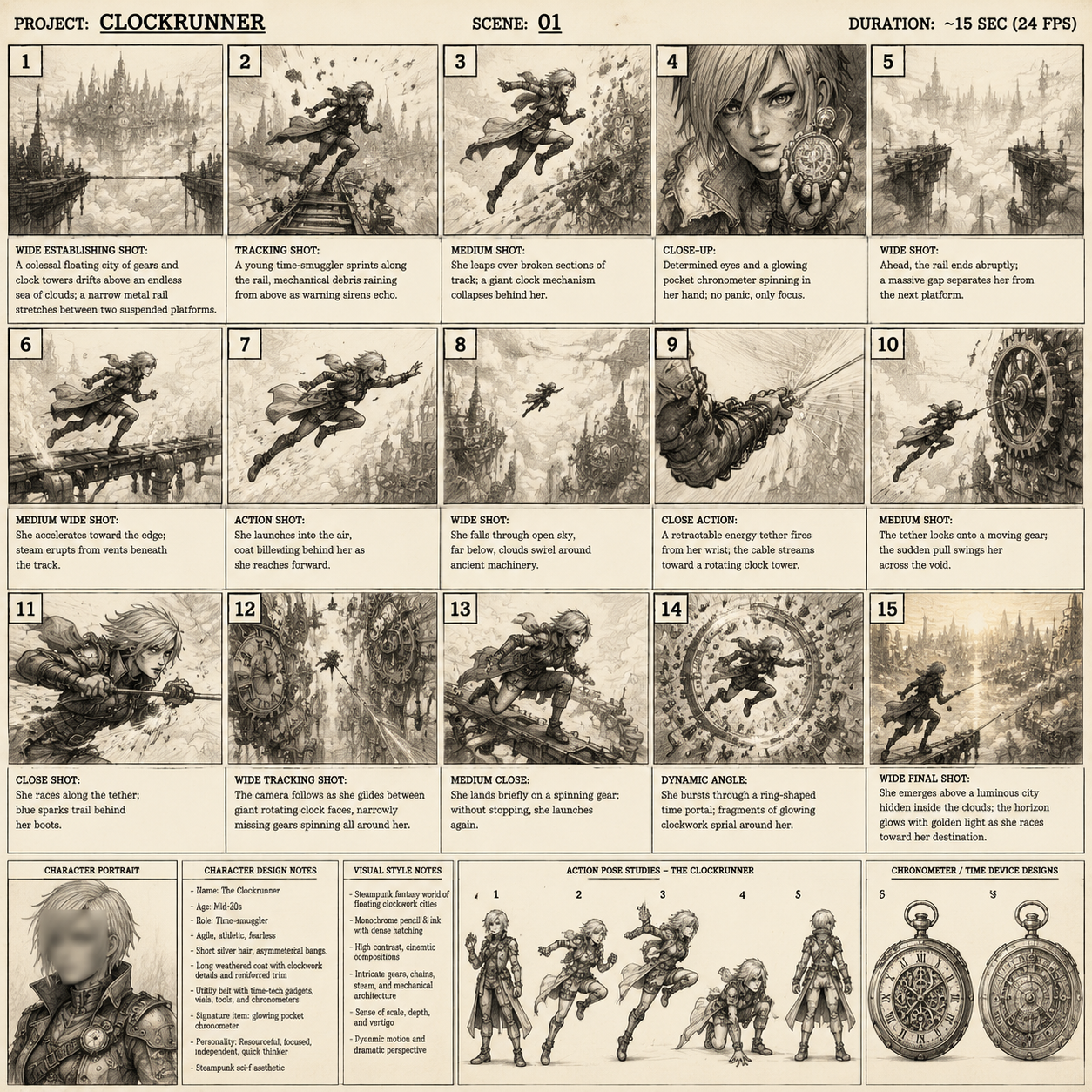
Keyframing complements fusion. A keyframe is a control image that defines a precise instant of the scene. Instead of generating a long sequence in one pass, the pipeline generates shorter segments anchored by keyframes, guaranteeing continuity at the boundaries. Fusion locks the identity; keyframes lock the continuity.
Consistency applies to more than characters. Recurring props, brand colors, vehicles and environments can all be locked the same way. Mature pipelines build a library of reusable visual identities, so a new project starts from existing assets instead of redefining everything from scratch.
The backend that makes it possible
Behind every smooth pipeline is an unglamorous but critical layer of infrastructure. The backend has to do four things well.
It has to manage model integration. A common pattern is a modular backend with dependency injection, often built with frameworks like NestJS and TypeScript. Each model is an implementation of a common interface — generate, refine, estimate cost — and the rest of the system calls the interface. Adding a new model becomes a configuration change instead of a rewrite.
It has to manage compute. Generation is GPU-intensive, and jobs arrive unevenly. A task queue system prioritizes requests, distributes them across available compute, retries failures and scales resources during peaks. Without a queue, a busy moment either wastes idle capacity or creates long waits.
It has to manage data. PostgreSQL is a common backbone for user data, project metadata and generation history. Object storage handles the heavy media files. The data layer also tracks provenance: which prompt, model and parameters produced which output. This is essential for reproducibility and for improving prompts over time.
It has to manage security and identity. Authentication, role-based access and encryption protect user projects and reference images. Billing and subscription management integrate at this layer as well, isolated from the generation logic so that pricing changes never touch the rendering pipeline.
A tour of the current model landscape
The model landscape is broad, but the contenders fall into recognizable groups.
At the quality frontier sit the models that define the state of the art. The Flux series is known for image quality and strong prompt adherence, making it a default choice for high-value stills and hero shots. Runway Gen-4 built its reputation on character consistency and has become a common choice for narrative work. Sora, from OpenAI, remains the benchmark for narrative understanding and scene complexity, especially for longer sequences.
The Asian breakthrough models have changed the competitive picture. Kling and PixVerse, in particular, brought strong prompt adherence and professional features at competitive cost. Tencent Hunyuan and the Alibaba Wan series have also pushed quality upward, with Wan earning attention for frame control and consistency. These models made high-quality generation accessible to a much wider audience.
Specialized models cover the niches: anime and stylized looks, physical realism, fast drafts, budget-friendly bulk generation. The landscape in mid-2025 looks like a diversified portfolio rather than a single winner — which is exactly why a model-agnostic pipeline is the right architecture.
Building an efficient production pipeline
A production pipeline can be built in five stages, each with a clear deliverable.
Stage one is intake: the idea becomes a brief — script, storyboard, visual references, target format and duration. The quality of this stage determines the quality of everything downstream. Teams that rush the brief pay for it in iterations.
Stage two is planning: the brief is split into shots, and each shot is assigned a model based on the catalog. This is where an AI director agent can help, proposing compositions and camera moves and routing each shot to the appropriate generator. The plan is validated by a human before generation starts.
Stage three is generation: shots are produced, with fusion and keyframes applied where identity and continuity matter. The queue manages compute; the router enforces the plan. Variants are generated for the shots that need options.
Stage four is review: each shot is checked against the brief — prompt fidelity, character consistency, motion quality. Failures are sent back with specific reasons, not vague "try again" feedback. This loop is where the team's taste becomes encoded in the pipeline.
Stage five is assembly: the approved shots are edited, sound is added, and the final video is adapted to the target formats. The output is a finished asset, not a folder of clips.
When to use which model
Decision frameworks beat intuition when the catalog grows. A useful framework scores candidate models on four axes.
Prompt fidelity: how closely does the model follow complex instructions? Critical for narrative work and branded content.
Consistency: how stable are characters and styles across shots? Critical for series, campaigns and anything with recurring elements.
Cost and speed: how much compute per second of output, and how fast? Critical for high-volume production and iteration-heavy workflows.
Failure modes: what does the model get wrong, and how often? A model that fails rarely but catastrophically may be worse than one that fails often but predictably.
The right choice depends on the project. A hero shot for a campaign prioritizes fidelity and consistency. A draft for internal review prioritizes speed. A series prioritizes consistency above everything. Documenting the trade-offs makes the choice repeatable instead of improvised.
Measuring and improving the pipeline
A pipeline without measurements is a collection of opinions. The teams that improve fastest are the ones that instrument every stage and let the data drive the next change.
The first metric is success rate: what fraction of generations pass the review stage on the first attempt? A low success rate usually points to weak briefs or a model mismatch, not to bad luck. Track it per model, per shot type and per prompt category, and the pattern becomes obvious. When one model fails twice as often on dialogue shots, the routing rule should know it.
The second metric is cost per delivered minute. Generation cost, retry cost and review time all belong in this number. It is the honest measure of efficiency, because it punishes both over-spending on hero models and under-spending that causes retries. A cheap model that fails half the time is usually more expensive than a mid-priced model that rarely fails.
The third metric is iteration latency: how long does it take from a review note to a new version? This is where workflow design shows up. Teams that keep the loop tight — clear failure reasons, fast regeneration, small review batches — iterate faster and finish with better output. Latency is the hidden tax of messy pipelines: every hour saved here compounds across the project.
The fourth metric is consistency drift: how often does a character or style fail the identity check across shots? This number catches problems that quality review sometimes misses, because it is measured on every shot rather than on the highlights. A drift rate that climbs over time usually means the reference library needs maintenance, not the models.
Measurement only pays off if it feeds action. A weekly review of these four numbers, with one experiment per week — change a routing rule, improve a brief template, add a reference block — compounds quickly. The pipeline becomes a system that learns, not a static script.
None of this requires exotic tooling. A spreadsheet and a habit of writing down failure reasons beat a beautiful dashboard that nobody reads. The discipline is the tool.
FAQ
How many models do I need to start?
Two or three. One strong generalist for most shots, one specialist for consistency or realism, and optionally one fast model for previews. Expand the catalog when a real need appears, not before.
Is a complex backend necessary for a solo creator?
No. A solo creator can start with scripts and configuration files. Modular architecture pays off when the team grows, volumes rise, or billing and multi-user features become necessary.
How do I compare two similar models fairly?
Run both on the same reference shots and score them against the same fixed criteria: prompt fidelity, character consistency, motion quality, generation time. Rankings from benchmarks are less useful than results on your own material.
What is the biggest mistake in AI video production?
Treating generation as the whole job. The pipeline — brief, planning, review, assembly — matters more than any single model. Teams that obsess over the latest model while skipping review and iteration loops produce worse work than teams using older models with disciplined workflows.
Conclusion
The future of video production is not a single model, however impressive. It is a pipeline that treats models as interchangeable components, locks consistency through fusion and keyframing, manages compute with queues and routing, and disciplines the process with briefs, reviews and measurements.
The teams that win will not be the ones with access to the newest model on day one. They will be the ones that can absorb new models into a working system within days, keep their characters and brands consistent at scale, and turn AI generation from a demo into a dependable production line. The models keep changing; the architecture is the durable asset.
