

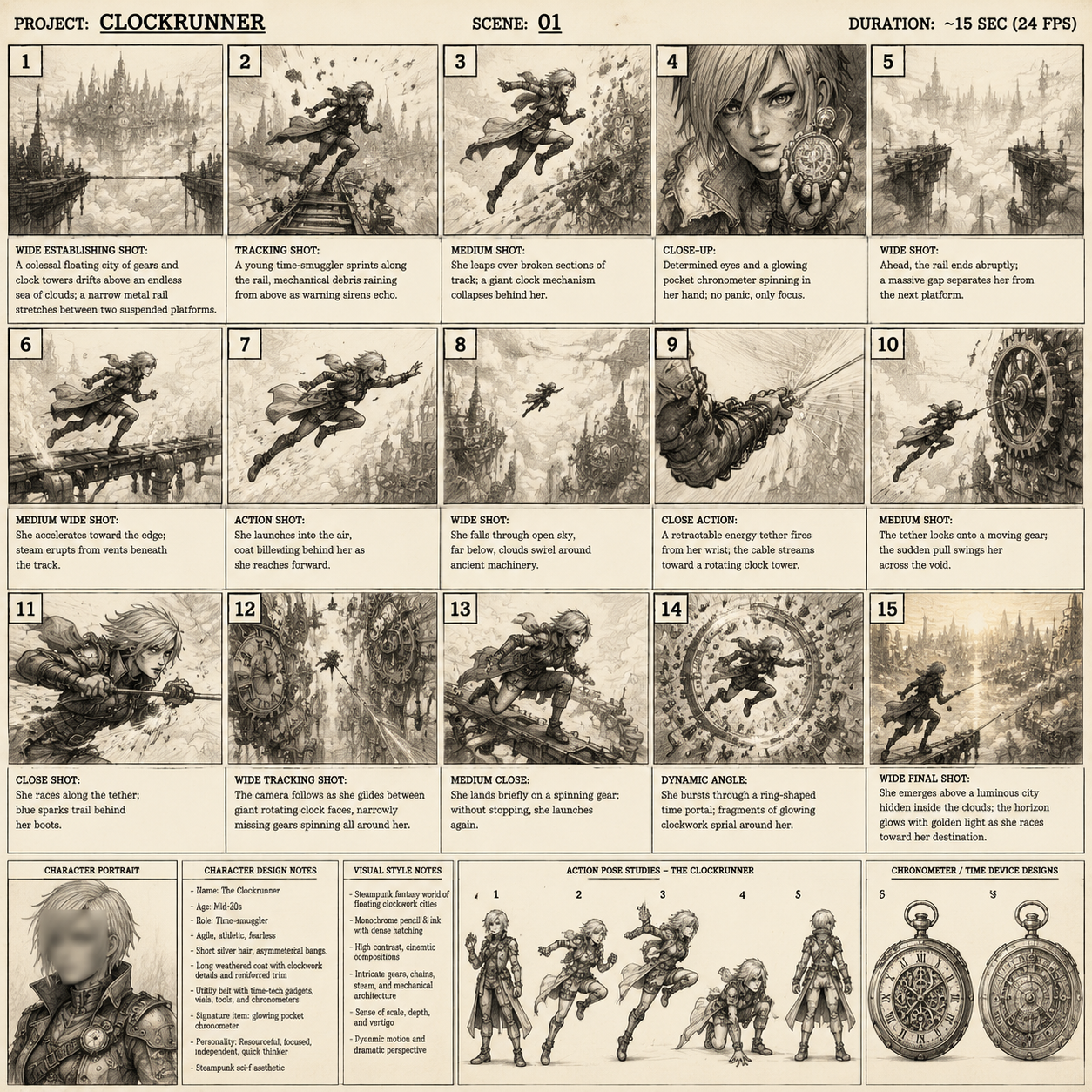
Gemini Alpha hidden features: how it compares to the generative AI landscape
The generative video space moves so fast that a model that was revolutionary six months ago can feel ordinary today. Amid this churn, Gemini Alpha has carved out a distinctive niche with a set of capabilities that are easy to overlook if you only read the headline specs. Behind the surface of being "one more video model" there are genuinely interesting design choices, especially around temporal control, motion precision, and the way the model handles multimodal input.
For creators deciding which model to build their workflow around, the useful question is not "which model is best" but "which model is best for which task." This article dives into the hidden strengths of Gemini Alpha, then compares it honestly with the other generative leaders: the Sora series from OpenAI, the Runway Gen series, and the Chinese models Kling and MiniMax Hailuo. The goal is practical guidance you can actually use when you choose a model for a project.
What sets Gemini Alpha apart: the overlooked strengths
Gemini Alpha is designed as a genuinely multimodal model rather than a patchwork of separate single-purpose modules. That architectural choice shows up in how it behaves on real tasks, and several of its best working modes are the least advertised.
Temporal control and motion precision
The most interesting hidden feature is the granularity of motion control. Rather than simply telling the model "make it move," you can guide the motion with unusual precision, specifying how a camera behaves or how a subject transitions through a scene over time. For creators who need choreographed movement, specific camera moves, or a subject that changes state in a controlled sequence, this level of temporal precision is a real advantage.
It is the kind of feature that does not appear on a feature list but changes the workflow daily. Projects that need consistent timing, or scenes where the movement itself is the point, benefit disproportionately from it.
Resource efficiency and accessibility
Another understated strength is how efficiently the model runs relative to its quality. In a field where top-tier models are often associated with heavy resource demands, Gemini Alpha aims for a more accessible trade-off between cost and quality. That matters for independent creators and small studios who cannot afford to burn their entire budget on a single clip, but still want results that look serious.
This is less glamorous than raw quality, but for real-world production it is often the deciding factor between a model you use every day and one you keep for special occasions.
Multimodal grounding
Because the model is natively multimodal, it handles conditions like starting images, style references, and text together with less friction. Feeding it a reference image and a precise motion instruction is a natural operation rather than a hack. This grounding is what enables consistent characters and controlled scenes without constantly re-describing everything in prose.
How Gemini Alpha compares to the leaders
No model is universally best, and the honest way to choose is to line them up against the tasks that matter to you.
Gemini Alpha vs. the Sora series
The Sora series has built its reputation on narrative realism and the ability to hold a coherent scene together over longer, more complex shots. Subjects stay related, spatial relationships hold, and the output reads as cinematic. Gemini Alpha counters with finer temporal and motion control, plus a more accessible resource profile. For a long, coherent narrative scene, the Sora series is often the stronger pick; for precise, controlled motion with a tighter budget, Gemini Alpha pulls ahead.
Gemini Alpha vs. Runway Gen-4 and Gen-3
Runway's Gen family has long been prized for creative control over style, the so-called "look and feel." If your project lives or dies on a specific aesthetic, Runway gives you fine-grained control over the visual language. Gemini Alpha offers different advantages: native multimodal grounding and precise motion instruction. If style and art direction are the priority, Runway is hard to beat; if you need temporal precision and multimodal input, Gemini Alpha has the edge.
Gemini Alpha vs. Kling and MiniMax Hailuo
The Chinese players, Kling and MiniMax Hailuo, have impressed with efficiency and value. Kling is renowned for believable physics and motion, while MiniMax Hailuo has made waves in cost-effectiveness and quality. Gemini Alpha sits in an interesting middle position: it competes on efficiency like the Chinese models while offering the multimodal and temporal refinement of a major ecosystem player. For creators who want excellent value without giving up sophisticated control, this is the sweet spot.
Choosing the right model for the job
The most reliable way to decide is to define the job first.
- For a long narrative scene that must stay coherent: favor the Sora series.
- For a scene defined by its style and look: favor the Runway Gen series.
- For a scene centered on believable physics and motion on a budget: consider Kling.
- For maximum value with strong quality: consider MiniMax Hailuo.
- For precise, choreographed motion, native multimodal input, and accessible resource needs: Gemini Alpha is your anchor model.
These are not strict rules but starting points. Models improve quickly, and the best practice is to test your actual scene type on two or three candidates before committing a project to one.
Building a workflow around your anchor model
Once you understand the strengths, you can build a practical workflow.
Standardize your input
Whatever model you lean on, clean, consistent input matters. For Gemini Alpha, prepare reference images and motion instructions with the same discipline you would for any serious tool. A clear subject, a defined camera move, and a statement of the atmosphere give the model the material it needs to use its precision smartly.
Prototype before you produce
Run small tests of your trickiest scenes before generating the final versions. Given how fast models iterate, a cheap prototype saves you from committing to settings that a newer release renders differently. This is doubly true when a model's best features are hidden, because you need to find them by exploring, not by reading specs.
Combine strengths across a project
Nothing says you have to pick one model for a whole project. A smart workflow splits the work: Gemini Alpha for the scenes that need temporal precision, a style-focused model for the aesthetic showcases, and a value model for bulk B-roll. Choosing per scene, rather than per project, gets you the best of several worlds.
Getting the most out of Gemini Alpha in practice
The hidden strengths only pay off if you work with them deliberately. Here is how to translate those strengths into better output.
Direct with motion, not just with adjectives
Because Gemini Alpha has fine temporal control, describe what the camera and subject do over time, not merely how the scene looks. Give the model a sense of direction and rhythm: an approaching crane shot, a slow push-in during a beat of tension, a subject that shifts state at a specific point. Models that read this kind of direction well reward you with footage that feels directed rather than randomly generated.
Feed clean multimodal input
Take advantage of the native multimodal grounding. Build your reference images to be consistent, and pair them with concise, concrete instructions. A clear starting image plus a focused statement of movement and atmosphere is the most reliable way to get the precision this model is capable of. Clean input unlocks the hidden features; ambiguous input hides them.
Use efficiency to iterate more
The resource-friendly profile has a strategic benefit: you can afford more iterations. With a cheaper per-generation cost, you can compare versions, tune the prompt, and prototype risky scenes without budgeting anxiety. Iteration is where quality is actually built, so a model that lets you iterate freely is a stronger partner than one that only wins on raw quality but punishes every retry.
Keep a record of what worked
Because the precise features are subtle, what works is often learned through experience rather than documented in a spec sheet. Keep a note of the motion instructions and input configurations that gave you reliable control. Over a few projects, that record becomes the most valuable part of your setup, letting you reproduce results instead of rediscovering them.
Building a balanced toolbox alongside Gemini Alpha
As powerful as any single model is, a well-rounded creator benefits from having a few complementing options available. The strengths of each model cover the others' blind spots, and choosing deliberately is how you get the best of the whole landscape.
Know the angles each model can play
No single tool is the answer to every request. For long, coherent narrative scenes, models built around narrative realism are worth having. For style-dominant work, a model prized for look and feel gives you more art direction. For budget-conscious bulk output, value-focused models round out the toolbox. The practical outcome is that you rarely need one model to be perfect, you need the platform to put the right model in front of each job.
Test the models you rely on, per scene
The performance of any model varies by scene type. A model that nails a quiet dialogue may struggle with fast, chaotic action, and the reverse is often true too. Rather than trusting a general reputation, prototype your actual scene types across the candidates. A few cheap tests tell you which tool genuinely wins for your recurring work, which is more valuable than any headline claim.
Evaluate the whole workflow, not just the model
The best model in the world is worth little if it does not fit your pipeline. Consider where the model sits relative to your other steps: does it import your references easily, does it export in the formats you need, and does it integrate with your editing process without extra friction? Choosing a model for a project means choosing a workflow, and the smoothest option often wins over the abstractly most powerful one.
Frequently asked questions
Is Gemini Alpha better than the Sora series?
Not universally. It is stronger on fine motion control and resource efficiency; the Sora series is often stronger on long, coherent narrative scenes. The right choice depends on the scene.
What is the best hidden feature of Gemini Alpha?
For most creators, the temporal control and motion precision, combined with native multimodal grounding, are the features with the biggest daily impact. They are the ones that change how you direct a shot.
Should I switch my whole workflow to one model?
Resist the urge. The strongest workflows use different models for what each does best. Use Gemini Alpha as an anchor for precision scenes and bring in other models where their specific strengths matter.
How much does efficiency really matter?
More than most feature lists suggest. In regular production, a model that balances cost and quality is the one you can actually use at volume. Efficiency is not a compromise, it is often the decisive practical feature.
Is Gemini Alpha good for beginners?
Yes. Its multimodal grounding and accessible resource profile make it a reasonable first anchor model. Beginners benefit from a model that accepts a reference image and a clear instruction without demanding fine-tuned prompt expertise.
Conclusion
The generative video field rewards creators who understand the models' hidden strengths rather than whoever shouts the loudest about raw capability. Gemini Alpha makes its case not as a one-dimensional winner but as a precision instrument: fine temporal control, native multimodal grounding, and a resource profile that fits daily production.
The practical takeaway is to stop asking which model is best and start asking which model is best for the scene in front of you. Prototype your difficult shots, standardize your input, and build a workflow that lets each model play to its strengths. That method, more than any single tool, is what separates creators who leverage the technology from creators who are mastered by it.
