
Why Photos Are Becoming the Starting Point for Video
For most of the history of digital video, creators had two options: shoot new footage with a camera, or animate everything from scratch. Both are slow, expensive, and technically demanding. The rise of generative AI changed the equation by introducing a third path: take an existing still image and let a model bring it to life. This workflow, usually called image-to-video or I2V generation, has moved from a novelty to a core production tool in a remarkably short time.
The reason is practical. Almost every creative project already has a strong visual reference: a concept art frame, a product photo, a character sheet, a location scout shot. Turning that reference into motion removes an entire stage of production. Instead of describing a scene with text and hoping the model understands, you hand the model a concrete picture and ask it to continue the story. The result is dramatically more control, fewer surprises, and a much shorter path between idea and finished clip.
By 2025, I2V is no longer a niche technology. It sits at the intersection of several advances: multimodal models that understand both space and time, diffusion architectures that can extrapolate beyond the input frame, and the practical infrastructure that lets creators run these models without a machine-learning degree. This guide explains how the technology works, which models are worth your attention, and how to build a repeatable workflow around it.
How Image-to-Video Models Actually Work
Understanding the mechanics helps you use the tools better. An image-to-video model is not simply animating pixels. It is solving a much harder problem: given one frame of visual information, predict a plausible sequence of future frames that stays consistent with the input.
From Spatial Understanding to Temporal Coherence
Early generative video was impressive in isolated frames but collapsed under motion. A character would shimmer, objects would morph, and the scene would drift into something unrecognizable after a few seconds. The root cause was a lack of temporal coherence: the model had no reliable memory of what the previous frame looked like.
Modern architectures address this by building video generation around joint spatial-temporal modeling. The model learns to represent not just the content of a frame but also how that content should evolve. Physics-aware training helps it respect gravity, momentum, and lighting continuity. This is why current models can extrapolate a coffee cup being lifted, a coat flapping in wind, or a car turning a corner with believable motion, rather than producing a wobbly approximation.
Character Continuity and Multi-Image Fusion
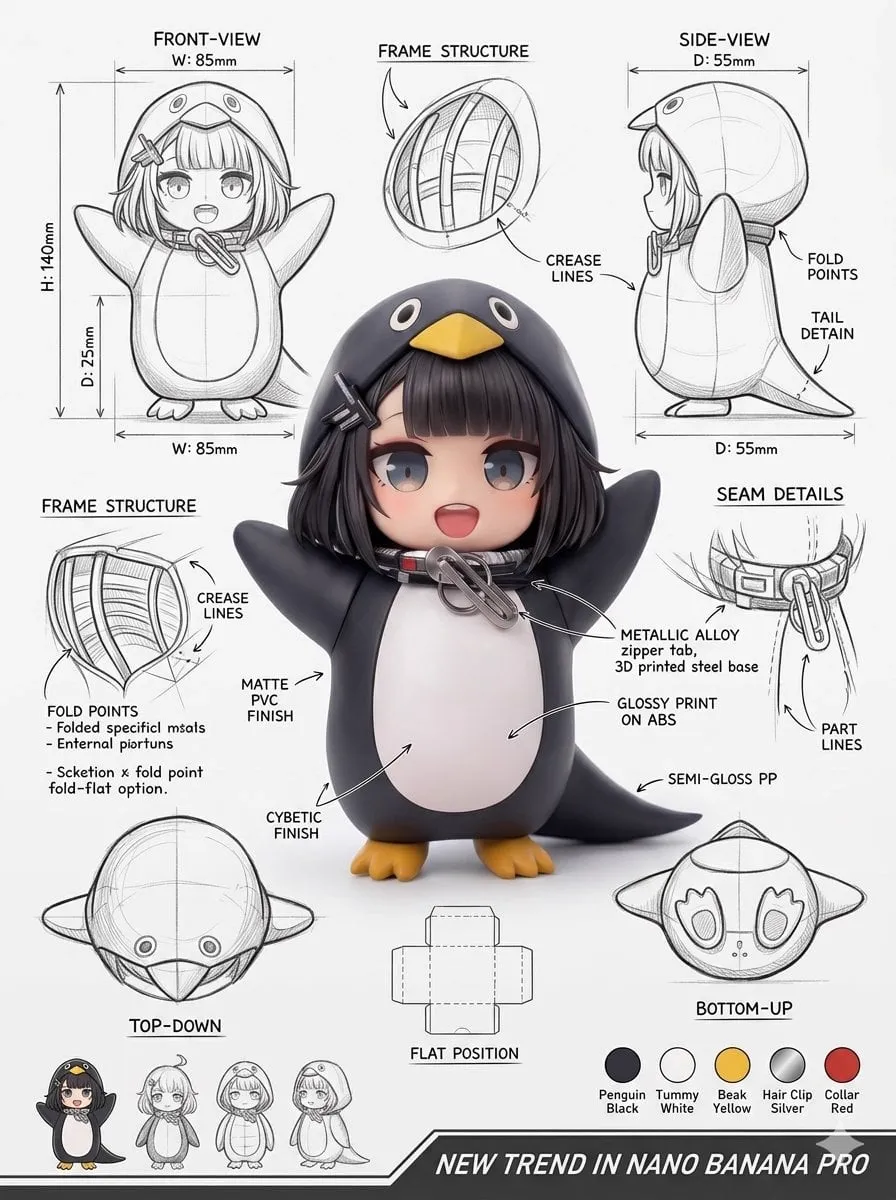
The hardest problem in generated video has always been character consistency. A protagonist who looks one way in the first shot and slightly different in the second breaks the viewer's immersion instantly. This is where multi-image fusion comes in. Instead of feeding the model a single reference, you provide several: a front view, a side view, a detail shot, an expression sheet. The model fuses these references into a stable identity and carries it across scenes, lighting changes, and camera angles.
This technique matters far beyond characters. The same principle stabilizes objects, locations, and even art styles. A brand mascot, a recurring prop, or a specific architectural setting can all be locked down the same way. For any project with recurring visual elements, fusion-based reference handling is the difference between a demo and a producible asset.
Controllable Camera Movement and Cinematography
Another major leap is camera control. Older models mostly produced a single locked-off shot with minor parallax. Current generation tools let you specify pan, tilt, dolly, zoom, and even more complex moves, and the model honors them while keeping the scene coherent. Combined with depth awareness, this turns a static illustration into something that feels like footage captured by a real camera crew.
For storytellers this is transformative. A slow push-in on a character's face, a dolly move that reveals a landscape, a handheld feel for tension: these choices carry emotional meaning. When a model gives you the same grammar as a camera, you stop fighting the tool and start directing.
The Best Image-to-Video Models in 2025
No single model wins every job. The current landscape splits into three broad groups, and most serious creators use more than one.
Flux and Runway: The Quality Benchmarks
The Flux series has built a reputation for image quality and prompt fidelity that carries over into video work. It is often the default choice when the starting image matters, such as concept art or design-heavy projects, because it preserves detail and style through the motion pass.
Runway's Gen-4 line represents the state of the art in controllable generation, with strong instruction following, consistent characters, and impressive camera moves. It is a favorite for narrative work and commercial projects where repeatability is essential. The tradeoff is cost and generation time: premium quality still demands premium resources.
OpenAI Sora and the Chinese Competitors: Kling and Hailuo
OpenAI's Sora made headlines for its ability to generate long, physically plausible scenes from minimal input, and it remains a benchmark for what is technically possible. Its impact on the field has been enormous, even as access has expanded gradually.
Meanwhile, Kling and Hailuo from Chinese labs have pushed the frontier from the opposite direction: aggressive iteration, accessible costs, and strong motion quality. Kling in particular has become a favorite for dynamic action and stylized content. Hailuo has excelled at realistic motion and is frequently cited as an excellent value pick. These models have forced the entire industry to move faster and have made high-quality generation affordable for a much wider audience.
Specialized Models: Vidu, Wan, and Pika
Beyond the headline names, specialized models fill important niches. Vidu has focused on speed and efficiency, making it a good fit for high-volume work. Wan has built strengths in specific content styles and regional aesthetics. Pika has emphasized playful, fast iteration and is popular among social-first creators who need quick turnaround.
The practical takeaway: treat the model landscape as a toolkit, not a contest. Choose the tool that matches the project's priorities, whether that is photorealism, style preservation, motion quality, speed, or cost.
How to Choose the Right Model for Your Project
Use these decision criteria to shortlist a model:
- Output style: photoreal, cinematic, anime, illustration, or product-focused. Match the model to the aesthetic, don't try to force it.
- Motion complexity: if the shot requires strong physics or complex action, prioritize models with proven motion quality.
- Character consistency needs: for recurring characters, prefer tools with explicit multi-image or reference-frame support.
- Turnaround: for social media and rapid iteration, speed may matter more than absolute quality.
- Budget: balance generation cost against the number of iterations your project realistically needs.
- Output length: some models are better at short clips, others at longer sequences. Check the limits before committing.
A good rule of thumb is to run a small test matrix early in a project: generate the same reference frame through two or three candidate models, compare motion, consistency, and style, and only then lock the pipeline.
A Practical Image-to-Video Workflow
The following workflow works whether you are a solo creator or a small studio.
Step 1: Prepare the Reference Frame
Your input image determines the ceiling of your output quality. Start with the highest resolution you can, clean up artifacts, and make sure the composition leaves room for the motion you plan. A cluttered frame produces cluttered motion.
Step 2: Lock the Character or Subject
If your shot includes a recurring subject, generate reference views first: front, side, three-quarter, and key expressions. Feed these into the model's fusion or reference feature. Check consistency across a few test generations before you commit to a full sequence.
Step 3: Design the Camera Move
Decide what the camera should do and why. Write it down in plain language: "slow push-in from medium to close-up" is a better prompt than "camera movement". If the tool supports it, use motion sliders or preset moves, then adjust speed and intensity.
Step 4: Generate, Review, Iterate
Treat the first generation as a draft. Look for three failure classes: identity drift (does the subject stay the same?), physical implausibility (does the motion obey basic physics?), and artifact noise (does the image degrade over time?). Fix the most important issue first, then regenerate. Expect several iterations before a shot is production-ready.
Step 5: Post-Production
Generated footage rarely ships untouched. Bring clips into an editor, stabilize if needed, color grade to match your project, and layer in sound. Many creators use generated footage as plates: background motion, establishing shots, or transition material that they combine with live or separately rendered elements.
Use Cases: From Social Media to Film
Image-to-video is spreading across every content vertical. Social media teams use it to turn static campaign art into motion ads and to create branded character content without photo shoots. Independent filmmakers use it for storyboards, previz, and even final shots that would be too expensive to build practically. Product teams animate concept renders to communicate design intent. Educators animate diagrams and historical images to make lessons more vivid.
The common thread is speed and leverage. One strong still image can become dozens of motion variants, each testable at near-zero marginal cost. That changes how quickly teams can explore creative directions and how many options they can afford to consider.
Common Mistakes and How to Avoid Them
- Expecting one generation to be perfect. Plan for iteration; it is a feature of the workflow, not a failure.
- Ignoring the input image. Garbage in, garbage out applies more strongly here than almost anywhere else.
- Over-prompting. Long, contradictory prompts confuse the model. Be specific but concise.
- Skipping consistency checks. Test character and style stability early, not after you have generated twenty shots.
- Using one model for everything. Match the tool to the job and switch when the job changes.
- Forgetting sound. Motion without audio feels unfinished; budget time for music, voice, and effects.
Prompt Craft for Image-to-Video
Getting a good result is as much about how you ask as which model you use. The most reliable pattern is a structured prompt: subject, action, environment, then camera. Describe what is in the frame, what it is doing, and where it is happening, in that order. "A woman in a red coat walks across a rainy city square at dusk, slow dolly follow" is far more effective than a sentence of adjectives.
Keep the prompt specific but short. Long prompts introduce contradictions, and contradictions are where drift and artifacts come from. If you need to convey a mood, use concrete visual language instead of abstract words: "low golden light, long shadows" beats "nostalgic". If the tool supports negative prompts, use them sparingly to remove known problems, such as extra fingers or warped text.
Learn the model's vocabulary. Every model has prompt patterns that work better than others, and most documentation includes example prompts. Steal those patterns, adapt them to your subject, and build a small library of prompts that reliably produce the shot types you need. Over time, your prompt library becomes a production asset as valuable as your footage.
Plan for consistency across shots in the same project: reuse the same environment descriptions, the same lighting terms, and the same character references. Repetition across prompts is not lazy; it is how you keep a multi-shot sequence coherent.
FAQ
How long does a typical image-to-video generation take? It depends heavily on the model, resolution, and length, ranging from under a minute for short low-res clips to many minutes for high-resolution sequences. Queue times on popular services add variability.
Can I use my own photos as starting frames? Yes, this is one of the main use cases. Portraits, product shots, and location photos all work well, though copyright considerations apply to content you do not own.
Is character consistency really solved? It is dramatically improved, but not guaranteed. Fusion and reference-frame techniques keep identity stable across scenes far better than before, yet complex motion, extreme angles, and long durations can still cause drift. Plan review checkpoints.
Do I need a powerful computer? Many capable tools run in the cloud, so a modest machine is enough. Local open-source models are an option for creators with strong GPUs and privacy requirements.
What about copyright for generated content? Rules vary by jurisdiction and platform. If you generate from images you own or have rights to, you are on the safest ground. Check the terms of each tool and your local regulations before commercial use.
Is image-to-video replacing traditional filmmaking? Not in the near term. It is replacing certain production tasks, especially those involving expensive or impractical shoots, and it is expanding what small teams can attempt. It works best as a complement to live production and animation, not a wholesale substitute.
Final Thoughts
Image-to-video generation has crossed the threshold from impressive demo to dependable production tool. The combination of temporal coherence, multi-image fusion for consistency, and real camera control means that a single strong still can now anchor an entire sequence of footage. The creators who benefit most are not necessarily the most technical ones; they are the ones who treat the model as a collaborator with a clear brief, a review process, and a willingness to iterate. Start with one image you care about, run it through a quality model with a deliberate camera move, and build your process from there.
