

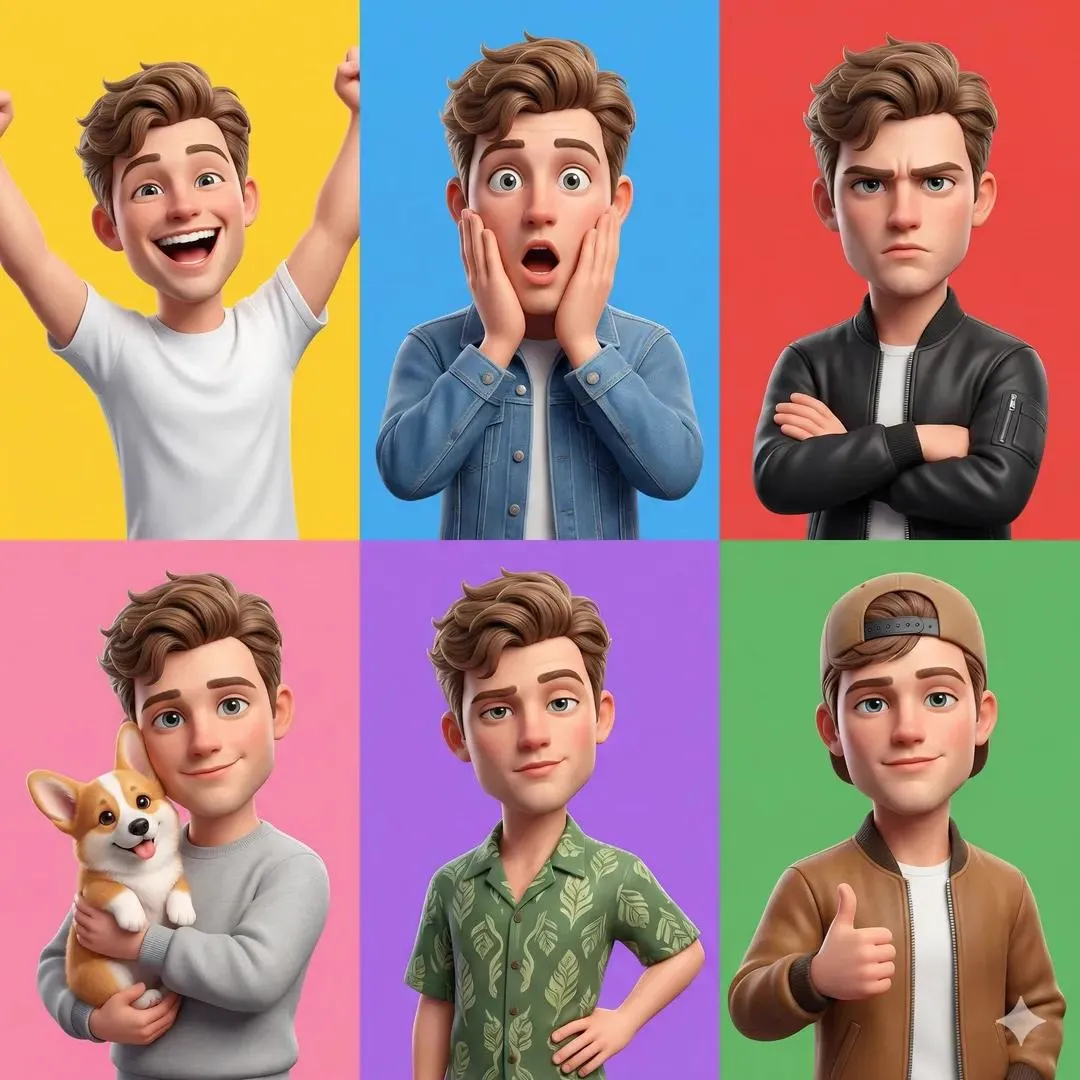
One of the fastest ways to kill an AI-generated short film is a character who changes face between scenes. The protagonist has brown eyes in the close-up and blue eyes in the wide shot; their jacket shifts color halfway through; the hairline moves. Viewers notice even when they cannot name the problem, and the whole production reads as amateur.
The fix is not a better prompt. It is a workflow change: give the model multiple reference images of the same character before you generate any video. This approach, often called multi-image fusion or multi-reference conditioning, locks a character's appearance so it survives scene changes, lighting shifts, and even model switches. This guide explains how it works and how to use it in your own pipeline.
What Multi-Image Fusion Actually Does
A single text prompt describes a character, but text is lossy. "A woman in her thirties with curly hair" leaves enormous room for interpretation, and every new generation can drift further. Multi-image fusion replaces that guesswork with visual anchors: you upload several images of the character, the system extracts a shared identity vector, and every video generation is conditioned on that vector.
The result is that the model treats the character as a fixed asset rather than a new invention each time. You can then generate an establishing shot, a close-up, and an action sequence, and the character stays recognizable across all three. This matters most for narrative work, where continuity is not a luxury but a requirement. If you are new to the production side, start with a solid AI video generator to understand baseline quality, then add consistency controls on top.
Building a Reference Set That Works
The quality of your consistency depends almost entirely on the images you feed in. A good reference set looks less like a single portrait and more like a mini casting sheet:
- At least four angles: front, side, three-quarter, and a low or high angle.
- Different lighting: daylight, indoor, and one moody or low-light frame.
- Consistent key features: face shape, hair, and build should match across all images.
- Optional costume and expression variants if your script needs them.
Think of this as the canonical character sheet. The system uses it to learn what is permanent about the character (bone structure, skin tone, facial geometry) and what is transient (clothing, hairstyle, lighting). Once the identity is locked, you can prompt for a character in "harsh midday sun" and the model will relight the existing character instead of inventing a new one that happens to be lit that way.
If your source images are uneven, run them through an AI image generator workflow to normalize resolution and lighting before fusion. Clean input means a cleaner identity vector and fewer surprises downstream.
Keeping the Character Consistent Across Lighting and Scenes
Lighting is where consistency usually breaks. A character defined only by sunny outdoor photos will drift the moment you ask for a dark interior. Multi-image fusion solves this by separating identity from illumination: the model learns the character's texture and form, then applies the requested lighting as a transformation on top.
To test how well your reference set holds up, generate the same character in standard daylight, then explicitly request a low-light noir scene. The facial features should remain recognizable even under aggressive shadows. If they do not, your reference set is probably too narrow, so add more lighting variety.
For longer narratives, plan for temporal changes. If the script calls for the character to change outfits halfway through, include those variants in the reference set and let the system distinguish between core identity and costume. This layered control is what separates a series-ready workflow from a one-off clip.
Using the Same Character Across Different Models
One of the underrated benefits of a proper identity vector is portability. The same character definition can be rendered with a photorealistic model for emotional close-ups and an animation-focused model for stylized sequences, and the fundamental geometry stays recognizable. This matters because different models have different strengths: one handles motion physics better, another has a more cinematic color palette.
Experiment with pairing: render key emotional moments with a high-fidelity model and use lighter, faster models for establishing shots. The identity layer keeps the character intact while you take advantage of each model's strengths. If you are choosing between models for a project, compare options like GPT Image 2 for stills and reference work and Seedance 2.0 for motion-heavy sequences, then reuse the same reference set across both.
Motion Coherence and Keyframes
Visual identity is only half the problem. A character also needs to move consistently: the way they walk in scene one should match how they walk in scene four. Two techniques help here:
- Keyframe control: mark the start and end pose of a complex motion, like drawing a weapon or standing up, and let the model interpolate the in-between frames.
- Motion reference: supply short video clips of a real performance and map that motion onto your consistent character.
Both techniques preserve the character's geometry while giving you control over action. They are especially important for action sequences, where viewers scrutinize continuity the hardest. The combination of a locked identity and controlled motion is what makes multi-image fusion feel like a production tool rather than a toy.
A Practical Workflow for Your Next Short Film
Here is a repeatable pipeline you can use today:
- Define the character with a reference sheet of 4-7 images covering angles, lighting, and expressions.
- Generate a few test frames across different scenes and lighting conditions to verify the identity holds.
- Lock the character asset before writing detailed scene prompts.
- Generate each scene with the locked asset, using keyframes for complex motion.
- Review for drift, then regenerate only the failed shots instead of redoing everything.
This workflow cuts down the most expensive part of AI filmmaking: fixing continuity errors after the fact. When the identity is locked up front, post-production becomes review and polish instead of salvage.
FAQ
How many reference images do I need? Four to seven is a good range. Fewer than three gives the model too little to work with; more than seven rarely adds much and can confuse the identity extraction.
Does this work with any model? Most modern video models support some form of multi-reference or image-conditioned generation. The technique is model-agnostic in principle, though quality varies. Test your reference set on the model you plan to ship with.
Can I use the same character for both images and video? Yes. Build the reference set once, use it to generate consistent stills for posters and thumbnails, and reuse it for video scenes. A tool like an AI image generator is useful for producing the reference images themselves.
What if the character still drifts? Tighten the reference set first: more angles, more consistent key features, more lighting variety. Then regenerate test frames and compare. Drift usually means the identity vector was built from conflicting inputs.
Character consistency is the difference between a demo reel and a film. With multi-image fusion, it becomes a repeatable part of your workflow instead of a constant fight with the model.
