
![“Luxury golden-hour styled hero shot of [FOOD] bathed in warm directional...](https://storage.brightvectorlabs.com/prompts/bright/food-and-drink/2013251289254420955-0.webp)
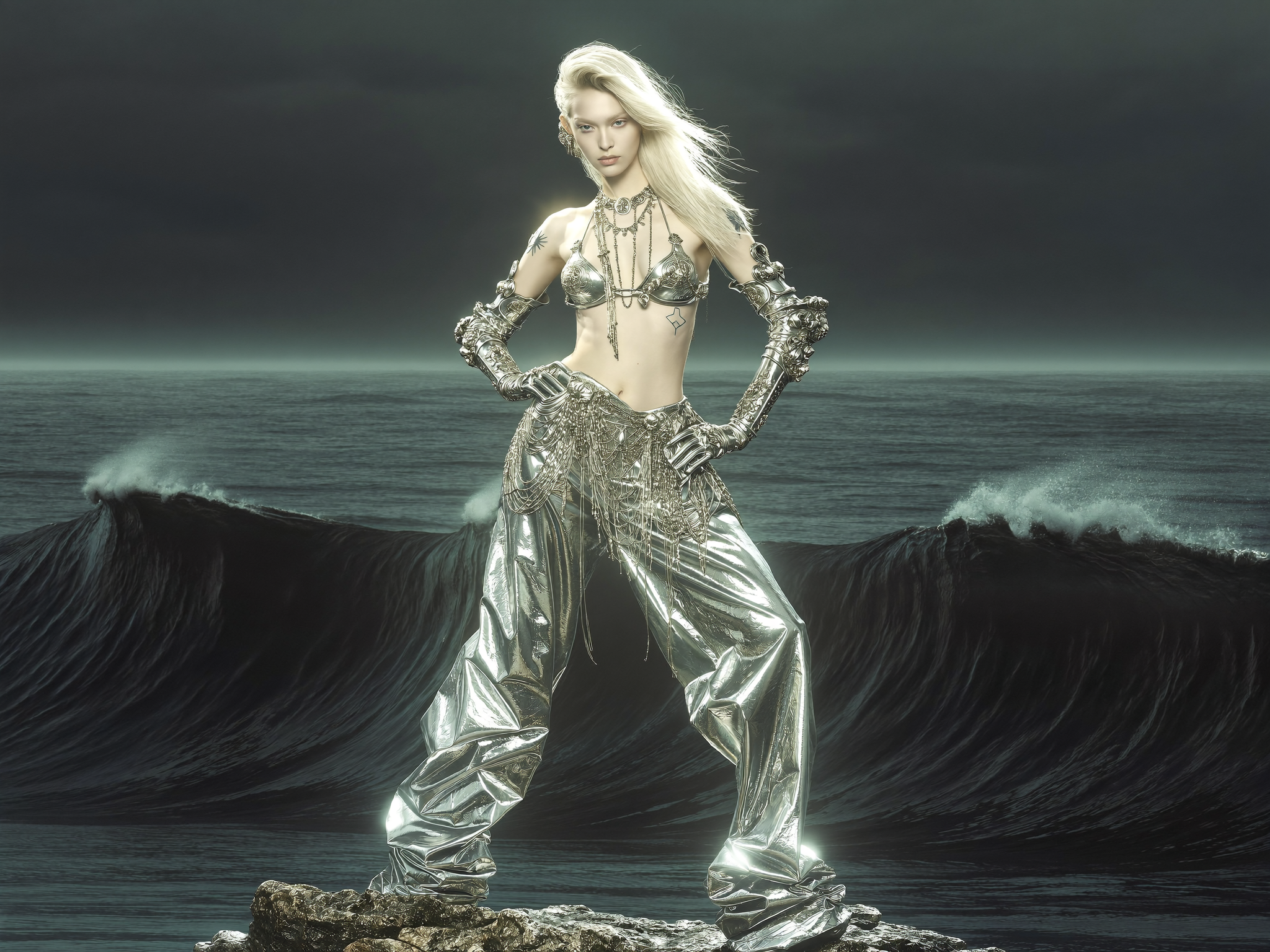
Anyone who has generated AI video for more than a week has hit the same wall: the first shot looks great, the second shot features a completely different person. The model changes the face, swaps the outfit, alters the body shape. For one-off clips this is annoying; for stories, series, ads, or branded content, it is disqualifying. Multi-image fusion is the technique that solves this problem. Instead of describing a character with words and hoping for the best, you feed the model several reference images and let it lock the character's identity into every generation. This guide explains how the technique works, how to build a solid character keyframe profile, and how to use it across different models and styles.
The Character Consistency Problem
In traditional animation and film, character consistency is solved by production discipline: model sheets, costume continuity, and the same actor. AI video has none of these by default. A text prompt like "a young woman with short hair and a red jacket" is a probability distribution, not a fixed identity. Every generation samples from that distribution, so every shot produces a slightly different woman. Across several shots, the differences compound and the character becomes unrecognizable.
This is not a cosmetic issue. Audiences read inconsistent characters as low quality, and for serialized content, episodic stories, or brand spokespeople, inconsistency destroys the entire premise. The market has recognized this: the tools that solve identity drift are the ones that graduated from novelty to production.
Multi-image fusion attacks the problem at the root. Rather than relying on text to carry identity, it extracts identity from images, which are inherently specific. Give the system three to five good photos of the character, and it builds a stable identity representation that can be attached to every future generation.
How Multi-Image Fusion Actually Works
Multi-image fusion is not averaging images together. It is a feature-extraction process: the system analyzes the reference images, identifies the stable characteristics of the subject, and embeds them into the generation pipeline.
In practical terms, the process looks like this. You upload several images of the character from different angles with consistent lighting and clothing. The system encodes these images and extracts an identity representation: facial structure, body proportions, distinctive features, and style details. From then on, every generation includes that identity representation as a strong conditioning signal, alongside the text prompt.
The key advantage over fine-tuning is flexibility. Fine-tuning modifies the model itself, which is expensive and risks overwriting general knowledge. Fusion keeps the model untouched and applies identity as a constraint at generation time. You can change the scene, the lighting, the outfit, even the artistic style, and the underlying identity stays anchored. Ask for the character in a rainy street at night, then in a sunlit garden, then as an anime illustration, and the face and body remain recognizably the same person.
Building a Character Keyframe Profile
The quality of your output depends on the quality of your reference set. A weak keyframe profile produces drift no matter how good the fusion engine is. Here is how to build one properly.
Start with three to five images. More is not always better; consistency matters more than quantity. Use images that show the character clearly: a front-facing portrait, a three-quarter view, a full-body shot, and a detail shot if there is a distinctive accessory. The lighting should be similar across images so the model does not confuse illumination with identity.
Keep the appearance consistent within the set. If the character has short hair in one image and long hair in another, the model will not know which identity to lock. Choose one canonical look for the profile, and update the profile when the character's design changes.
Avoid cluttered backgrounds and small subjects. The reference should be about the character, not the environment. Crop tightly, keep the subject large in frame, and use high-resolution source images. Blurry or compressed references degrade the extracted identity.
Store your profiles as reusable assets. Name them clearly, note the canonical appearance, and keep them in a shared folder so every team member generates with the same identity. A character library is the visual equivalent of a brand book: it turns individual effort into consistent output.
Using Fusion Across Different Models and Styles
The most powerful feature of identity-based fusion is that the same character can travel across models. Different models excel at different aesthetics: one produces photorealistic scenes, another excels at anime action, another at stylized 3D. With a fused identity, the character can appear in all of them without becoming a different person.
In practice, you define the character once, then switch the scene description and the style prompt while keeping the identity reference attached. This enables storytelling structures that were previously impractical: a series where each episode has a different visual treatment, an ad campaign with a consistent spokesperson across multiple art directions, or a narrative that moves from realistic world to dreamlike animation while following the same protagonist.
The caveat is that not every model implements fusion with equal quality. Some preserve identity faithfully across styles; others approximate it. Before committing to a project, run a small cross-model test: generate the same character in two styles with the same reference set, and compare the results. A ten-minute test saves you from discovering drift halfway through production.
A Practical Production Pipeline
Here is a pipeline that puts fusion to work in real projects.
Define the character. Write a short character sheet: name, role, canonical appearance, key accessories, personality notes. This becomes the brief for the keyframe profile and for every prompt.
Generate the keyframes. Create or commission the reference images. If you are using an image model, generate several options and pick the set with the most consistent identity. Keep the canonical look locked.
Write the scene prompts. For each scene, describe what happens and where, referencing the character by name and attaching the identity reference. Keep the identity description identical across scenes; change only the scene variables.
Generate and review. Batch-generate the shots, then review for both quality and identity. Check the face, the silhouette, and the distinctive details against the reference set. Flag any shot where the character drifts and regenerate it.
Assemble and polish. Edit the approved shots into sequence, normalize color across scenes, and add sound. If a scene looks slightly off, resist the urge to fix it in post: regenerating with a stronger reference usually beats color correction.
Optimizing for Different Content Types
The same fusion workflow adapts to different formats with small tweaks.
For short series and episodes, build one canonical profile per main character and keep a shot list that tracks where each character appears. Consistency across episodes matters as much as consistency within one.
For product and e-commerce content, the "character" is the product itself. Fusion keeps the product's shape, logo, and colors identical across angles and lifestyle scenes, which is critical for credibility. Use detail shots as references so the model captures the small design elements.
For social media creators, a lighter version works: one reference set, a few recurring scene templates, and a consistent style prompt. The goal is recognizable identity in a fast production loop.
For long-form animation, invest more in the profile: multiple angles, expression sheets, and outfit variations as separate reference sets. The payoff is a character that survives dozens of scenes without a single identity break.
Fusion vs. Other Consistency Methods
Multi-image fusion is not the only way to keep characters consistent, and knowing the alternatives helps you choose the right tool for the job.
Fine-tuning is the classic approach: train the model on your character so it learns the identity in its weights. It produces excellent fidelity, but it is expensive, slow, and fragile. Every new character requires a new training run, and training can degrade the model's general abilities. It makes sense for a flagship character used across an entire project, and little sense for a character that appears in a handful of scenes.
LoRA-style adapters sit between fine-tuning and fusion. They add a small, specialized layer to the model, giving good fidelity at a lower cost than full fine-tuning. The trade-off is still complexity: you manage multiple adapters, each tied to a specific model version, and switching between characters means switching adapters.
Prompt-based consistency is the cheapest method: describe the character identically in every prompt and hope the model follows. It works for simple, stylized designs with strong distinctive features, and fails for realistic faces where small differences are visible. It is a starting point, not a production strategy.
Fusion's advantage is speed and portability. No training, no adapters, works across models that support it, and changes to the character are as simple as updating the reference set. The trade-off is that fidelity depends on the quality of your references and the implementation quality of the tool. For most content teams, fusion is the best balance of cost, speed, and consistency; the heavier methods earn their complexity only on flagship assets.
Common Mistakes and How to Avoid Them
Inconsistent reference sets are the top cause of failure. Mixed lighting, mixed outfits, and mixed angles confuse the identity extraction. Fix the appearance in the references before touching the generator.
Overloading the scene prompt is the second mistake. If you describe ten objects, the model spreads attention across everything and the character suffers. Keep the scene focused; the character should be the clear subject.
Skipping the cross-model test is the third. Fusion quality varies, and assuming one model's behavior applies to another leads to mid-project surprises.
Ignoring the review step is the fourth. Identity drift can be subtle, especially in motion. Watch the full sequence, not single frames, and compare against the reference set.
Finally, treating fusion as a substitute for story is the fifth. Consistency makes content credible; it does not make it interesting. The character needs a reason to exist, a goal, and a journey. Fusion is the production tool that lets the story happen without visual breaks.
Frequently Asked Questions
How many reference images do I need? Three to five high-quality, consistent images are usually enough. More images help only if they are consistent with each other.
Can fusion preserve a character across completely different art styles? In well-implemented systems, yes. The identity anchor survives style changes; the visual rendering follows the style prompt. Always verify with a small test first.
Is multi-image fusion the same as fine-tuning? No. Fine-tuning changes the model weights; fusion applies identity as a generation-time constraint. Fusion is faster, cheaper, and more flexible.
What if my character's design changes mid-project? Update the reference set and regenerate affected scenes. Do not mix old and new references in the same profile.
Does this work for products and objects, or only people? Both. The technique is identity-agnostic: it can lock a face, a product, an animal mascot, or a vehicle.
How long does it take to set up fusion for a new character? Usually under an hour: gather or generate the references, check they are consistent, and run a quick test scene. The setup pays for itself on the second scene onward.
What if the tool I use does not support fusion? Use the closest alternative: a strong image reference attached to each generation, plus a rigorously repeated identity description. The results will not match true fusion, but they are far better than prompt-only generation.
Can fusion be combined with fine-tuning? Yes, and some advanced teams do exactly that: fine-tune a flagship character for maximum fidelity, then use fusion to carry that identity into models that were not part of the training. The two methods complement each other.
Final Thoughts
Character consistency is the difference between AI video as a toy and AI video as a production tool. Multi-image fusion solves the technical half of that problem by anchoring identity in images instead of words. The other half is yours: a clear character definition, disciplined reference sets, and a review process that catches drift before it reaches the audience. Build the profile once, use it everywhere, and your characters will finally survive contact with the algorithm.
