
Why Consistency Is the Hardest Problem in AI Video
Ask anyone who works with AI video what annoys them most, and the answer is usually the same: characters change between shots. The protagonist has a different face in every scene, the logo changes color from one angle to the next, and the hero product looks like a different object in each frame. The clips are individually fine. Together, they tell a story that does not hold together.
This matters more than it seems, because inconsistency is not a cosmetic flaw. It breaks the viewer's suspension of disbelief, and once that breaks, the content stops working as communication. A commercial with a product that changes shape is not persuasive; it is confusing. A narrative where the main character looks like a new person every scene is not artistic; it is broken.
The industry has been solving this problem from several directions, and the most practical solution to arrive in the last couple of years is multi-scene image fusion: using reference images to lock identities across shots. Instead of hoping the model remembers a text description, you give it the actual image of the character or product and ask it to place that identity into each new scene. The technique does not solve everything, but it is the single biggest step toward serialized, production-quality AI content.
What Multi-Scene Image Fusion Actually Is
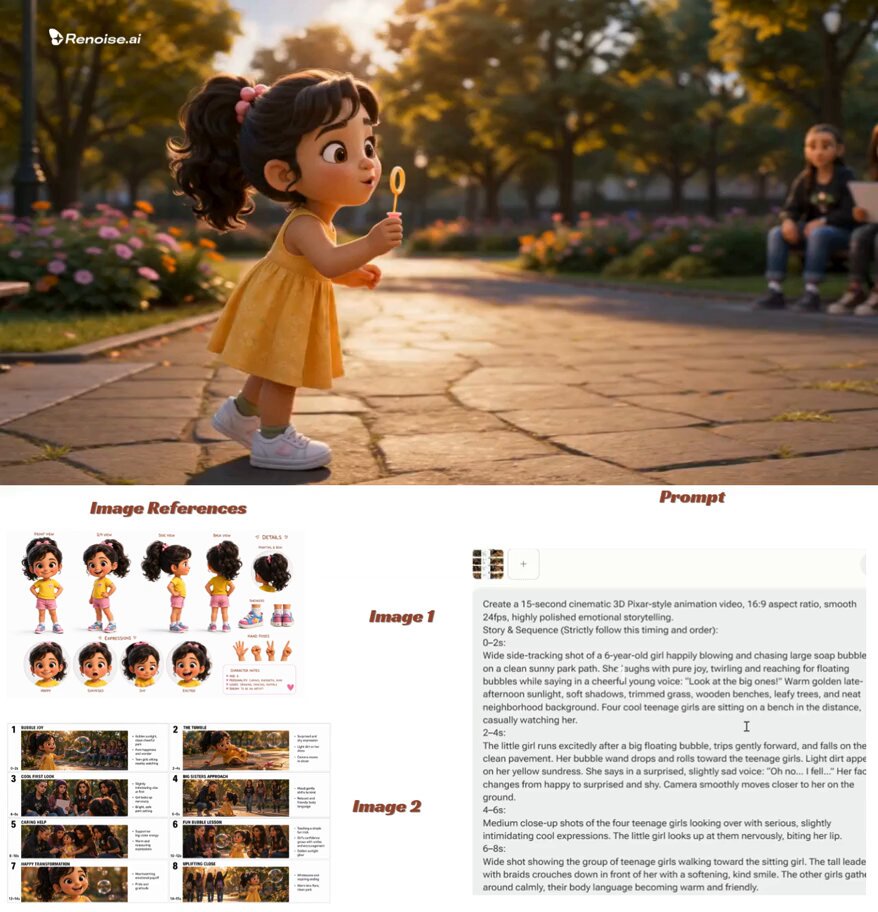
Multi-scene image fusion is a feature that lets you combine a reference image with a scene description to generate a new shot that preserves the identity of the reference. In the simplest version, you upload a picture of a character, write a prompt for a new scene, and the output shows that same character doing something new in a new place.
The word fusion matters because the model is not simply copying the image into the frame. It is blending the identity information, the face, the outfit, the style, with the new scene context, the setting, the action, the lighting. The result should read as "the same person, different moment" rather than "a collage of two images."
This is a different capability from image-to-video, where you animate a single still image. Fusion is about carrying identity across multiple distinct generations, and it is the feature that makes multi-shot narratives practical. You can establish the hero in a character sheet, then generate the opening scene, the confrontation, and the resolution, all with the same face.
It also works for non-character elements. Products, mascots, locations, and brand assets can all be anchored with reference images, which makes the technique useful for commercial content, not just fiction. The logo that stays stable across a whole campaign is worth more than the logo that renders beautifully once.
How Free Generators Work and Where They Stop
The free tiers of AI video tools are excellent for learning and for simple one-off clips, and they are also where most people first hit the consistency wall.
A free generator typically gives you access to an entry-level model with limited duration, limited daily generations, and sometimes a watermark. The model itself is usually capable of producing decent single clips, but its consistency features, if they exist at all, are often the first thing removed from the free tier. Reference-image support, character locking, and multi-image fusion are frequently premium features, because they are exactly what separates casual output from production output.
That means the free tier is the wrong place to fight the consistency problem. You can learn the vocabulary, practice prompt writing, and prototype shot ideas for free, but if your project depends on a character or product appearing identically across multiple scenes, you should expect to budget for the feature that makes that possible.
There is still a middle path. Some free tiers allow you to provide a starting image even when they do not call it fusion, and even a weak consistency tool plus disciplined prompt wording can produce acceptable results for short projects. The discipline matters: identical descriptions, a single well-made reference, and careful scene planning compensate for a lot of model limitation.
Using Reference Images to Lock a Character
The core skill in consistency work is making a good reference image and using it well. Here is the practical method.
First, generate or select the reference. The ideal reference is a front-facing, well-lit image of the character, with the full face visible, a neutral expression, and clear details of hair, clothing, and any distinctive features. This image is the source of truth, so invest the time to get it right, including several variations until you have one that looks exactly like the character you want.
Second, standardize the reference across the project. Use the same image everywhere, do not swap in a different reference halfway through because the first one was not perfect. Consistency of the source produces consistency of the output; changing the anchor changes the character.
Third, write scene prompts that are specific about everything except the identity. The identity comes from the reference; the scene prompt should describe the new location, the action, the camera, the light, and the mood. If the scene prompt also tries to describe the character, the two descriptions can conflict, so keep the character description minimal or absent.
Fourth, review for drift and regenerate. After generating a scene, compare the character in the output to the reference. If the face has shifted, the outfit has changed, or the proportions look off, regenerate before moving on. Accepting a drifted shot saves time in the moment and costs it later when the whole sequence does not match.
Planning a Multi-Scene Narrative
Consistency tools work best when the narrative is planned before generation begins. A shot list is not optional; it is the difference between a coherent story and a series of attractive accidents.
Start with the story in one paragraph: who, where, what changes, and how it ends. Then break the story into scenes, and for each scene write the essential information: the location, the characters present, the action, and the emotional beat. This scene list is your production bible.
Next, decide what must stay constant and what can vary. The character's identity must stay constant; the lighting, the camera, and the wardrobe within reason can change to serve the story. Write down the constants explicitly, because they are what the reference images will protect.
Then assign each scene its shots. Most scenes need two or three shots: an establishing shot, an action shot, and a reaction or detail shot. For each shot, note the reference images it uses, the scene prompt, and the intended mood. This is also the moment to decide which scenes can reuse a previous shot's setup, which saves generation budget.
Finally, generate in story order. Producing scenes in narrative order makes it easier to keep the arc in mind, and it lets you reuse references and settings from earlier scenes. When you assemble the final cut, the story order also makes review simpler: you can watch the piece as a story, not as a pile of clips.
A Step-by-Step Fusion Workflow
Here is a complete workflow for producing a consistent multi-scene piece with fusion-based tools.
Step one: write the one-paragraph story and the scene list. This is a writing task, not a tool task, and it is where the project succeeds or fails.
Step two: create the reference assets. Generate the character sheet, the product shot, or the location anchor, and approve them carefully. If a reference is wrong, fix it now.
Step three: write the shot prompts. For each shot, prepare the scene description, the camera instruction, and the mood words, and note which reference each shot needs.
Step four: generate the establishing shot of each scene first. These shots set the visual tone and usually show the most context, so they are the best place to verify that the references are working.
Step five: generate the remaining shots and review each one against the reference and the scene intent. Regenerate drifted shots immediately.
Step six: assemble the sequence and watch it as a whole. Look for consistency across shots, not just within them, and check that the story beats land in order.
Step seven: finish with sound, captions, and export. The consistency work is done; the finishing work is standard editing.
When to Move to Paid Features
The line between free and paid is not about snobbery; it is about what the project requires. Ask yourself three questions before deciding.
Does the output need to be watermark-free for its intended use? If the clip is going into a client deliverable, an ad, or a public campaign, the answer is usually yes, and that is a paid-feature requirement on most platforms.
Does the project depend on consistency across many shots? A single clip can be made on a free tier. A character-driven series, a product campaign with one hero product, or a branded narrative cannot, not reliably, and the consistency features that make them possible are typically paid.
Does your workflow need volume and speed? Free tiers ration generations and queue them slowly. If the project is time-sensitive or needs many iterations, the throughput of a paid tier changes what you can attempt.
If the answer to any of these is yes, budget for it. A month of a paid tier for a real project usually pays for itself in time saved and quality gained, and the alternative, fighting free-tier limits on a deadline, is the most expensive option of all.
There is no shame in using paid features; the goal is producing work that holds together, not proving that you can do everything with the cheapest tier. Budget decisions should follow project requirements, and the creators who scale are the ones who move between tiers deliberately: free for exploration, paid for delivery, and never the reverse.
Common Consistency Failures and Fixes
Even with good tools, consistency failures happen, and most of them have known causes and known fixes.
The first failure is a weak reference. If the character sheet has bad lighting, an odd angle, or too much expression, every downstream shot inherits those problems. Fix: regenerate the reference until it is clean and neutral.
The second failure is description conflict. If the scene prompt describes the character's appearance in detail, it can override the reference. Fix: keep character description out of scene prompts and let the reference carry the identity.
The third failure is reference switching. Using different references for different scenes, or updating the reference mid-project, produces different characters. Fix: freeze the reference after approval and use it for every shot.
The fourth failure is a scene that asks for too much. A prompt that demands a complex action, a crowd, and a specific character at the same time will sacrifice the identity to fit everything else. Fix: simplify the scene, or generate the character and the background in separate passes where the tool allows.
The fifth failure is review fatigue. After many generations, drifted shots start to look acceptable. Fix: build a consistency check into the review, comparing every shot to the reference side by side, and never accept drift silently.
Frequently Asked Questions
What is the difference between image-to-video and multi-scene image fusion? Image-to-video animates one still image. Fusion carries an identity from a reference into many new scenes, which is what enables multi-shot stories and campaigns.
Can I achieve character consistency without a reference image? You can improve it with identical text descriptions and careful seed control, but it is fragile. A reference image is the reliable way to protect identity across shots.
Does fusion work for products and logos, or only characters? It works for anything that must stay recognizable: products, mascots, locations, and brand assets. The same reference technique applies.
Why does my character still change even with a reference? Usually because the reference is weak, the scene prompt conflicts with it, or the scene asks for too much complexity. Check those three causes first.
Is consistency worth the extra cost for short projects? For a single clip, no. For anything serialized, branded, or narrative, yes, because inconsistency destroys the value of the content, and the cost of fixing it later is higher than the cost of doing it right.
