
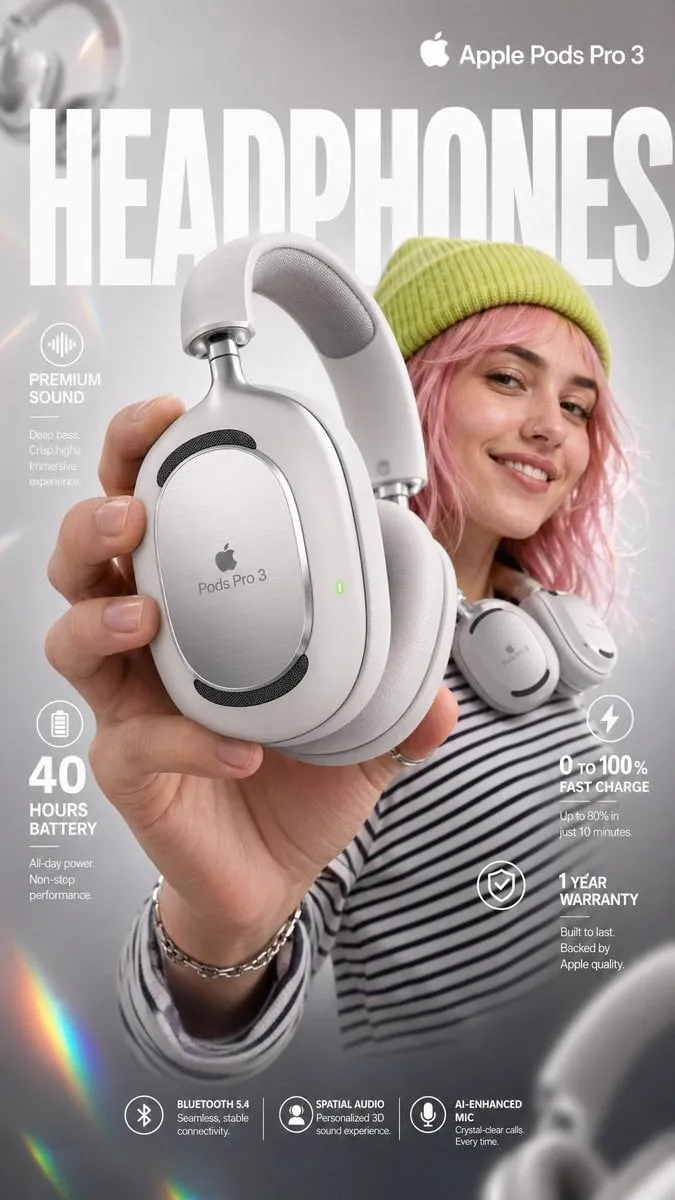
AI image models have made enormous progress, yet hands remain the most visible tell that an image was machine-generated. A face can be flawless, lighting can be perfect, and composition can be cinematic — and then a character reaches forward with six fingers, or a thumb bends in a direction thumbs do not bend. For anyone producing visual content seriously, this is not a minor cosmetic issue. A deformed hand destroys the illusion instantly, and it can make an otherwise usable image worthless.
The good news is that the problem is addressable. Negative prompts — instructions that tell the model what to avoid — are one of the most effective tools for cleaning up hand anatomy in AI-generated images. This guide explains why hands fail so often, how negative prompts actually work, how to build a practical negative-prompt vocabulary, and how to combine them with other techniques to get consistent, usable results.
Why AI Models Struggle with Hands
Before fixing the problem, it helps to understand why hands are so hard for generative models in the first place. Two main causes stand out.
First, training data. Large image datasets contain far more high-quality examples of faces, landscapes, buildings, and products than they do of hands in clear, varied poses. Faces dominate portrait photography; hands often appear cropped, partially occluded, holding objects, or in motion. A model trained mostly on ambiguous hand imagery learns an approximate statistical version of a hand rather than a precise anatomical one.
Second, geometry. A hand is an incredibly complex object: 27 bones, dozens of joints, and an enormous range of natural poses, foreshortening angles, and interactions with other objects. Modeling that space accurately requires more representational capacity than modeling a relatively rigid object like a car. Small errors in joint placement compound into fingers that fuse, multiply, or twist in impossible ways.
None of this means the model is broken. It means the sampling process needs guidance — both about what to include and what to exclude. Negative prompts handle the exclusion side.
What Negative Prompts Actually Do
Positive prompts describe what should be in the image: "a woman in a red dress standing by a window." They define the desired semantic space. Negative prompts describe what should be absent: "blurry, low quality, extra fingers." They act as a repulsion filter, steering the sampling process away from unwanted regions of the latent space.
In practical terms, during generation the model evaluates candidate images against both the positive and negative conditions. Tokens in the negative prompt push the generation away from features associated with those words — deformed anatomy, artifacts, text, watermarks, and so on. The effect is not binary; it is probabilistic and tunable through weighting and classifier-free guidance strength.
Two useful mental models:
- Positive prompts pull. They attract the sample toward the described content.
- Negative prompts push. They repel the sample away from described defects.
Because the push is continuous, negative prompts work best when they target specific, recurring failure modes. A generic "bad, ugly" negative prompt does far less than a targeted list naming the exact defects you keep seeing.
Building a Negative-Prompt Vocabulary for Hands
The most practical approach is to create a small, reusable vocabulary file you paste into every generation involving hands. Start with the anatomy-specific terms, then add the general quality terms.
Hand-specific negatives:
- extra fingers
- six fingers
- seven fingers
- missing fingers
- fused fingers
- deformed hands
- malformed hands
- broken fingers
- extra digits
- disfigured hands
- clawed hands
- extra joints
General quality negatives that protect overall output:
- blurry
- low resolution
- low quality
- oversaturated
- distorted
- out of frame
- cropped
- watermark
- text
- signature
- jpeg artifacts
Keep the list focused. Overloading the negative prompt with dozens of unrelated terms can dilute the effect of the important ones and, in some models, degrade overall image quality.
Weighting and Syntax Across Tools
Different tools expose negative prompts differently. Learning the syntax for the tools you actually use matters more than memorizing one universal format.
Stable Diffusion (AUTOMATIC1111, ComfyUI): the negative prompt is a separate field. Parentheses and weights increase emphasis, for example (extra fingers:1.4). Bracket syntax [term] decreases weight in some interfaces. This is where the most fine-grained control is available.
Midjourney: use --no followed by terms, like --no extra fingers, deformed hands. Midjourney's --no support is relatively coarse compared to Stable Diffusion, but it still meaningfully reduces the targeted defect.
DALL-E and other API-based tools: negative prompting is often handled indirectly — either through the model's built-in safety and quality filters or through explicit exclude parameters where supported. If the tool lacks a native negative prompt field, you can often achieve similar results by phrasing the positive prompt to describe correct anatomy explicitly ("five fingers, natural hand anatomy, relaxed open palm").
Flux and other newer models: support varies. Some pipelines accept a negative prompt natively; others ignore it or use it only for certain samplers. Test with your specific model version rather than assuming behavior carries over from older models.
The general rule: if you can set weights, give the anatomy terms the highest weight, because they are doing the critical work.
The Iterative Testing Loop
Negative prompts are not a set-and-forget fix. They require iteration. Here is a repeatable loop that produces reliable results.
- Generate a small batch (four to eight images) with your positive prompt and an empty negative prompt. Record the failure modes you actually see: extra fingers, bent wrists, fused digits, wrong number of joints, etc.
- Add only the negative terms that correspond to the observed failures. Resist the urge to paste a giant list from the internet.
- Generate another batch. Compare the defect rate, not just whether the image looks better. Track how many of eight images are usable.
- If a specific defect persists, increase its weight or rephrase it (for example, "extra fingers" vs "six fingers" can behave differently).
- Once the defect rate drops below acceptable, freeze that vocabulary as your baseline and reuse it.
This loop usually converges in three or four rounds. The key is measuring the usable-image rate, because a single beautiful image can hide a workflow that still fails most of the time.
Combining Negative Prompts with Other Hand-Fix Techniques
Negative prompts are powerful but not sufficient on their own. The best results come from combining them with other controls.
Higher step counts and CFG tuning. Generation parameters interact with negative prompts. In Stable Diffusion, increasing classifier-free guidance (CFG) strengthens both positive and negative adherence, but too high a CFG introduces its own artifacts. Test CFG values in the 5–9 range when hand defects are the issue.
Reference images and img2img. Instead of regenerating from scratch, generate a first pass, then use the best image as a reference for refinement. Many tools support image-to-image workflows where the model redraws with the reference as a strong prior — hands often stabilize on the second pass.
Inpainting. If only the hand is broken, crop and regenerate just the hand region with a focused positive prompt ("detailed hand, five fingers, natural anatomy") and your negative vocabulary. This is often faster and cheaper than regenerating the whole frame.
ControlNet and pose guidance. For character images, pose-controlled pipelines (skeleton or openpose conditioning) constrain the overall body layout, which indirectly reduces anatomical chaos in the limbs. Combined with negatives, this is the most robust setup for full-body shots.
Multi-pass consistency tools. Some modern platforms use multi-image fusion or keyframe referencing to keep a character consistent across frames and iterations. If you are producing a series with the same character, define reference frames for the hands too, not just the face — this prevents "identity drift" in the limbs across shots.
A Step-by-Step Workflow for Clean Hands
Putting it together, here is the workflow I use for character and portrait images where hands are visible.
- Write the positive prompt with explicit anatomy language: mention "five fingers," "natural hand position," and the action the hand performs. Vague prompts invite vague anatomy.
- Paste the hand-focused negative vocabulary.
- Generate a batch of at least six images.
- Inspect hands first, before evaluating anything else. If the face is great but the hand is broken, the image is still a retake.
- If the defect rate is high, tune weights or add pose/reference conditioning rather than just re-rolling the same prompt.
- For the winners, run a hand-region inpaint pass with a tight positive and the negative list to polish the final result.
- Upscale last, after anatomy is correct. Upscaling a broken hand only produces a bigger broken hand.
When Negative Prompts Do Not Help
There are cases where negative prompts will not save you, and it is worth knowing them so you do not waste hours.
Tiny hands in a wide shot. If the hand occupies only a few pixels, no prompt will fix the anatomy. Either crop and generate a close-up, or accept abstraction at that scale.
Extreme foreshortening. A hand pointing directly at the camera is hard for many models regardless of prompting. Change the angle or use reference conditioning.
Interaction between two hands. Two hands clasping, or a hand holding another hand, multiplies the difficulty. These shots benefit most from reference images and inpainting, not just negatives.
Model limitations. Some models simply produce better hands than others, independent of prompting. If a model fails your anatomy test consistently, switch models rather than fighting it. This is normal — different models have different strengths, and hands are a known differentiator.
FAQ
Do negative prompts work in every AI image tool?
No. Support varies. Stable Diffusion-based tools offer the most control. Midjourney supports --no. Some newer models ignore negative prompts or only honor them in certain samplers. Always test.
What is the single most useful negative term for hands?
"extra fingers" and "deformed hands" are the two highest-value terms for most people. "Six fingers" is worth adding when the model tends to over-generate digits.
Can negative prompts hurt image quality?
Yes, if overused. An enormous negative list can fight the positive prompt and produce washed-out or generic results. Keep the list targeted and monitor overall quality, not just hand quality.
Should I put "hand" in the negative prompt?
Usually not. Negating the subject itself ("no hands") can remove hands entirely or cause the model to hide them, which is rarely what you want. Negate the defects, not the anatomy.
How is this different from inpainting?
Negative prompts prevent defects at generation time across the whole image. Inpainting repairs a specific region after the fact. They complement each other: negatives reduce the defect rate, inpainting cleans up the remaining failures.
Is there a universal negative-prompt list that works everywhere?
No. The right vocabulary depends on the model, the sampler, the subject, and even the seed. Build your own baseline list, then tune it per project.
A Sample Negative-Prompt Starter Kit
To make the guidance concrete, here is a starter kit you can adapt. It is deliberately short — the point is to see which terms actually matter for your model before expanding.
Base quality block:
- blurry
- low quality
- low resolution
- watermark
- text
- signature
Anatomy block for hands:
- extra fingers
- six fingers
- seven fingers
- deformed hands
- malformed hands
- fused fingers
- broken fingers
- disfigured hands
Optional additions when you see specific recurring defects:
- clawed hands (for unnatural curling)
- extra joints (for double-bent knuckles)
- long fingers (for unnaturally stretched digits)
- missing fingers (for sparse digit rendering)
Paste the base block into every generation, add the anatomy block whenever hands are visible, and append the optional terms only when your defect-rate tracking shows they are needed. Revisit the kit every few weeks — models update, and the vocabulary that matters can shift with them.
Measuring Your Improvement
It is worth closing with a habit that most creators skip: measure the improvement. Pick a fixed test prompt with visible hands, run ten generations with no negative prompt, and count how many are usable. Then run ten with your negative vocabulary and count again. The difference is your actual defect-rate improvement — not a feeling, a number.
Keep a simple log: date, model version, negative list used, usable count out of ten. Over time, that log tells you which model handles hands best, which terms earn their place in your list, and when a model update has made an old vocabulary obsolete. It turns prompt tuning from guesswork into a small, repeatable experiment — and that habit is worth more than any single tip in this guide.
Final Thoughts
Hands are the hardest test most AI image models face, but they are a solvable problem. Negative prompts give you a direct, cheap, and repeatable way to push the generation away from the anatomical failures that plague AI imagery. Combined with explicit anatomy language in the positive prompt, batch testing, and targeted inpainting, they can take your usable-image rate from frustrating to reliable.
The long-term trend is encouraging: newer models are steadily better at anatomy, and tools keep adding more precise controls. But the fundamentals — understanding what the model is doing, building a targeted vocabulary, and measuring your defect rate — will remain useful no matter how good the models get. Start with a small list, iterate, and let the data decide.
